


The pasta's prepped, proteins are portioned, and you've got seven servers scheduled for what OpenTable shows as a packed Saturday night. Then reality hits. Those three 6-tops at 7:30? Ghost tables. The anniversary couple with the window seat request? Never showed. By 9 PM, you're sending servers home early while your kitchen sits on $800 worth of prepped food that won't make it through the weekend.
No-shows aren't just empty chairs—they're a compounding operational nightmare that breaks your labor efficiency, kills your food cost targets, and demoralizes staff who depend on those tips. Most restaurants lose between 5-15% of their covers to no-shows, but the damage multiplies during peak periods when you can't reseat those tables fast enough.
The restaurants who crack the no-show code don't rely on generic confirmation emails or blanket deposit policies. They build differentiated systems based on service level, booking patterns, and recovery protocols that actually work when someone doesn't show up.
Why standard confirmation approaches fail for different service models
Your neighborhood bistro and the steakhouse downtown face completely different no-show dynamics, yet most use identical confirmation workflows. This mismatch creates unnecessary friction for regulars while letting high-risk reservations slip through unchallenged.
A casual dining spot averaging $35 per head operates on volume and table turns. Their typical no-show might cost them $140 for a 4-top, but they can often walk-in fill within 20 minutes on busy nights. Meanwhile, the fine dining restaurant with $95 average checks and 2.5-hour table times loses $380 plus the inability to reseat that table for the entire service. Same problem, vastly different operational impact.
The confirmation approach that works for quick-serve won't work for special occasion dining. Your regular Tuesday night pizza crowd books differently than someone making anniversary reservations two months out. One group decides that afternoon where to eat. The other has been planning for weeks. Yet most restaurants hit both with the same "confirm your reservation" text 24 hours out.
What actually moves the needle is matching your confirmation intensity to both your service style and the specific booking profile. That corner booth reservation made 6 weeks ago for a party of 8? That needs different handling than the deuce who booked online this morning.
Building your differentiated confirmation cadence
Casual dining confirmation timeline
Eliminate operational bottlenecks effortlessly.
Dineoly helps you manage every reservation, order, and staff shift seamlessly.
- Unified reservation and order management
- Real-time staff scheduling
- Inventory and sales tracking
No credit card required
For restaurants where the average check runs $25-50 and table turns happen in under 90 minutes, your confirmation cadence should feel light but persistent. These guests often book same-week, sometimes same-day, and their plans change frequently.
5 days out (for advance bookings only): Send a friendly email—not a text—that feels more like a reminder than a demand. "Hey! We're looking forward to seeing your party of 4 this Saturday at 7 PM. If plans change, just let us know!" No confirmation required yet. You're just staying present.
48 hours out: Text message with a simple confirm/modify/cancel option. "Hi Sarah! Quick reminder about your table for 4 tomorrow at 7 PM. Reply Y to confirm, C to cancel, or call us at [number] if you need to adjust anything."
Day-of (3 hours before): Final text for unconfirmed reservations only. "Last check—still joining us tonight at 7? Reply Y to confirm or C to release your table. Thanks!"
You're not being aggressive here. These aren't the guests who ghost maliciously—they're the ones whose babysitter canceled or who forgot they made plans. Give them easy outs and they'll actually use them.
Fine dining confirmation timeline
When your per-person average exceeds $75 and you're dealing with special occasions, coursed meals, and limited seatings, the timeline extends and the touch points multiply.
14 days out: Email with excitement-building content. Include chef specials, wine features, or seasonal menu highlights. "Your evening with us is coming up on [date]. Chef Williams just added an incredible black truffle supplement to the tasting menu if you're interested..."
7 days out: Personal phone call for parties of 5+ or special occasion bookings. This isn't just confirmation—it's when you catch dietary restrictions they forgot to mention and special requests that prevent day-of chaos.
72 hours out: Text or email requiring active confirmation. "Your reservation for 2 on Saturday at 8 PM is coming up. Please confirm by clicking this link or replying YES. If we don't hear from you within 24 hours, we'll need to release your table."
24 hours out: Final confirmation for all parties, even those already confirmed. Include parking info, dress code reminders, and what to expect. "Confirmed for tomorrow at 8 PM! Valet parking is complimentary. We'll have your requested quiet table ready. See you soon!"
Notice the escalation? You're building anticipation while creating multiple opportunities for cancellation before it becomes a no-show.
Deposit versus hold strategies by service type
The credit card debate splits the industry, but the answer depends entirely on your model and market.
When holds work better than deposits
Credit card holds fit restaurants where:
-
Average check per person stays under $60
-
You serve lots of regulars and locals
-
Table turns happen quickly (under 90 minutes)
-
Walk-ins can fill gaps reasonably well
The hold should equal roughly 50% of the expected check for the party size. For a 4-top at a $45 per person spot, that's a $90 hold—enough to sting if they ghost, not enough to prevent booking.
But holds require different messaging than deposits. You're not taking their money yet, so frame it as protecting the reservation, not a fee: "We'll hold your table with a card on file. No charge unless you miss your reservation without 4 hours notice. Easy to modify online anytime!"
When deposits become necessary
Deposits make sense when:
-
You're booked weeks in advance
-
Average check exceeds $75 per person
-
Table times run 2+ hours
-
Special events or prix fixe menus
-
History shows 10%+ no-show rates
The deposit amount matters less than the timing. A $25 per person deposit taken at booking feels different than the same amount charged 72 hours before arrival. Most successful fine dining operations take deposits immediately for prime slots (Friday/Saturday 7-9 PM) but only for off-peak times if the reservation isn't confirmed within the cancellation window.
| Party Size | Standard Deposit | Prime Time Deposit | Holiday/Event Deposit |
|---|---|---|---|
| 2 guests | $25/person | $35/person | $50/person |
| 3-4 guests | $25/person | $40/person | $60/person |
| 5-6 guests | $35/person | $50/person | $75/person |
| 7+ guests | $50/person | $65/person | $100/person |
Apply these as credits toward the final bill, not fees. The psychological difference between "losing a deposit" and "prepaying for dinner" changes how guests perceive the policy.
Host recovery scripts that actually work
When someone doesn't show and hasn't canceled, your host becomes the first line of recovery. Most host training stops at "mark them as no-show in the system," but that's where the real opportunity begins.
The 15-minute recovery call
Exactly 15 minutes after reservation time (not 10, not 20), your host makes one call. Not a text, not an email—a call:
"Hi, this is Marcus from [Restaurant]. I'm calling about your 7:30 reservation—we're holding your table and wanted to make sure you're still planning to join us tonight. If you're running late, no problem at all, just let me know when to expect you. If tonight doesn't work, I can help reschedule right now."
Key points:
-
Sound helpful, not annoyed
-
Offer the reschedule immediately
-
Give them an easy out
-
Document the response
About 30% of these calls result in either the party showing up late or rebooking for another night. That's recovery you don't get from passive no-show marking.
The walk-in conversion protocol
Once you've confirmed the no-show (no response to the 15-minute call), the table enters recovery mode. Don't just release it to the walk-in list—maximize its value:
Step 1: Check your waitlist for parties that match the table size exactly. Call them first with a "table just became available" message.
Step 2: Look for smaller parties you can accommodate. A 6-top no-show might work perfectly for two 2-tops and a deuce who've been waiting.
Step 3: Only then release to pure walk-ins, but incentivize quick seating: "We can seat you right now at a great table, but we'll need it back by 9:30—is that okay?"
This staged approach fills tables faster and often with guests who appreciate the opportunity more than the original party would have.
Escalation paths for chronic offenders
Some guests become serial no-show problems. They book multiple reservations for the same night across different restaurants. They consistently cancel inside the window. They dispute credit card holds. You need a clear escalation path that protects your business without creating PR nightmares.
First offense: The gentle reminder
After a no-show, send this within 24 hours:
"Hi [Name], we missed you last night! Hope everything's okay. We know plans change—next time just shoot us a quick text so we can open the table for other guests. Looking forward to seeing you soon!"
Log this in your reservation system with a note. Many POS systems let you tag guest profiles, but honestly, a simple spreadsheet shared with your host team works fine.
Second offense: The deposit requirement
When they book again (and they will), require a deposit regardless of party size or time. Your host script:
"Perfect, I can book that table for you! Since we had a miscommunication last time, I'll need to secure this reservation with a card on file. It's fully refundable with 24 hours notice or applied to your check. Does that work?"
If they push back, stand firm but friendly: "I totally understand. It's actually our standard policy now for rebooking after a missed reservation. Protects the table for you and helps us manage our kitchen prep."
Third offense: The booking restriction
Three strikes means they lose standard booking privileges. They can still dine with you, but only through specific channels:
-
Same-day reservations only (can't book in advance)
-
Requires manager approval for any booking
-
Full prepayment for special events or holidays
-
Waitlist only for prime times
This isn't a ban—it's operational protection. Document everything in case they complain publicly. Your response to any negative review becomes: "We welcome all guests but require confirmation policies after repeated no-shows to ensure fairness for everyone wanting to dine with us."
Sample messaging templates by scenario
Standard confirmation text (casual dining)
"Hi! Confirming your table for [party size] tomorrow ([day]) at [time]. Reply Y to confirm, C to cancel, or M if you need to modify. Thanks! - [Restaurant]"
Why this works: It's short, action-oriented, and gives three clear options without overwhelming.
Advance booking email (fine dining)
"Good evening [Name], Your reservation for [party size] is one week away—[day, date] at [time]. We're preparing an excellent evening for you. A few quick items: • Please let us know about any dietary restrictions • Valet parking is available for $12 • Our full menu is attached if you'd like to preview Please confirm your reservation by clicking here: [link] If your plans have changed, no problem—just let us know by [date] to avoid the cancellation fee. Looking forward to serving you, [Restaurant] Reservations Team"
The "running late" response
Guest texts they're running 20 minutes late. Your response: "No problem at all! We'll adjust your reservation to [new time]. Table will be ready when you arrive. Drive safely!" Never guilt them about being late if they communicate. You want to reward the behavior of notifying you.
The special occasion check-in
"Hi [Name]! We see you're celebrating [occasion] with us on [date]. Would you like us to prepare anything special? Champagne on arrival, special dessert, specific table request? Just let us know! - [Restaurant]"
This does two things: builds excitement (reducing no-show likelihood) and captures revenue opportunities you'd otherwise miss.
Integrating confirmation workflows with operations
A restaurant no-show policy only works when it connects to your actual operations, not just your reservation system. The best operators link confirmations directly to prep decisions, staffing adjustments, and service recovery protocols.
Here's a simple workflow diagram to clarify the process.
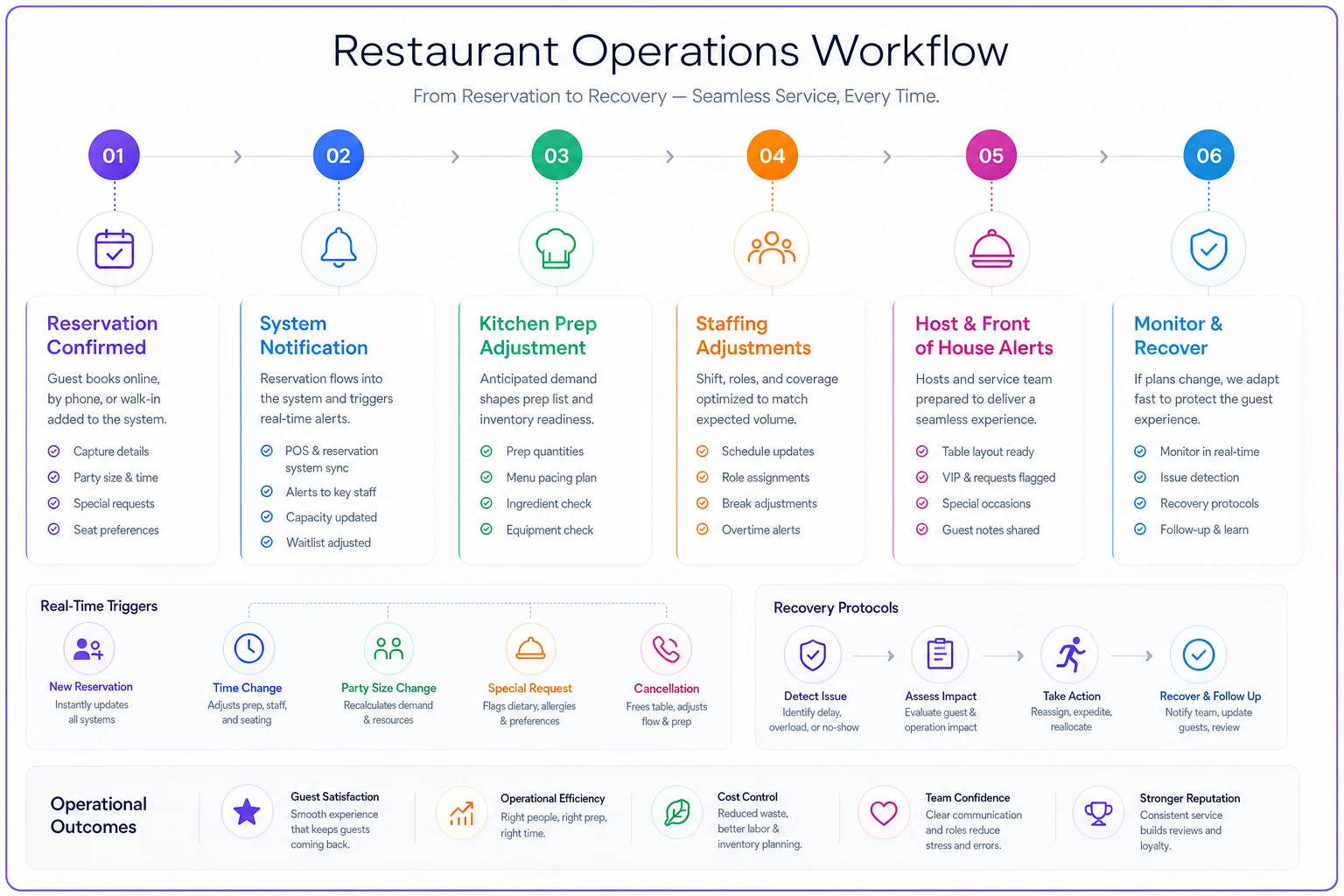
Think about your Saturday prep meeting. If you're showing 200 covers on the books but haven't confirmed 40% of them by Friday afternoon, that uncertainty ripples through every decision. Do you prep for 200 or 160? Do you call in the extra server or risk being short?
Give hosts a prioritized unconfirmed list each pre-shift so calls target the highest-risk reservations first.
Build triggers based on confirmation rates. When confirmation percentage drops below 70% by service day minus one, automatically flag for management review. This might mean calling larger parties personally, adjusting prep quantities, or keeping one server on call rather than fully scheduled.
The connection between confirmations and kitchen prep is where AI-powered restaurant management platforms really shine. Instead of manually tracking confirmation rates and adjusting prep lists, these systems can automatically flag when unconfirmed reservations exceed your threshold and suggest specific prep adjustments based on historical no-show patterns. A system tracking both your reservations and inventory can say "based on 30% unconfirmed reservations for tonight, reduce salmon prep by 6 portions and hold the extra server until 6 PM."
Your host team needs real-time visibility into confirmation status too. Not just a note in the reservation system, but actual workflow guidance. When an unconfirmed 8-top hasn't responded to multiple attempts, your host should know to call them personally during pre-shift, not discover it during service.
Measuring what actually matters
Most restaurants track no-show percentage and call it a day. But that single metric hides the real operational impact. You need to measure:
Recovery rate: Of the tables that no-show, how many did you fill with walk-ins? A 10% no-show rate means something different if you recover 80% versus 30% of those tables.
Confirmation to show rate: What percentage of confirmed reservations actually show up? If it's below 95%, your confirmation process isn't actually confirming anything.
Channel-specific no-show rates: OpenTable bookings might no-show at 8% while your website direct bookings no-show at 3%. That intelligence drives where you require deposits.
Time-slot analysis: Do your 5:30 PM bookings no-show more than 7:30 PM? That patterns helps you adjust policies by time rather than blanket rules.
Track these weekly, not monthly. No-show patterns shift quickly based on weather, events, and seasons. The restaurants that stay ahead adjust their policies dynamically based on data, not annually based on frustration.
When to break your own rules
Every policy needs escape valves. Your best regular who books monthly suddenly no-shows without contact? Before you implement your standard escalation, consider their history. Maybe something serious happened.
Large parties booking far in advance for special occasions—weddings, anniversaries, celebrations of life—deserve different handling than corporate dinners or casual gatherings. The emotional weight of these events means plans rarely change, but when they do, it's usually for significant reasons.
Weather events, local emergencies, and widespread technical issues (remember when AT&T went down for 12 hours?) all warrant policy flexibility. The restaurants that thrive long-term know when to enforce rules and when to show grace.
Your restaurant no-show policy shouldn't be carved in stone. It should be a living operational tool that adapts to your business reality. The goal isn't to punish no-shows—it's to prevent them while protecting your operations when they inevitably happen.
Build the system, train the team, then trust the process while staying flexible enough to handle the exceptions. That's how you turn a no-show policy from a necessary evil into an operational advantage that actually protects both your business and guest relationships.
Ready to elevate your restaurant operations?
Join 2,000+ restaurants using Dineoly to enhance efficiency, increase table turnover, and delight diners.