


Most operators chasing better turnover attack the wrong lever. They tell servers to move faster, rush the dessert conversation, or start dropping checks before guests have set down their forks. It works for about two weeks, then review scores start bleeding and regulars quietly stop coming back.
The real problem isn't speed. It's timing precision — knowing exactly how long each phase of a meal should take for your service style, and building seating cadence around those numbers instead of guessing. When you get that right, you turn more tables and guests feel more taken care of, not less.
This piece walks through time-budget templates by service style, seating cadence math, the pre-bussing and host scripts that actually move the needle, and the guardrails that stop you from turning your dining room into a churn machine.
Why "turn tables faster" quietly backfires
Speeding everything up assumes every minute of a meal is equally compressible. It isn't.
Guests barely notice if their entrée fires two minutes quicker. They absolutely notice when the check lands while they're mid-sentence, or when a runner starts stacking plates before the last person finishes. Those are the moments that generate the "felt rushed" complaint — and that complaint is expensive, because it kills repeat visits and drags down your review average.
In real operations, the turnover problem is almost never that meals take too long overall. It's that the dead time between phases is wildly inconsistent. A table finishes entrées and sits 14 minutes before anyone offers dessert. Another table pays and lingers 20 minutes because nobody reset expectations. Meanwhile a party stands at the host stand watching empty-but-uncleared four-tops.
That gap — done eating, not yet turned — is where turnover dies. And it's fixable without rushing a single guest.
Build a time budget for each phase, not the whole meal
The mistake most managers make is thinking in one number: "we want a 90-minute turn." That's useless operationally because nobody in the room can act on it. Servers can't manage a 90-minute abstraction. They can manage "greet within 90 seconds" and "offer dessert within 4 minutes of clearing entrées."
Eliminate operational bottlenecks effortlessly.
Dineoly helps you manage every reservation, order, and staff shift seamlessly.
- Unified reservation and order management
- Real-time staff scheduling
- Inventory and sales tracking
No credit card required
Break the meal into phases and assign each one a target window. Here's a realistic phase budget by service style:
| Phase | Casual/Fast-Casual | Full-Service Casual | Upscale/Fine Dining |
|---|---|---|---|
| Greet & water | 60–90 sec | 90 sec–2 min | 2–3 min |
| Order taken | 3–5 min | 5–8 min | 8–12 min (unhurried) |
| Apps/first course | 6–9 min | 8–12 min | 12–18 min |
| Entrée fire-to-table | 8–12 min | 12–18 min | 18–25 min |
| Clear entrées → dessert offer | 2–3 min | 3–4 min | 4–6 min |
| Dessert/coffee | 8–10 min | 10–15 min | 15–25 min |
| Check drop → payment | 3–5 min | 4–6 min | Present when signaled |
| Bus & reset | 3–4 min | 4–6 min | 5–8 min |
| Target total | 45–60 min | 75–95 min | 110–140 min |
The point of this table isn't to put a stopwatch on your staff. It's to expose which phase is leaking time in your room. Most restaurants find the leak in two specific places: the clear-to-dessert gap and the check-drop-to-payment gap. Tighten those two and you often recover 8–12 minutes per table without touching the parts guests actually care about.
A useful way to think about it: the phases guests want to be slow — ordering, eating, dessert — should stay slow. The phases that are pure logistics — clearing, resetting, dropping the check — are where you compress. Nobody savors the moment their dirty plates get cleared.
Seating cadence: stop seating in clumps
Even with perfect time budgets, you'll drown your kitchen and servers if you seat six tables inside an eight-minute window. The classic Friday failure: the 7:00 reservation block hits, the host seats everyone at once because they all showed up, the kitchen gets slammed with simultaneous entrée fires, and service quality craters across every table at exactly the same moment.
Seating cadence is the deliberate spacing of arrivals so demand hits the line in a manageable stream instead of a wall.
If a single server can properly manage a new table every 6–8 minutes without quality dropping, your host stand cadence needs to respect that — regardless of what the reservation book technically allows.
Sample reservation spacing template (per 4-table server section, full-service casual):
-
Seat table 1 at 6
00
-
Seat table 2 at 6
08
-
Seat table 3 at 6
16
-
Hold — server now has three active tables, let the first cycle through apps
-
Seat table 4 at 6
30 (as table 1 hits entrée phase)
-
Turn table 1 around 7
15, reseat at 7:20
-
Maintain 8–10 minute stagger through peak
The math that matters: if you have four servers and each can absorb a new seat every 8 minutes, your whole room can safely take roughly one new table every 2 minutes during peak. That's your true seating rate — and it's usually very different from how the reservation system spaces bookings by default.
Most reservation platforms let you set slot intervals, but managers rarely tune them to actual section capacity. They leave it at 15- or 30-minute blocks and let parties clump. Setting your booking intervals to match real per-section absorption is one of the highest-leverage changes you can make, and it costs nothing.
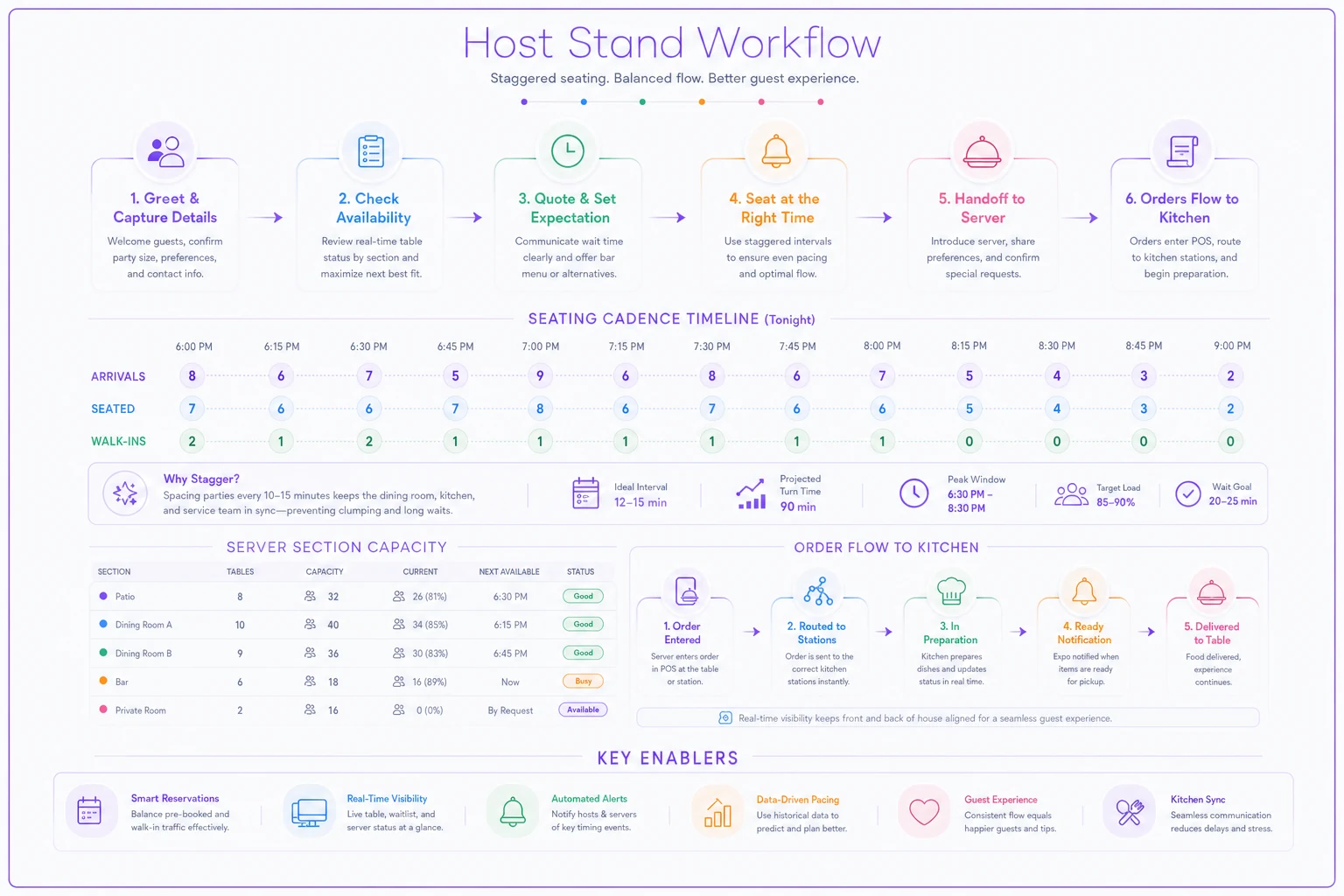
A simple visual like this helps hosts follow the intervals without thinking too hard.
Pre-bussing is the cheapest turnover gain you're ignoring
Pre-bussing — clearing finished plates, glassware, and clutter during the meal rather than all at once at the end — does two things simultaneously. It makes the table feel attended to (guests read it as good service), and it collapses the final reset time because there's far less to clear when the party leaves.
A table that's been pre-bussed throughout the meal resets in 2–3 minutes. A table where everything piles up resets in 6–8 minutes and usually needs a full wipe-down and re-lay. Across a busy night with 40–50 turns, that difference alone can free up an extra half-turn per section.
-
Clear app plates within 2 minutes of the last bite in that course
-
Remove empty glassware and bottles on every table pass
-
Consolidate condiments and clutter after entrées land
-
Never let more than one finished course sit on a table
-
Crumb or wipe visible mess before dessert (upscale)
Make pre-bussing visible on every server pass so guests perceive attentiveness, not rushed service.
The mistake is treating pre-bussing as the runner's job only. It's everyone's job on every pass. A server walking to the POS empty-handed is wasted motion. "Full hands in, full hands out" isn't just kitchen discipline — it's a turnover strategy.
Host scripts that reset guest expectations without pressure
The check-drop-to-departure gap leaks the most turnover time, and it's almost entirely a communication problem. Guests linger because nobody has gently signaled the meal is winding down. Then when you do move to close the table, it feels abrupt because there was no lead-up.
Scripts fix this by setting expectations early and softly. A few that work:
At seating (for parties with a reservation behind them):
> "We've got your table reserved and just want to make sure you enjoy every minute — we do have a party coming in at [time], so we've got you until then."
That single sentence, delivered warmly at the start, does more for turnover than any amount of hovering at the end. Guests appreciate the transparency and self-pace accordingly.
Offering dessert (compress the gap):
> "Can I tempt you with dessert or coffee, or shall I get your check started?"
This bundles the decision instead of making two separate trips with dead time between them. It respects the guest while quietly moving toward close.
Check presentation:
> "No rush at all — I'll take this whenever it's convenient."
Telling people there's no rush tends to make them leave faster, because it removes the passive-aggressive tension that makes people dig in. The version that backfires is silently dropping the check face-down and standing three feet away.
The pattern across all of these: warmth up front buys you speed at the end. Restaurants that skip the seating-time script are the ones forced to rush guests later, which is exactly what tanks the experience.
Staff task lists tied to the cadence
Turnover falls apart when nobody owns the transition moments. Build role-specific task lists anchored to the phases:
Host:
-
Track section load, not just open tables — a clean table with a slammed server isn't seatable
-
Stagger seating to match per-section absorption
-
Communicate cook times and wait estimates to arriving parties
-
Flag tables sitting more than 10 minutes post-payment to the manager
Server:
-
Hit greet window every time — this is the phase guests judge hardest
-
Pre-buss on every pass
-
Bundle the dessert and check offer into one conversation
-
Fire the reset the moment the party stands
Runner/busser:
-
Reset targets
3 minutes casual, 5 minutes upscale
-
Re-lay to standard immediately — no half-set tables sitting on the floor
-
Signal the host the instant a table is guest-ready
Manager:
-
Watch the two leak phases (clear-to-dessert, check-to-depart) in real time
-
Intervene on tables stuck in transition, not tables where guests are enjoying themselves
That last distinction matters more than it sounds. A manager pushing turnover should be attacking dead time, never a table where guests are happily eating. Confusing those two is how restaurants develop a reputation for rushing people.
Guardrails so turnover never crosses into churn
Speed without guardrails is how you win the night and lose the guest. Set measurable limits that keep quality intact:
-
Greet time never exceeds target even at peak — if it slips past 3 minutes, you're seating too fast for your staffing, so slow the cadence
-
No check drops before dessert is declined — the check should never arrive as a hint
-
No plate stacking in front of seated guests — pre-buss, don't bus-and-run
-
Reset quality is fixed — a faster reset that's sloppy costs more than the time it saves
-
"Felt rushed" complaints capped — if they tick up week over week, the cadence is too aggressive and you pull it back
That last guardrail is what keeps you honest. Turnover gains are only real if guest experience holds. Track the rushed-feeling signal — comment cards, review mentions, server feedback — as seriously as you track covers per night. If covers go up but that signal climbs too, you haven't improved efficiency. You've borrowed against loyalty.
A realistic example
A neighborhood full-service bistro, about 70 seats, was averaging roughly 55–60 covers on a Friday night and turning most tables once, occasionally 1.3 times. The owner assumed they were at capacity.
The audit showed the room wasn't full — it was badly sequenced. Reservations were spaced in 15-minute blocks, so parties clumped and the kitchen got walloped at 7:15. The clear-to-dessert gap was averaging around 11 minutes because servers waited to be flagged down. Post-payment tables sat cleared-but-unturned for 8–9 minutes.
Changes made over about three weeks: reservation intervals retuned to match per-section absorption (roughly a table every 2 minutes across the floor instead of clumped blocks), the dessert-and-check bundling script, mandatory pre-bussing on every pass, and the seating-time transparency line.
By the end, average Friday covers moved to roughly 72–78, with the busier weeks touching a solid 1.5 turns on the prime section. Reset time dropped to around 3 minutes. The "felt rushed" signal actually went down slightly — because the seating script and pre-bussing made service feel more attentive. That's the outcome you want: more covers, steadier line, happier guests.
When this makes sense — and when it doesn't
When to push turnover:
-
You regularly turn away walk-ins or have a wait during peak
-
Your reservation book fills but covers feel low relative to seats
-
Your leak phases (clear-to-dessert, check-to-depart) are visibly bloated
When it's a bad idea:
-
Your dining room isn't full in the first place — squeezing turnover on a half-empty room just annoys the guests you do have
-
Your kitchen can't handle faster ticket flow — turning tables faster than the line can fire just moves the bottleneck and creates ticket-time complaints
-
Your concept is explicitly slow or experiential — a tasting-menu room chasing turns is fighting its own brand
Who should not do this:
Operators whose current service is already shaky. If greet times are inconsistent and food is coming out uneven, tightening cadence will amplify every existing flaw. Fix service consistency first, then layer turnover discipline on top of a stable operation.
Where systems help
None of this requires software to start — the scripts, task lists, and pre-bussing standards are pure floor discipline. But two things get meaningfully easier with the right tooling.
First, seating cadence enforcement. Manually tracking per-section load in your head during a Friday rush is nearly impossible, which is why hosts default to seating whatever's clean. Reservation and table-management platforms with proper interval controls let you set true absorption rates and stagger arrivals automatically, so the clumping problem solves itself without someone watching the floor every second.
Second, leak-phase visibility. Table-status tracking that timestamps when a table clears entrées, gets its check, and pays makes dead-time gaps visible instead of invisible. When a manager can see "table 12 cleared 9 minutes ago, no dessert offered," they intervene on the right thing at the right moment — attacking dead time instead of accidentally rushing a table that's mid-conversation.
Tooling amplifies good discipline. It doesn't replace it. Get the phase budgets, cadence, and scripts right first, then use systems to hold the standard consistently across every shift and every host.
The whole game with turnover is precision, not speed. Protect the phases guests came for, compress the phases that are pure logistics, space arrivals to match what your floor can actually absorb, and set guardrails so you know the moment you've pushed too far. Do that, and you fit more covers into the same four walls while guests walk out feeling like they were the only table in the room.
Ready to elevate your restaurant operations?
Join 2,000+ restaurants using Dineoly to enhance efficiency, increase table turnover, and delight diners.