

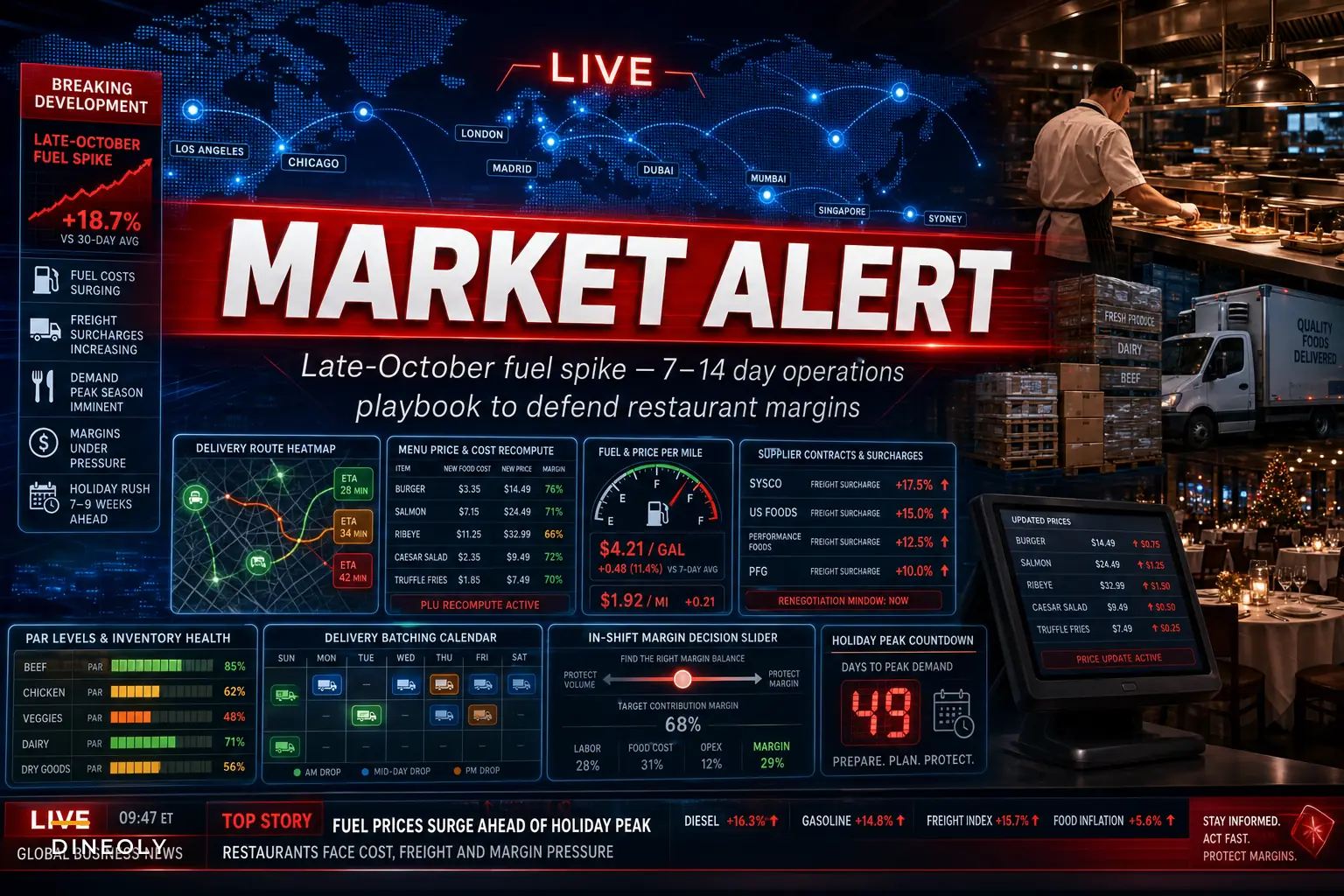

The oil market snapped hard in the last week of October. Brent and WTI pushed to roughly six‑month highs after attacks on tankers and Saudi energy infrastructure rattled supply expectations — CNBC reported crude jumping around 2% in a single session on fears of wider escalation. The EIA's latest Short‑Term Energy Outlook already flagged higher expected retail gasoline and diesel prices heading into winter.
For most restaurant operators, crude futures feel abstract. Diesel doesn't. And diesel is the number that actually hits your P&L — through inbound freight, distributor fuel surcharges, and last‑mile delivery fees. The lag between a crude spike and your invoice is usually two to four weeks, which means operators reading this in early November are about to see the pass‑through land right as holiday volume ramps.
This isn't a "watch the news" piece. It's a breakdown of where a diesel spike actually enters your cost structure, which decisions you can make this week, and which ones will quietly wreck your service if you make them in a panic.
Where fuel actually enters your cost structure (and where it doesn't)
Most operators assume a fuel spike means "food costs go up." That's too blunt to act on. The increase doesn't hit every line equally, and if you treat it as one big blob you'll end up raising menu prices you didn't need to touch while ignoring the costs quietly bleeding you.
A more useful way to map it:
| Cost area | How fuel hits it | Typical lag | How much control you have |
|---|---|---|---|
| Inbound freight / distributor surcharge | Added as a line item or baked into case price | 2–4 weeks | Medium — negotiable, consolidatable |
| Last‑mile delivery (your own or 3PL) | Per‑stop and per‑mile fees rise | 1–3 weeks | High — you control frequency |
| Proteins & produce input cost | Supplier's own freight + harvest/transport | 3–6 weeks | Low — partially substitutable |
| Paper, packaging, disposables | Petroleum‑linked materials | 4–8 weeks | Medium — par and spec control |
| Utilities / heating (winter overlap) | Natural gas and heating oil move with the complex | Monthly cycle | Medium — scheduling + maintenance |
The pattern worth noticing: the costs you have the most control over — delivery frequency, par levels, packaging specs — are the ones operators react to last, because they're invisible. The one everyone reaches for first, raising menu prices, is a blunt instrument that risks guest pushback right when holiday traffic is deciding where to spend.
A fuel spike is really a test of how granular your cost visibility is. If you can't separate "the chicken got more expensive" from "the delivery of the chicken got more expensive," you can't respond precisely.
The deeper problem a fuel spike exposes
Most of these rising‑cost events reveal the same thing: the restaurant was already running on stale assumptions.
Eliminate operational bottlenecks effortlessly.
Dineoly helps you manage every reservation, order, and staff shift seamlessly.
- Unified reservation and order management
- Real-time staff scheduling
- Inventory and sales tracking
No credit card required
Menu prices were probably costed on invoice data from last quarter. Par levels were set for a demand pattern that may not match the next six weeks. The delivery schedule was built around convenience, not cost. Everything worked fine while input costs sat still. A fuel shock just removes the slack that was hiding the sloppiness.
In real operations, this shows up as a lagging recost cycle. A distributor adds a fuel surcharge in week one. The invoice gets paid in week two. Nobody re‑runs plate costs until the monthly P&L review in week five. By then you've sold thousands of covers at margins you thought were intact and weren't. The money's already gone.
The operators who ride these events out well aren't the ones with the best suppliers. They're the ones whose costing is a living system instead of a once‑a‑quarter spreadsheet refresh. That's the real exposure — not fuel, but the speed of your recost loop.
Move 1: Re‑run costs on your top 15 sellers first, not the whole menu
Don't try to recost all 60 items. You'll never finish it in time, and most of your profit comes from a handful of dishes anyway.
Pull the 15 items that drive the bulk of your covers and margin. Re‑run their plate costs against this week's invoices, including any new freight surcharge allocated across the case. For most kitchens, a 6–10% jump in a key protein's landed cost moves a plate's food cost percentage by a couple of points — enough to flip a "star" into a "puzzle" without anyone noticing on the floor.
This is the discipline we break down in the menu engineering as a system approach — yield‑adjusted costing tied to a supplier cadence rather than a calendar. A fuel spike is just the moment that proves why that cadence has to be shorter than monthly.
Allocate any new freight surcharge across the case when re‑running plate costs.
Once you've got the updated numbers, you have real choices: adjust the recipe yield, renegotiate the spec, reposition the item on the menu, or — only if the first three don't work — touch the price.
Move 2: Consolidate deliveries before you touch menu prices
This is the lever almost nobody pulls first, and it has the fastest payback.
Every delivery carries a fuel surcharge now. If you're taking five produce drops a week when you could take three, you're paying that surcharge two extra times for the convenience of fresher‑feeling stock you're often over‑ordering anyway. Freight consolidation is boring and it works.
A workflow that actually holds up:
-
Audit your current delivery frequency by vendor. List every standing delivery day and the average order value per drop.
-
Flag any vendor delivering more than twice a week for non‑perishables. Those are consolidation candidates with almost no quality risk.
-
Shift to fewer, larger drops and renegotiate the surcharge based on higher per‑order volume — distributors will often drop or reduce it to keep a bigger standing order.
-
Rebuild par levels around the new schedule so you're not stocking out between drops.
-
Recheck waste after two weeks to confirm larger orders aren't rotting on the shelf.
The common mistake is consolidating deliveries without adjusting pars, then stocking out mid‑week and placing a panicked emergency order — which carries the worst fuel surcharge of all. Consolidation and par resetting are one move, not two.
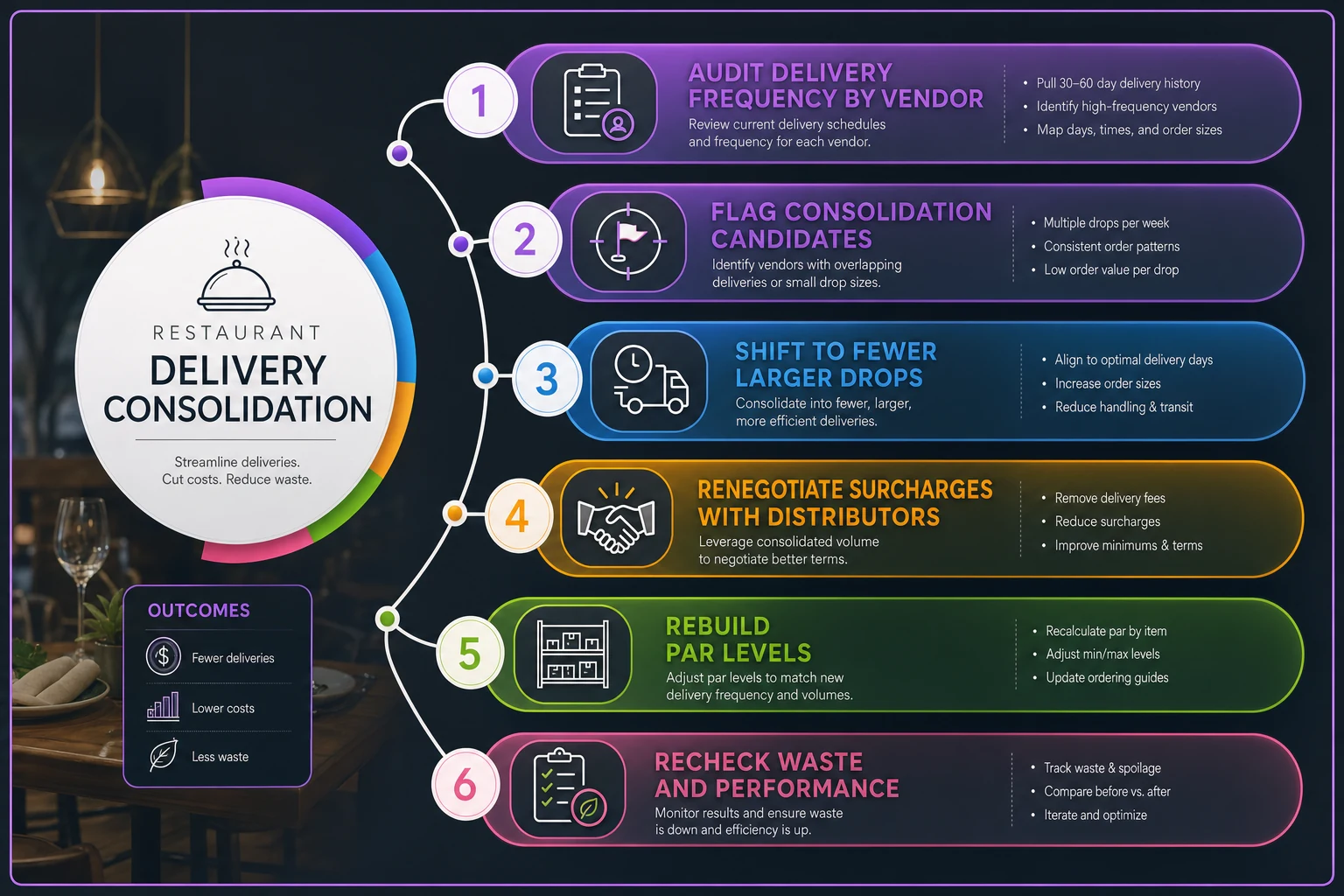
The diagram lays out the consolidation steps in sequence so you can follow the process from audit to waste check.
Move 3: Protect service by deciding what you won't cut
Panic cost‑cutting during a price shock is where restaurants quietly degrade the guest experience. Someone trims labor on a Friday, the expo falls behind, tickets back up, tables turn slower, and you've traded a predictable fuel cost for an unpredictable revenue loss.
Before cutting anything, write down the two or three things that are off the table no matter what:
-
Peak‑period kitchen staffing on your highest‑volume shifts
-
The quality spec on your signature dishes — the ones people actually come for
-
Host and expo coverage during the holiday rush, when a bad first impression costs you a repeat visit
Everything else is negotiable. Prep labor on slow mid‑weeks, delivery frequency, packaging grade, side‑item portioning — those can flex. The point is to make the tradeoffs on purpose instead of letting a stressed manager improvise them at 6 p.m.
A real scenario
A mid‑sized casual‑dining operation — two locations, roughly 180 seats combined — started seeing distributor fuel surcharges climb in early November. Their instinct was a 4% across‑the‑board menu price increase heading into the holidays.
Instead they ran the sequence above. Recosting the top 15 sellers showed only four items had meaningfully drifted — one burger and three chicken dishes where the protein's landed cost had jumped close to 9%. Those four got a small price bump and a half‑ounce portion adjustment. The rest of the menu held.
On the freight side, they cut dry‑goods and paper deliveries from four drops a week to two, renegotiated the surcharge on the larger standing order, and reset pars accordingly. Combined, the delivery changes saved them somewhere in the range of $900–$1,300 a month across both units — more than the blanket price hike would have netted after factoring in the covers they'd have lost from sticker shock.
It wasn't a dramatic turnaround. They just absorbed the spike without annoying regulars going into their busiest six weeks. That's usually what getting through a cost shock actually looks like.
When a menu price increase actually makes sense
Raising prices isn't wrong — it's just often the first move when it should be the last. It makes sense when:
-
An item's landed cost has moved enough that no recipe or spec change recovers the margin
-
The item is a known "star" with inelastic demand — guests order it regardless
-
Your prices have genuinely lagged the market for a while and this is overdue anyway
It's the wrong call when you're raising prices reflexively across the whole menu to cover a cost increase that's actually concentrated in a few items, or when you're doing it blind because you haven't recosted and you're just guessing at a percentage. A fuel spike is temporary pressure; a permanent price change made in a panic tends to stick around and quietly suppress traffic long after diesel settles.
Keeping the recost loop alive after the spike passes
The restaurants that handle these events best don't scramble each time. They've shortened the distance between "invoice changed" and "decision made." That's partly discipline and partly having the data in one place — invoice costs, plate costs, par levels, and waste visible on the same screen instead of scattered across a POS, a spreadsheet, and a distributor portal.
Operational platforms with built‑in costing and automated invoice capture make this feasible without someone manually re‑keying case prices every week. The system flags when a landed cost crosses a threshold and a plate's margin slips, so the recost happens close to real time instead of five weeks late. Not replacing the operator's judgment — just making sure the numbers in front of them are current when they decide.
But you don't need software to start. You need a shorter loop. Recost your top sellers this week. Consolidate your deliveries. Decide what you refuse to cut. Do those three things and a fuel spike becomes a manageable line‑item adjustment instead of a margin event you discover a month too late.
Fuel prices will settle eventually — they always do. The question is whether your costing caught up fast enough to keep the covers you sold in the meantime from being quietly unprofitable. That part is entirely within your control.
Ready to elevate your restaurant operations?
Join 2,000+ restaurants using Dineoly to enhance efficiency, increase table turnover, and delight diners.