

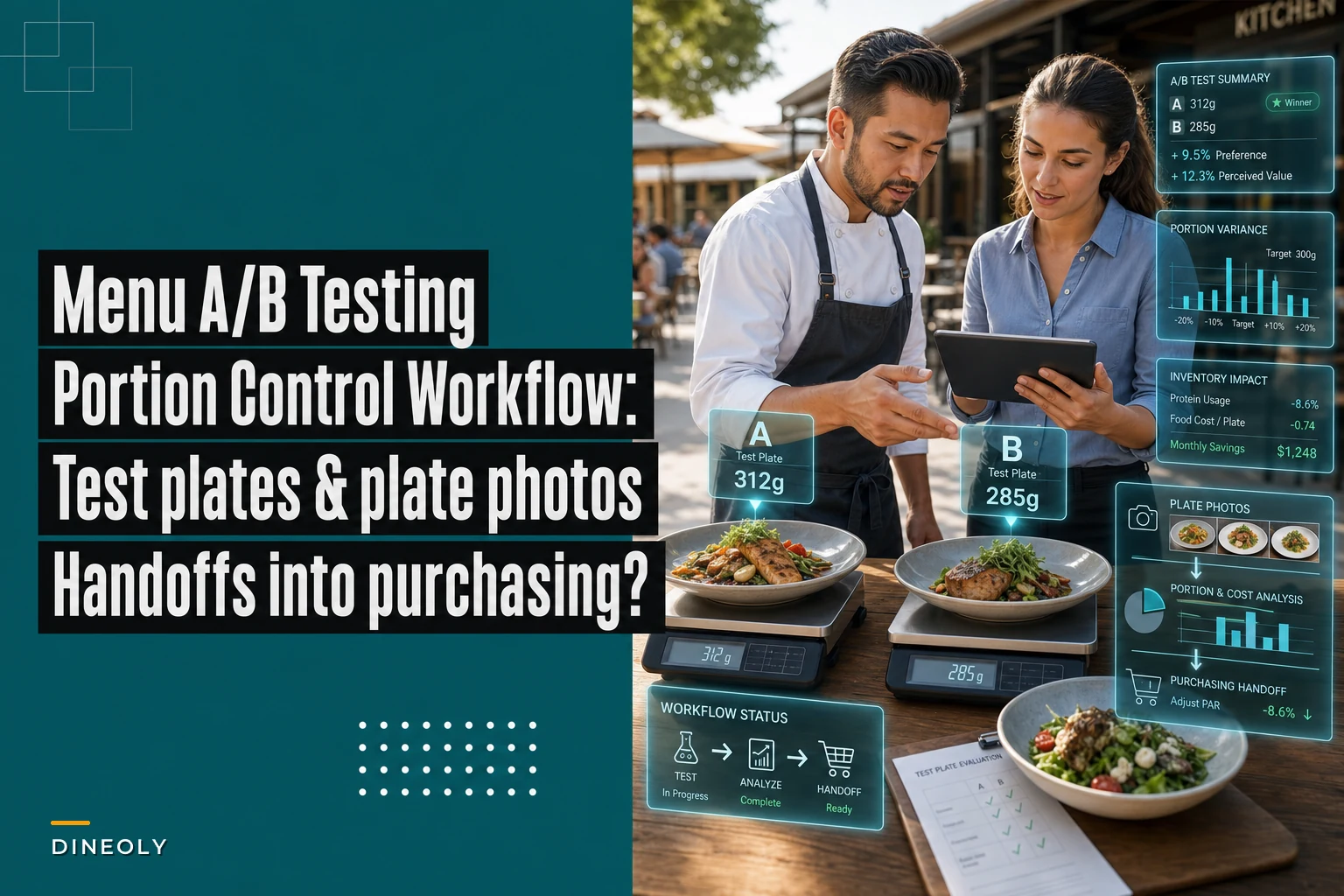

Three months ago, a Mediterranean restaurant owner in Denver showed me their food cost reports. 28.8% overall — looks decent on paper. Then we watched dinner service. The hummus portions varied by almost 40% between plates. Same dish, same price, wildly different amounts hitting tables.
This wasn't a training problem. The kitchen had portion guides. They had scales. They even had those portion control ladles everyone pretends to use during rushes. But without a real testing and feedback loop, their menu engineering portion control workflow was basically suggestions written on a laminated card nobody looked at.
Most restaurants treat portion control like a one-time setup task. Print the portion guide, train the crew, hope for the best. Meanwhile, every plate that leaves the kitchen becomes a tiny profit leak or a consistency problem waiting to explode on Yelp.
Why portion drift destroys more than food costs
Portion inconsistency creates three operational nightmares that compound over time.
Your purchasing becomes impossible to predict accurately. When your chicken piccata uses anywhere from 5.5 to 8 ounces of protein depending on who's working sauté, your par levels become fiction. You're either running out mid-service or watching expensive proteins expire in the walk-in.
Guest experience issues hit harder than most operators realize. Table 12 sees Table 14's pasta and wonders why their portion looks smaller. Even if both portions are technically within spec, perception drives complaints. Regular customers notice immediately when their usual order feels light.
The cascade effect on menu pricing gets ugly fast. You price dishes based on 6-ounce portions, but your kitchen averages 7.2 ounces during busy periods. That 20% overportioning on a $24 entrée selling 40 times nightly costs you roughly $6,900 monthly in lost margin. Scale that across your whole menu and you're hemorrhaging profit while thinking you have a marketing problem.
Building test-plate protocols that kitchen teams actually follow
Effective portion testing starts before service, not after customer complaints. Every Monday morning, before the prep list takes over, run test plates for your top five sellers plus any new specials. Not during family meal, not when someone has time — scheduled, mandatory, 9:30 AM sharp.
Eliminate operational bottlenecks effortlessly.
Dineoly helps you manage every reservation, order, and staff shift seamlessly.
- Unified reservation and order management
- Real-time staff scheduling
- Inventory and sales tracking
No credit card required
The chef plates each dish exactly to spec while the sous or kitchen manager photographs from directly above with consistent lighting.
Keep a simple template:
-
Dish name and date
-
Target portion weight for each component
-
Actual weight (yes, weigh after plating)
-
Photo reference number
-
Who plated it
-
Quick note on presentation issues
Store these photos in dated folders on a shared tablet or computer the kitchen can access during service. Not in someone's phone, not in a random Google Drive — somewhere the line can pull up "Week 43 Salmon Reference" in ten seconds during a rush.
The critical piece: test plates during different prep stages. Your morning crew's portions often differ from night shift's. A cook portioning at 10 AM with full mise en place creates different portions than the same cook at 8 PM running low on prepped vegetables. Document both scenarios.
Photo documentation that prevents portion arguments
Plate photos serve two purposes: training and accountability. Random iPhone shots don't cut it though.
Set up a photo station with consistent lighting — a simple ring light and a designated spot on the pass works. Always shoot from the same angle, ideally straight down. Include a ruler or portion guide in frame for the first shot of each dish, then remove for the beauty shot.
Include a ruler or portion guide in the first frame to calibrate portion size across photos.
Create a naming system that doesn't require thinking: [Date][Dish abbreviated][Shift]_[Version if multiple tests]
Example: 1118ChxParmAM_v2
During service, these photos become the standard, not memory or interpretation. Line cook thinks the portion looks right? Pull up the reference photo. Takes eight seconds instead of a five-minute discussion about what "generous but not excessive" means for risotto portions.
The accountability component matters most. When servers complain about inconsistent portions, you have documentation. When food costs spike, you can compare current plating against historical references. One Italian place in Phoenix discovered their carbonara portions had crept up 35% over six months just by comparing photos from their archive.
Chef-to-manager handoff steps that close the feedback loop
The breakdown usually happens here — test results sitting in a notebook while purchasing continues blindly ordering based on old pars.
After each testing session, the chef fills out a simple handoff sheet for the manager:
Portion Adjustment Alert
-
Dishes tested today
[List]
-
Portions requiring adjustment
[Specific items]
-
Impact on theoretical food cost
[+/- percentage]
-
Recommended purchasing changes
[Specific products and amounts]
-
Training needs identified
[Which stations need review]
-
Next test date
[Scheduled]
Keep it under one page. The manager reviews it same day, not end of week. Any portion change over 10% triggers an immediate purchasing adjustment and a mandatory line meeting before next service.
Most operations miss tracking who's working when portions drift. If Tuesday night portions run heavy but Thursday stays on spec, you've identified a training opportunity, not a recipe problem. One sports bar discovered their wing portions went up 22% whenever their most popular cook worked fryer. Turns out he was adding "a little extra" for regulars, training everyone else to do the same.
Measurement templates that translate to real purchasing adjustments
Generic portion guides fail because they don't connect to ordering patterns. Your measurement template needs to link directly to purchasing decisions.
Structure your tracking like this:
| Menu Item | Component | Target Portion | Test Result | Variance % | Weekly Volume | Purchase Impact |
|---|---|---|---|---|---|---|
| Grilled Salmon | Salmon | 6 oz | 6.8 oz | +13% | 280 orders | +15.6 lbs/week |
| Caesar Salad | Romaine | 3 oz | 2.7 oz | -10% | 420 orders | -9.45 lbs/week |
| Ribeye | Beef | 12 oz | 12.2 oz | +1.6% | 90 orders | +1.1 lbs/week |
The "Purchase Impact" column drives action. Suddenly that small variance on high-volume items shows its true cost. The Caesar might look like you're saving money, but underportioning high-margin salads to save on romaine is backwards economics.
Build variance thresholds that trigger specific actions:
-
Under 5% variance
Note and monitor
-
5-10% variance
Retrain and retest within 48 hours
-
Over 10% variance
Immediate correction, purchasing adjustment, and daily testing for one week
Some variances are acceptable — proteins within 0.2 ounces, sides within 10%. Others demand immediate attention. Sauce portions creeping up 30% might seem minor until you calculate the annual impact on your highest-margin items.
Routing results into purchasing decisions without creating chaos
Test results mean nothing if they don't change ordering behavior. You can't adjust pars daily without driving your suppliers insane.
Implement a two-tier adjustment system. Minor variations (under 5% impact on category spending) accumulate into a weekly adjustment. Major variations (over 5% or affecting proteins) trigger immediate par changes.
Your purchasing adjustment workflow:
-
Test plates identify 15% overportioning on chicken dishes
-
Calculate weekly impact
340 chicken orders × 1.2 oz extra = 25.5 lbs additional
-
Adjust protein order for next delivery up by 26 lbs
-
Set calendar reminder to verify correction after two weeks
-
Document par change in purchasing log with reason
The crucial step everyone skips: telling your supplier why orders changed. A quick email — "Portion testing showed we're running 15% over on chicken, adjusting pars accordingly" — prevents confused calls about unusual orders and helps them anticipate your needs.
Track these adjustments in a simple spreadsheet. Date, item, old par, new par, reason for change, expected impact. After three months, patterns emerge. Maybe portions always creep up in October when you're training holiday staff. Maybe certain dishes resist portion control no matter what.
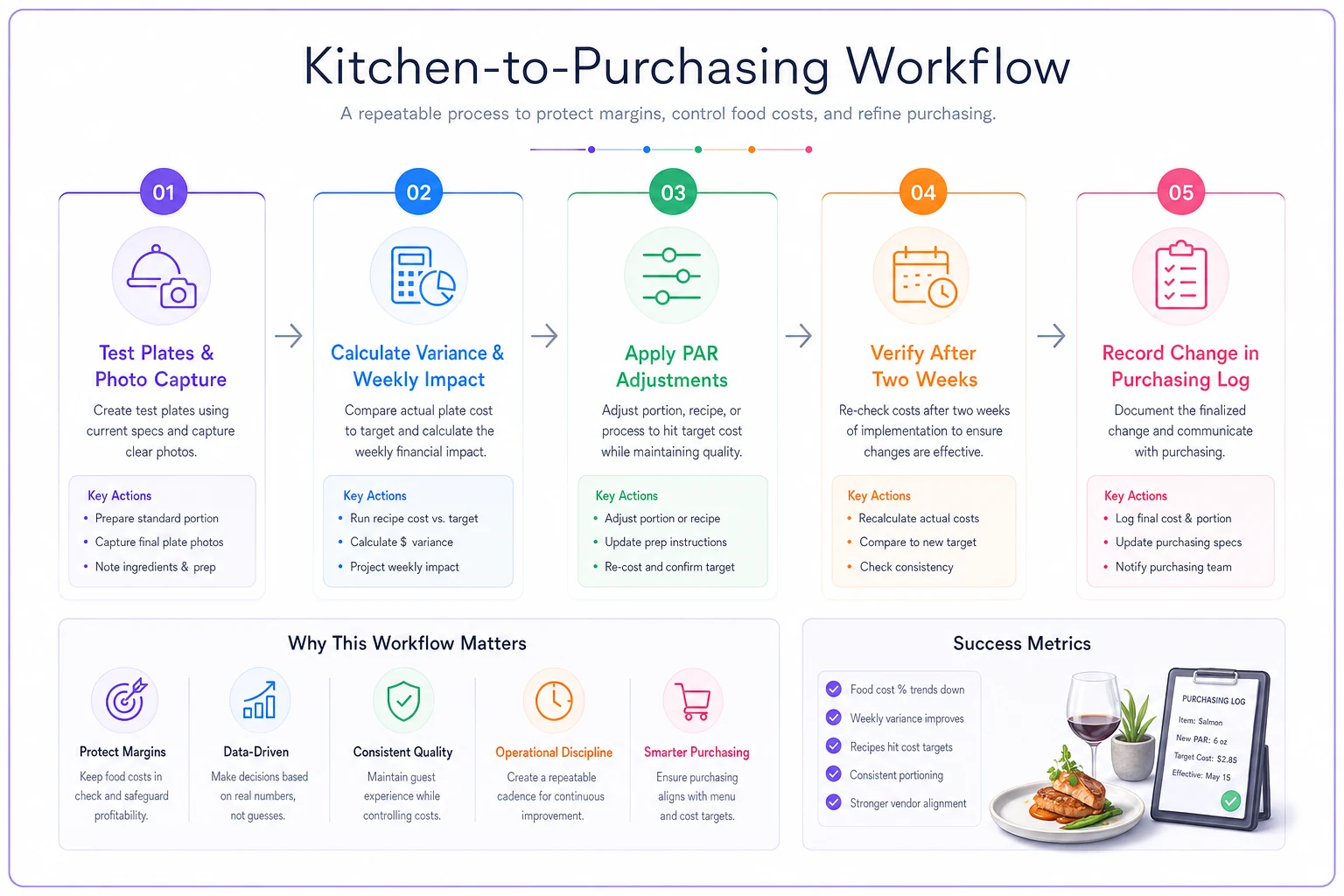
A simple visual of this workflow helps teams follow the steps and prevents the handoff from getting lost in email threads.
This data drives menu engineering decisions beyond just portion sizes.
When automation prevents the slow profit bleed
The portion control challenge isn't catching problems — it's maintaining consistency when seventeen other fires need attention.
AI-powered operational platforms can analyze plate photos automatically, flagging portions outside acceptable ranges before they become patterns. The system tracks who plated what, when portions drift, and correlates that with sales data to show actual profit impact.
The purchasing integration eliminates the handoff breakdown. Test results automatically calculate par adjustments, queue them for manager approval, and update ordering guides. No more spreadsheets that nobody updates. No more wondering if purchasing got the portion memo.
One seafood restaurant reduced their protein costs by 11% in eight weeks just by having their operational platform flag portion variances in real-time. The chef got alerts when portions drifted over 8%. Purchasing automatically adjusted based on actual portion data, not theoretical yields.
The photo archive became searchable — type "salmon" and see every test plate from the past quarter, with weights and variances. When front-of-house reports a portion complaint, the system pulls up that dish's recent test history, shows who plated it, and whether it matches current standards.
Instead of finger-pointing, you get data-driven solutions.
Maintaining momentum when everyone thinks portions are "fixed"
The biggest failure in portion control happens around week three, when everyone thinks the problem is solved. Test plates become sporadic. Photo documentation stops. Portions start their inevitable drift back toward chaos.
Build forcing functions into your workflow. Monday test plates happen regardless — put them on the prep list, not a separate reminder. Photo documentation becomes part of expo training. Every new menu item gets five test plates before launch, not after customers complain.
Review portion data during weekly manager meetings. Not food cost percentages — actual portion variances. "Pasta portions up 8% this week" creates urgency. "Food cost at 31%" creates shoulder shrugs.
Tie portion control to performance metrics that matter to your team. BOH bonus pools can include a portion consistency component. Servers who report portion issues constructively get recognized. Make it part of the culture, not a temporary campaign.
Share the wins. When portion control drops food costs by 2%, that's real money. Calculate it, share it, celebrate it. When consistency improves and complaints drop, connect it to the testing routine.
Teams maintain processes they believe in, not ones they're forced to follow.
The compound effect of systematic portion testing
A Mediterranean bistro in Austin started systematic portion testing after food costs hit 34%. Six months later, they're running at 29% with better customer satisfaction scores. Not through dramatic changes — through consistent Monday morning test plates, documented standards, and automated purchasing adjustments.
The profit impact compounds. Better portions mean accurate purchasing. Accurate purchasing reduces waste. Less waste means better inventory turns. Better turns mean fresher ingredients. Fresher ingredients mean better dishes. It's an operational flywheel that starts with weighing hummus accurately.
Your menu engineering portion control workflow doesn't need to be complicated. Test weekly, document visually, communicate clearly, adjust purchasing accordingly. The restaurants thriving in tight-margin environments aren't doing anything revolutionary. They're just doing the basics consistently, with systems that don't rely on memory or motivation.
Start Monday. Pick five dishes. Weigh them, photograph them, document the variance. Build from there. Your P&L will thank you, your guests will notice, and your kitchen will finally stop arguing about what "normal" portions look like.
The path to consistent profits runs straight through your portion control process. Make it systematic, make it visual, make it stick.
Ready to elevate your restaurant operations?
Join 2,000+ restaurants using Dineoly to enhance efficiency, increase table turnover, and delight diners.