

The kitchen printer starts its familiar Friday night symphony around 6:47pm. Tickets cascade down like confetti, each one representing a table that expects their food in reasonable time. Your expo—let's call him Marcus—scans the growing pile while three servers hover behind him asking about orders that went in eight minutes ago. The line cooks are heads-down, focused on their stations. Nobody's actually coordinating anything.
Marcus makes a split-second call: "86 the salmon special!" But the server at table 14 just rang it in thirty seconds ago. Now there's a disappointed guest, a comped appetizer, and a manager doing damage control in the dining room. Meanwhile, table 7's appetizers are getting cold under the heat lamp because their server is dealing with a spilled wine situation.
This happens everywhere during peak hours when communication between front-of-house and kitchen operations breaks down. Longer ticket times, more errors, frustrated staff, and guests who won't return.
The coordination gap that creates chaos
Most restaurants treat FOH kitchen coordination like optional guidelines rather than operational necessities. Servers yell questions at the pass, line cooks ignore everything except their immediate tickets, and expos juggle seventeen priorities without any clear system.
During a Friday rush, communication failures cascade through the operation. A server doesn't know the kitchen ran out of ribeye twenty minutes ago. The kitchen doesn't know table 9 has a severe nut allergy until the dish is already plated. The expo doesn't realize two orders for the same table got separated in the ticket queue.
Each breakdown compounds into bigger problems. Most restaurant teams think better communication means talking more. But adding noise to an already chaotic environment just creates confusion. You need structured protocols that work even when nobody has time to think.
Building your triage messaging system
Effective triage starts with categorizing every piece of communication by urgency and routing it through the right channel. Not every message needs immediate attention, and treating them all equally guarantees important information gets lost.
Eliminate operational bottlenecks effortlessly.
Dineoly helps you manage every reservation, order, and staff shift seamlessly.
- Unified reservation and order management
- Real-time staff scheduling
- Inventory and sales tracking
No credit card required
| Tier | Details |
|---|---|
| Critical (Red Flag) | Allergy notifications, 86'd items, guest at table waiting 40+ minutes |
| Urgent (Yellow Flag) | Special modifications, large party coordination, VIP tables |
| Standard (Green Flag) | Regular orders, timing questions, general updates |
Each tier needs its own protocol. Critical messages bypass normal channels entirely—these go straight to whoever can solve them fastest. Your server with an allergy modification walks directly to the relevant station, makes eye contact with the cook, and verbally confirms the modification. No tickets, no assumptions.
Urgent messages follow a visual flag system. When a server needs to communicate something urgent but not critical, they place a yellow flag (literally a small yellow card or clip) on the ticket at the pass. The expo knows to prioritize reading and addressing these tickets first. This visual cue cuts through the noise without adding verbal chaos.
Standard communication flows through normal channels—POS systems, ticket printers, and routine check-ins at the pass. These don't need special handling, just consistent execution.
Peak-mode fast-track rules that actually work
When you hit that inevitable rush where everything happens at once, normal protocols need modification. Peak-mode isn't about abandoning structure—it's about streamlining decision-making when every second counts.
Implement automatic triggers that shift your operation into peak mode. When ticket times exceed 25 minutes or when you have more than 12 open tables, specific fast-track rules kick in:
Rule 1: Station captains only During peak, only designated station captains communicate with the expo. If a sauté cook needs something, they tell their captain, who consolidates communication. This reduces the expo's cognitive load from managing six voices to managing two or three.
Rule 2: The two-minute rule Any modification or special request that takes longer than two minutes to execute gets declined during peak hours. Servers know this rule and can set guest expectations accordingly. "During our rush, we're limited to our standard menu preparations" becomes an acceptable explanation when it's policy, not preference.
Rule 3: Pre-fired standards Certain items get pre-fired based on historical data. If you know you'll sell 30-40 Caesar salads between 7-8pm on Fridays, your cold station pre-makes components for 20 of them. This isn't about pre-making entire dishes—it's about having mise en place specifically calibrated for peak demand.
Rule 4: Silent zones The pass becomes a silent zone during peak except for critical communications. Questions about timing, general updates, and non-urgent modifications wait until the rush breaks. Servers check the board or screens for updates rather than asking verbally.
A quick visual workflow for peak-mode decision routing.
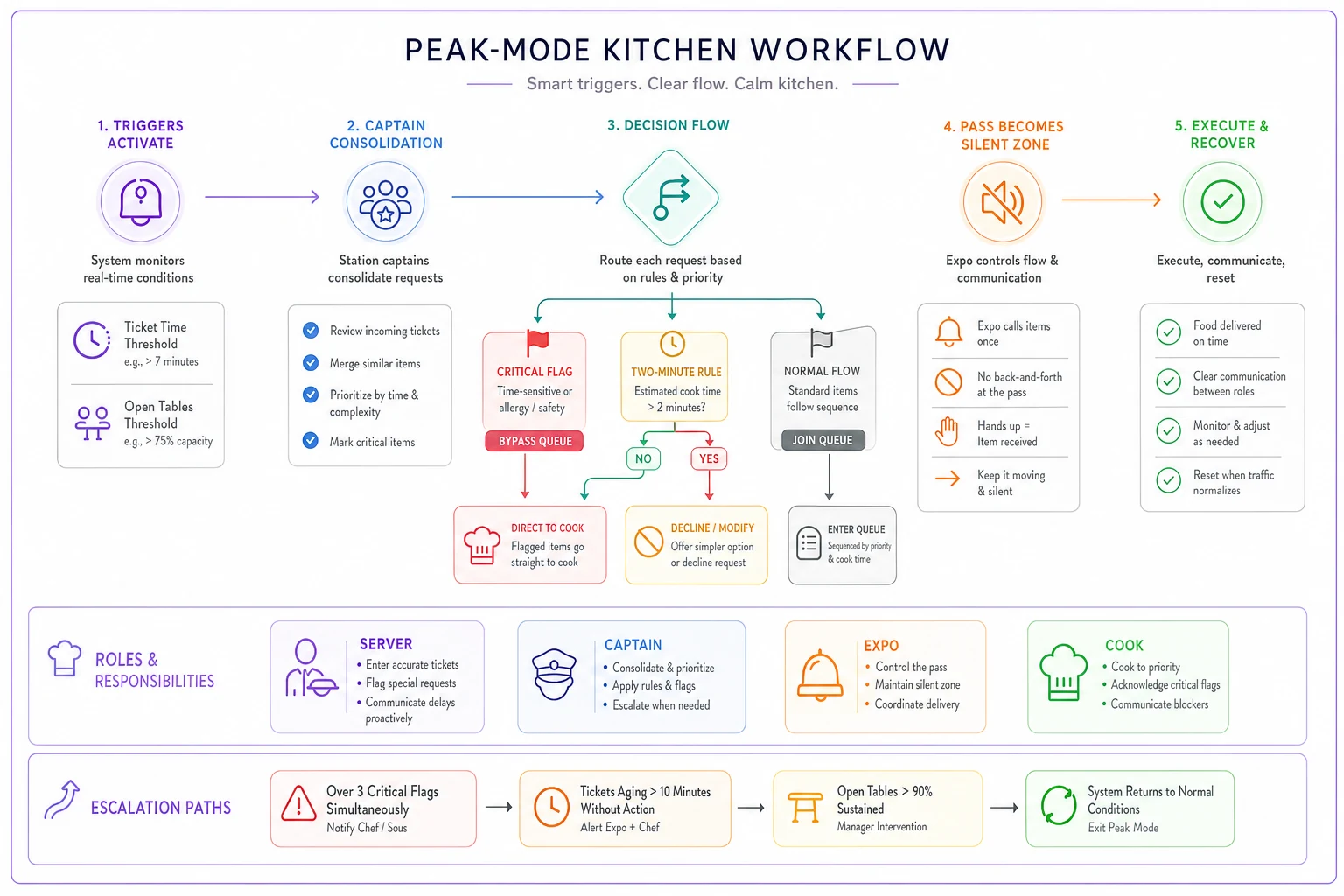
This flow shows who communicates with whom and which decisions get escalated during peak.
Visual patterns that cut through noise
Low-tech visual systems often outperform high-tech solutions during service because they require zero cognitive processing. A red ticket clip means allergy. A blue clip means VIP. Everyone knows this instantly without reading or thinking.
Color-coded plate markers: Small colored picks that indicate modifications. Green means vegetarian modification, orange means gluten-free, red means allergy. These travel with the plate from station to pass to table, eliminating the game of telephone that usually happens with modifications.
Station status boards: Simple magnetic boards at each station showing "All Day" counts. When a cook fires two steaks, they move two magnets to the "fired" column. The expo can see at a glance what's working without asking.
Table progression strips: Colored tape strips on the edge of the pass that show table status. Green strip means appetizers out, yellow means entrees fired, red means dessert ordered. Servers can see their table's status from across the kitchen without interrupting the expo.
Keep a labeled container of spare colored clips and markers at the pass so replacements are immediate.
During a typical Saturday rush, these simple visual systems can cut communication time by around 40% while reducing errors.
Accountability steps that prevent finger-pointing
When orders go wrong, the post-mortem usually devolves into "the server rang it in wrong" versus "the kitchen made it wrong" versus "expo sent it to the wrong table." Without clear accountability protocols, every mistake becomes a blame game that solves nothing.
Step 1: Verbal confirmation for all modifications Server states modification clearly. Cook repeats it back. Both parties confirm. This takes three seconds but prevents twenty-minute remakes. "Salmon, no butter, extra lemon." "Got it—salmon dry, extra lemon." "Confirmed."
Step 2: Ticket ownership signatures Whoever plates a dish initials the ticket. When table 12's steak comes back overcooked, you know exactly who to coach. Not for punishment, but for improvement.
Step 3: Pass checkpoint The expo owns quality control at the pass. They check every plate against the ticket before it leaves the kitchen. If something's wrong, it stops here—not at the guest's table. This means training expos to actually read tickets fully, not just glance at them.
Step 4: Service recovery tracking Every remake, every comp, every complaint gets logged with three pieces of information: what went wrong, where it broke down, and who handled recovery. Patterns emerge quickly. Maybe Tuesday's dinner crew has communication issues. Maybe seafood dishes consistently have problems. You can't fix what you don't track.
Sample scripts for common situations
Having pre-written scripts for common scenarios eliminates hesitation during service. Staff know exactly what to say, removing the cognitive burden of crafting responses during chaos.
For 86'd items (Server to guest): "I just checked with the kitchen, and we've sold out of the ribeye for tonight. Our strip steak is prepared similarly and has been popular this evening, or I can recommend the lamb which is exceptional tonight."
For extended wait times (Manager to table): "Your entrees are taking longer than anticipated—about X more minutes. I've asked the kitchen to send out an order of our house-made focaccia while you wait, on us. Would you like me to refresh your drinks as well?"
For modification confirmations (Server to cook): "Order for table 8—salmon with dairy allergy, confirming no butter on grill or finish?" (Cook responds): "Confirmed—clean grill section, olive oil only, no butter."
For rush communications (Expo to servers): "We're in peak mode. Check the board for timing, modifications go through captains only. Clear plates from tables 3 and 7 if you're free."
For quality issues (Cook to expo): "This salmon is slightly over. Do we run it or refire?" (Expo decides based on ticket time and table status, not guessing)
Peak-shift checklists that maintain standards
Shift changes during peak hours create dangerous coordination gaps. The morning crew's mental map of what's happening doesn't automatically transfer to the night crew. Without proper handoff protocols, critical information disappears.
Your peak-shift transition needs a physical checklist that captures:
-
Kitchen status
- Items 86'd (with approximate times they ran out) - Items running low (less than 5 portions) - Any equipment issues affecting production - Special prep for large parties or events - Current ticket times and backup situations
-
Front-of-house status
- VIP or special occasion tables - Guests with allergies currently seated - Any service recovery situations in progress - Server section changes or coverage issues - Tables with extended wait times
-
Active modifications
- Any special dietary restrictions being accommodated - Custom preparations approved by chef - Large party orders in queue - Pre-ordered items for later seating
This checklist lives at the pass, gets filled out by the departing shift leader, and reviewed with the incoming leader. Takes maybe four minutes but prevents the thirty-minute scramble when critical information gets lost in transition.
The real impact on ticket times and accuracy
A mid-size restaurant implementing these protocols typically sees ticket time reductions of 15-20% during peak hours. More importantly, error rates—wrong dishes, missed modifications, allergy incidents—drop by roughly half.
The financial impact goes beyond faster service. Fewer remakes means lower food costs. Fewer comps means higher revenue. Better coordination means less staff stress, which reduces turnover.
A kitchen that runs smoothly during peak hours might save $2,000-3,000 monthly just in reduced waste and comps. But the real value comes from consistency. Guests experience the same service quality whether they come in on a slow Tuesday or a slammed Saturday. That predictability builds trust and repeat business in ways that marketing never could.
When coordination protocols make sense (and when they don't)
These structured protocols work best in restaurants doing at least 150 covers during peak service. Below that volume, the overhead of maintaining these systems might exceed the benefits. A 30-seat neighborhood bistro probably doesn't need three-tier triage messaging.
They also require buy-in from both FOH and BOH leadership. If your chef thinks coordination protocols are "corporate nonsense" or your service manager won't enforce them, they'll fail within a week.
The systems only work when everyone follows them, especially during the chaos when they matter most. Don't implement everything at once. Start with one element—maybe just the visual flag system for modifications. Run it for two weeks, adjust based on what you learn, then add another element. Full implementation might take two months, but that gradual approach ensures each protocol actually sticks.
Modern tools that enhance (not replace) human coordination
While these protocols work with purely manual systems, operational software can amplify their effectiveness. Modern platforms can automatically flag allergy orders, track 86'd items across all terminals, and alert managers when ticket times exceed thresholds.
AI automation particularly helps with pattern recognition—identifying when certain combinations of factors typically lead to coordination breakdowns. Maybe Thursday nights with a particular server and cook combination consistently have issues. Software spots these patterns that humans miss in the daily chaos.
The key is using technology to enhance human coordination, not replace it. An AI agent monitoring ticket times and automatically alerting the expo when table 14 has been waiting 35 minutes prevents service failures. But the actual coordination—the human judgment about how to recover—still requires experienced staff making real-time decisions.
Some restaurants integrate their POS systems with kitchen display systems that automatically implement triage protocols. Orders get color-coded by urgency, modifications appear in bold red text, and the system automatically suggests firing sequences based on dish complexity and current station loads.
These tools reduce cognitive burden on staff, letting them focus on execution rather than information management. But they work best when paired with clear human protocols. Technology without process just digitizes chaos.
Making protocols stick when everyone's burned out
The biggest challenge with FOH kitchen coordination protocols isn't designing them—it's maintaining them when everyone's exhausted after a brutal Saturday double. Protocols fail when they become suggestions rather than standards.
Build enforcement mechanisms directly into operations. Make protocol adherence part of performance reviews. Track metrics that reveal when protocols aren't being followed. If modification errors spike on certain shifts, you know where to focus training.
Create natural rewards for following protocols. When proper triage messaging prevents a service meltdown, publicly recognize it. When the visual flag system catches an allergy issue before it becomes an incident, celebrate that save.
Staff need to see that these protocols prevent problems, not just add steps. Regular refresh training keeps protocols sharp. Every month, spend ten minutes of pre-shift reviewing one protocol. Role-play scenarios. Ask staff what's working and what's not. Protocols should evolve based on real-world use, not remain static because "that's how we've always done it."
Coordination protocols exist to reduce stress, not increase it. When implemented properly, they make everyone's job easier by eliminating uncertainty. The cook knows exactly when to fire those steaks. The server knows exactly how to communicate that modification. The expo knows exactly which tables have priority.
That clarity, especially during peak chaos, transforms restaurant operations from barely-controlled chaos into smooth execution. The restaurants that thrive treat coordination like the critical operational function it is, not an afterthought. They invest in protocols, train relentlessly, and maintain standards even when it's difficult. The result is an operation that handles a Saturday night rush with the same precision as a quiet Monday lunch—and guests who keep coming back because they know what to expect.
That clarity, especially during peak chaos, transforms restaurant operations from barely-controlled chaos into smooth execution. The restaurants that thrive treat coordination like the critical operational function it is, not an afterthought. They invest in protocols, train relentlessly, and maintain standards even when it's difficult. The result is an operation that handles a Saturday night rush with the same precision as a quiet Monday lunch—and guests who keep coming back because they know what to expect.
Ready to elevate your restaurant operations?
Join 2,000+ restaurants using Dineoly to enhance efficiency, increase table turnover, and delight diners.