


Most restaurants guess their prep levels wrong because they treat every forecast the same. A Tuesday lunch where you know exactly what's coming needs different prep rules than a Saturday night where reservations keep changing and walk-ins could spike 40% either direction.
The confidence game that determines whether you throw out $400 of prep or run out during Saturday rush
The real operational problem isn't forecasting accuracy—it's that kitchens prep the same way whether they're 90% confident or 50% confident about tomorrow's covers. This disconnect between forecast confidence and prep strategy creates the classic restaurant paradox: overprep on slow nights while somehow running out during busy services.
After watching hundreds of kitchens struggle with this, the pattern is obvious. The chef who preps 120 portions because "better safe than sorry" throws out 35 portions three nights in a row. Then the same kitchen runs out of mise en place during a predictable Saturday rush because they didn't adjust their confidence intervals for known variance days.
Why confidence-based prep beats standard par levels
Standard par levels assume every day follows the same demand pattern. Restaurant demand varies wildly based on weather, events, seasons, and random chance. A confidence-based system acknowledges this reality and adjusts prep accordingly.
Eliminate operational bottlenecks effortlessly.
Dineoly helps you manage every reservation, order, and staff shift seamlessly.
- Unified reservation and order management
- Real-time staff scheduling
- Inventory and sales tracking
No credit card required
Take your slowest Tuesday versus your busiest Saturday. The Tuesday might vary by 15 covers max, while Saturday could swing 60 covers in either direction. Using the same prep buffer for both days guarantees waste or stockouts.
The math gets worse when you factor in shelf life. Those proteins you prepped Monday morning for "just in case" Tuesday demand? By Thursday they're questionable. By Friday they're trash. But if you underprep Thursday thinking you'll use Monday's excess, now you're scrambling during service.
Confidence intervals solve this by matching prep levels to demand certainty. High-confidence days (regular Tuesday lunch with 85% repeat customers) get tight prep with minimal buffer. Low-confidence days (first Saturday of summer with a street festival nearby) get wider buffers but only for items that can carry over or repurpose.
Building confidence intervals that actually work
Start by categorizing your forecast confidence into three buckets:
High confidence (85%+ accuracy): Regular weekday services, established seasonal patterns, days with mostly reservations Medium confidence (65-85% accuracy): Weekend services, minor weather impacts, partial event days Low confidence (under 65% accuracy): Major events, severe weather, new menu launches, holidays
Now assign prep multipliers to each confidence level. Here's a working template based on item shelf life:
| Item Category | High Confidence | Medium Confidence | Low Confidence |
|---|---|---|---|
| Proteins (2-day shelf) | 1.05x forecast | 1.15x forecast | 1.25x forecast |
| Sauces (5-day shelf) | 1.1x forecast | 1.25x forecast | 1.4x forecast |
| Vegetables (3-day shelf) | 1.05x forecast | 1.2x forecast | 1.3x forecast |
| Garnishes (1-day shelf) | 1.0x forecast | 1.1x forecast | 1.15x forecast |
Notice how longer shelf-life items get bigger buffers on uncertain days. You can afford to overprep sauces because they'll keep. You can't afford to overprep garnishes that die overnight.
Track your actual waste for two weeks, then adjust the multipliers up or down by 5% until waste drops below 3% of food cost.
Full prep versus finish-to-order decision trees
Not everything needs full prep. Some items work better with partial prep or finish-to-order approaches, especially on low-confidence days.
Full prep when:
-
Item takes over 8 minutes to prepare from scratch
-
Confidence is high (85%+)
-
Item has 3+ day shelf life
-
Labor cost exceeds ingredient cost
Partial prep when:
-
Item takes 4-8 minutes from scratch
-
Confidence is medium (65-85%)
-
Components have different shelf lives
-
You can repurpose components elsewhere
Finish-to-order when:
-
Item takes under 4 minutes from scratch
-
Confidence is low (under 65%)
-
Ingredients cost more than $8 per portion
-
Daily demand varies by more than 40%
A real example: high-end seafood dishes almost always go finish-to-order on uncertain days. The protein costs too much to waste, and skilled line cooks can execute in 3-4 minutes. But your braised short ribs that take 3 hours? Full prep even on low-confidence days, just adjust the quantity.
Fast top-up routines for mid-service adjustments
Even the smartest prep system needs mid-service adjustments. Build these quick-prep items into your workflow:
5-minute top-ups:
-
Pre-cut vegetables that need final blanching
-
Portioned proteins ready for quick sear
-
Base sauces that need final seasoning
-
Garnishes with backup mise ready
15-minute top-ups:
-
Pasta that can cook while plating continues
-
Quick pickles and compressed vegetables
-
Simple emulsions and vinaigrettes
-
Grilled vegetables from prepped/oiled state
30-minute top-ups:
-
Stocks reduced to sauces
-
Partially cooked proteins finished to temp
-
Soups from prepared base
-
Risotto from par-cooked rice
Pre-identify which menu items can use these quick-prep components. Mark them clearly on your prep sheets so any cook can execute the top-up without asking questions during rush.
Build top-up triggers into your system. When you hit 70% depletion on any item with more than 90 minutes of service remaining, start the appropriate top-up routine. This prevents the panic moment when you realize you're completely out with 45 minutes left.
Label top-up stations with timers and a simple checklist so any cook can start a 5/15/30-minute routine without asking.
Here’s a visual workflow for how top-up triggers move from depletion monitoring to execution:
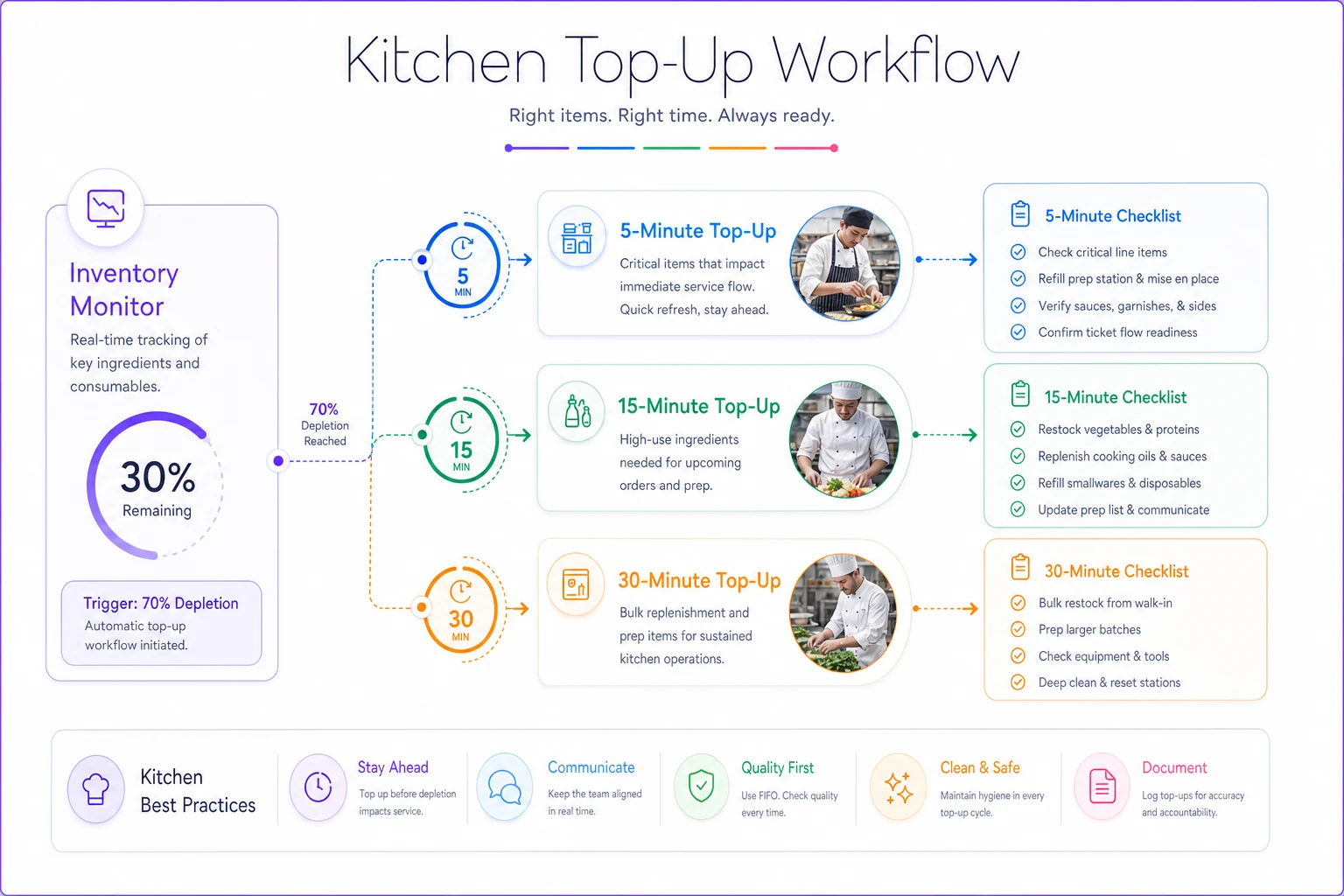
Use this flow as a training aid so staff understand when to trigger each routine and who owns the task during service.
Sample prep schedules for different confidence scenarios
High-Confidence Tuesday (92% forecast accuracy) 6:00 AM - Proteins: prep 1.05x expected covers 7:30 AM - Sauces: prep 1.1x for lunch and dinner combined 9:00 AM - Vegetables: prep exact forecast amount 10:00 AM - Garnishes: prep to order after checking morning reservations 2:00 PM - Evaluate lunch depletion, adjust dinner prep down if needed 3:00 PM - Final dinner prep based on reservation confirmations
Medium-Confidence Friday (74% forecast accuracy) 5:30 AM - Proteins: prep 1.15x forecast, keep 20% at partial prep stage 7:00 AM - Sauces: prep 1.25x, ensure all bases ready for quick finishing 8:30 AM - Vegetables: prep 1.2x, focus on items that carry to Saturday 10:00 AM - Set up quick-prep station with 15-minute top-up items ready 2:00 PM - Check weather and local events, adjust evening prep up/down 10% 4:00 PM - Pre-stage finish-to-order components for high-cost items
Low-Confidence Saturday with Local Event (48% forecast accuracy) 5:00 AM - Proteins: prep only 1.0x forecast, but stage 0.25x for rapid prep 6:30 AM - Sauces: prep 1.4x, these keep through Monday 8:00 AM - Vegetables: prep 1.1x, keep backup mise for 20-minute prep 9:30 AM - Create "overflow prep list" with 30-minute items ready to go 11:00 AM - Check event attendance, adjust lunch prep final quantities 3:00 PM - Make go/no-go decision on overflow prep based on lunch turnout 5:00 PM - All hands ready for continuous top-up during service
Managing the waste-versus-stockout tradeoff
You'll never hit zero waste and zero stockouts simultaneously. The goal is finding the profitable balance.
Track these metrics weekly:
-
Waste as percentage of food cost (target
under 3%)
-
Stockout incidents per 100 covers (target
under 2)
-
Prep labor hours per cover (target
varies by concept)
-
Customer complaints related to unavailable items (target
near zero)
When waste creeps above 3%, tighten your confidence intervals by 5%. When stockouts exceed 2 per 100 covers, widen intervals by 5%. This creates a feedback loop that naturally optimizes your prep levels.
The expensive mistake happens when restaurants only track waste, not stockouts. They celebrate throwing away less food while ignoring the revenue lost from telling customers their preferred dish isn't available. A $12 portion thrown away hurts less than a $45 entrée sale lost to stockout.
Dealing with multi-day shelf life complexity
Real kitchens don't prep everything fresh daily. Your mother sauces, braised items, and some proteins carry across multiple days. This creates cascading complexity in your confidence calculations.
Consider a sauce with 5-day shelf life. Monday's prep needs to account for:
-
Monday's high-confidence demand
-
Tuesday's high-confidence demand
-
Wednesday's medium-confidence demand
-
Thursday's medium-confidence demand
-
Friday's low-confidence demand
The standard mistake: prepping Monday based only on Monday-Tuesday demand, then scrambling Wednesday when you realize you're short for the weekend.
Instead, use declining confidence multipliers. If Wednesday is medium-confidence at 1.25x, Thursday is 1.2x, and Friday is 1.15x. This natural taper prevents overproduction while maintaining coverage.
For items crossing a weekend, add a complexity factor. That sauce prepped Thursday for Sunday use needs extra buffer because you can't easily recover from a stockout on Sunday morning.
When confidence-based prep makes sense (and when it doesn't)
This system works best for:
-
Restaurants with $2M+ annual revenue
-
15+ menu items with varying prep times
-
Significant day-to-day demand variation (30%+ swings)
-
Multiple revenue streams (dine-in, takeout, catering)
-
Seasonal menu changes
Skip this approach if you run:
-
Fixed-menu operations with minimal variation
-
Ultra-high-volume single-item concepts
-
Commissary kitchens with predictable production schedules
-
Operations where ingredient cost is under 20% of menu price
The effort required to maintain confidence intervals only pays off when demand variation and ingredient costs create real financial impact. A burger joint slinging 400 identical burgers daily doesn't need confidence intervals—they need consistent execution.
Implementation timeline and training requirements
Week 1-2: Track actual demand versus forecast, categorize into confidence buckets Week 3-4: Build initial confidence intervals, train prep team on new multipliers Week 5-6: Run parallel systems (old and new) to compare waste and stockouts Week 7-8: Full cutover to confidence-based prep, daily adjustment meetings Week 9-12: Fine-tune multipliers based on results, reduce meeting frequency
The training challenge isn't teaching the math—it's changing the mindset. Prep cooks comfortable with fixed par levels resist variable targets. Build simple reference cards showing exactly what to prep based on the day's confidence level. Remove the guesswork.
During implementation, expect 10-15% higher prep labor costs as teams learn the system. This drops back to baseline by week 8, then saves 5-10% long-term through reduced re-prep and emergency prep situations.
Building software support without overcomplicating
The best demand-driven prep planning combines human judgment with AI-powered operational software assistance. Track confidence levels, automatically calculate prep quantities, and flag when actuals deviate significantly from forecast.
Simple spreadsheets work initially, but they break down when tracking multiple locations or complex menus. Purpose-built restaurant operations platforms handle the complexity while keeping the interface simple enough for kitchen staff.
The software shouldn't replace kitchen judgment—it should enhance it. When your system automatically adjusts Tuesday's prep based on Monday's actual usage, tracks waste patterns by day of week, and suggests confidence levels based on historical accuracy, your team makes better decisions faster.
Key features that actually matter:
-
Mobile-friendly prep lists
-
Automatic quantity calculations based on confidence
-
Waste tracking by item and day
-
Integration with POS for real-time depletion
-
Quick-prep alerts during service
Skip the AI prediction engines and complex analytics initially. Get the basic confidence-interval system working first, then add intelligence gradually.
The bottom line on confidence-based prep
Switching from fixed par levels to confidence-based prep typically reduces food waste by 20-35% while cutting stockouts in half. The math isn't complicated—it's just different from what most kitchens learned.
Start small. Pick your five highest-cost ingredients and apply confidence intervals for two weeks. Track the results, adjust the multipliers, then expand to more items. Within two months, you'll have a system that adapts to demand variation instead of fighting it.
The restaurants still throwing out $400 of prep while running out during rush? They're treating every forecast like it's equally reliable. Once you separate high-confidence Tuesday lunch from low-confidence Saturday night, your prep levels naturally align with reality instead of hope.
Start small. Pick your five highest-cost ingredients and apply confidence intervals for two weeks. Track the results, adjust the multipliers, then expand to more items. Within two months, you'll have a system that adapts to demand variation instead of fighting it.
The restaurants still throwing out $400 of prep while running out during rush? They're treating every forecast like it's equally reliable. Once you separate high-confidence Tuesday lunch from low-confidence Saturday night, your prep levels naturally align with reality instead of hope.
Ready to elevate your restaurant operations?
Join 2,000+ restaurants using Dineoly to enhance efficiency, increase table turnover, and delight diners.