

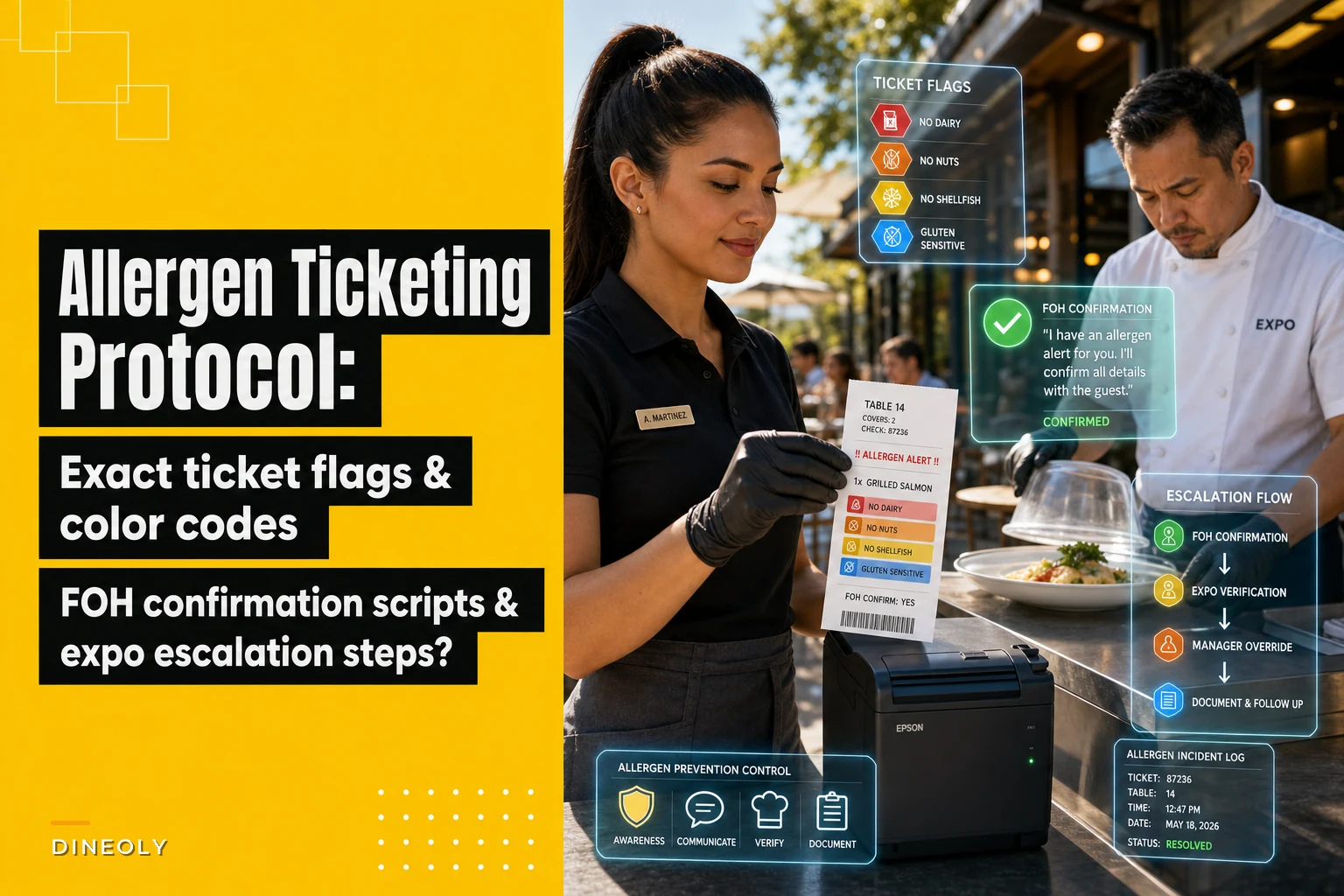

Most allergen mistakes don't happen because a cook doesn't care. They happen because the allergy note lived in three different places, said three slightly different things, and by the time the ticket hit the pass nobody was sure which version was true. A server wrote "no nuts" on a comment line. The POS printed it in the same gray text as "extra napkins." The expo was slammed and read the top three items, not the flag buried at the bottom.
That gap — between what the guest said and what the line actually acted on — is the whole problem. A tight restaurant allergen ticketing protocol closes it. Not with more meetings, but with exact formats, exact words, and a couple of hard stops that don't bend during a rush.
Below is a system you can print, tape to the expo station, and run tomorrow. It's built around three things that survive a busy Saturday: unmistakable ticket flags, scripts nobody has to improvise, and an escalation path for when something goes wrong.
Why allergen notes fail on the line specifically
The failure is almost never "the kitchen ignored it." Walk it backward and it's usually one of these:
-
The allergy was typed into a free-text comment field that prints in the same font and color as prep modifiers, so it visually blends in with "sub fries" and "sauce on side."
-
The server confirmed the allergy verbally at the table but never read it back to the guest, so a mishearing ("no dairy" vs "no added dairy") went straight to the cook.
-
The expo scanned the ticket for fire timing, not safety flags — because timing is what expos are trained to protect.
-
Nobody owned the plate as the allergen plate once it left the pass, so a runner grabbed the wrong one off a stack of four identical-looking dishes.
There's a pattern worth naming: allergen info degrades every time it's handed off without a confirmation step. Table to POS. POS to printer. Printer to line. Line to pass. Pass to runner. Five handoffs, and if even one is silent, the flag can quietly disappear.
The fix isn't "be more careful." It's making the flag physically impossible to miss and forcing a spoken confirmation at the two handoffs that matter most.
The ticket flag format (exact, not "highlight it somehow")
Vague instructions like "make allergy tickets stand out" fall apart because every station interprets them differently. Standardize the format down to the character.
Eliminate operational bottlenecks effortlessly.
Dineoly helps you manage every reservation, order, and staff shift seamlessly.
- Unified reservation and order management
- Real-time staff scheduling
- Inventory and sales tracking
No credit card required
``
ALLERGEN — [ALLERGEN NAME]
``
``
 ALLERGEN — PEANUT
>> BOWL 4 — SEVERE / EPIPEN ON GUEST <<
``
A few rules that make this actually work:
-
The allergen name is spelled out, never abbreviated. "SHF" for shellfish gets misread. "SHELLFISH" doesn't.
-
It prints at the top of the ticket, above item lines — not buried in modifiers. If your POS can't force position, print allergen orders as a separate ticket entirely.
-
One allergen ticket = one allergen guest. Don't combine an allergy order with the rest of the table on one chit. It sounds inefficient. It prevents the "which bowl was it" problem entirely.
-
If the guest states severity or carries an EpiPen, that goes on the flag. Cooks treat "severe" differently, and they should.
Color-coding that doesn't rely on color alone
| Signal | Purpose | Where it lives |
|---|---|---|
| Red chit clip / red sticker | Fast visual "this is the allergen plate" | On the ticket at the pass + on the plate cover |
ALLERGEN caps header | Machine-independent, works on any printer | Top of every allergen ticket |
| Separate single-guest ticket | Prevents plate mix-ups | POS routing rule |
| Colored plate cover / cloche | Marks the finished plate through the pass | Expo station |
The physical red clip does something a screen never will: it survives the trip from printer to line to pass to runner without needing anyone to re-read anything. The plate cover is the same idea applied to the finished dish — the allergen plate looks different from arm's length.
If your POS can't force top-of-ticket placement, route allergen orders to print as a separate ticket.
Quick visual of the ticketing workflow:
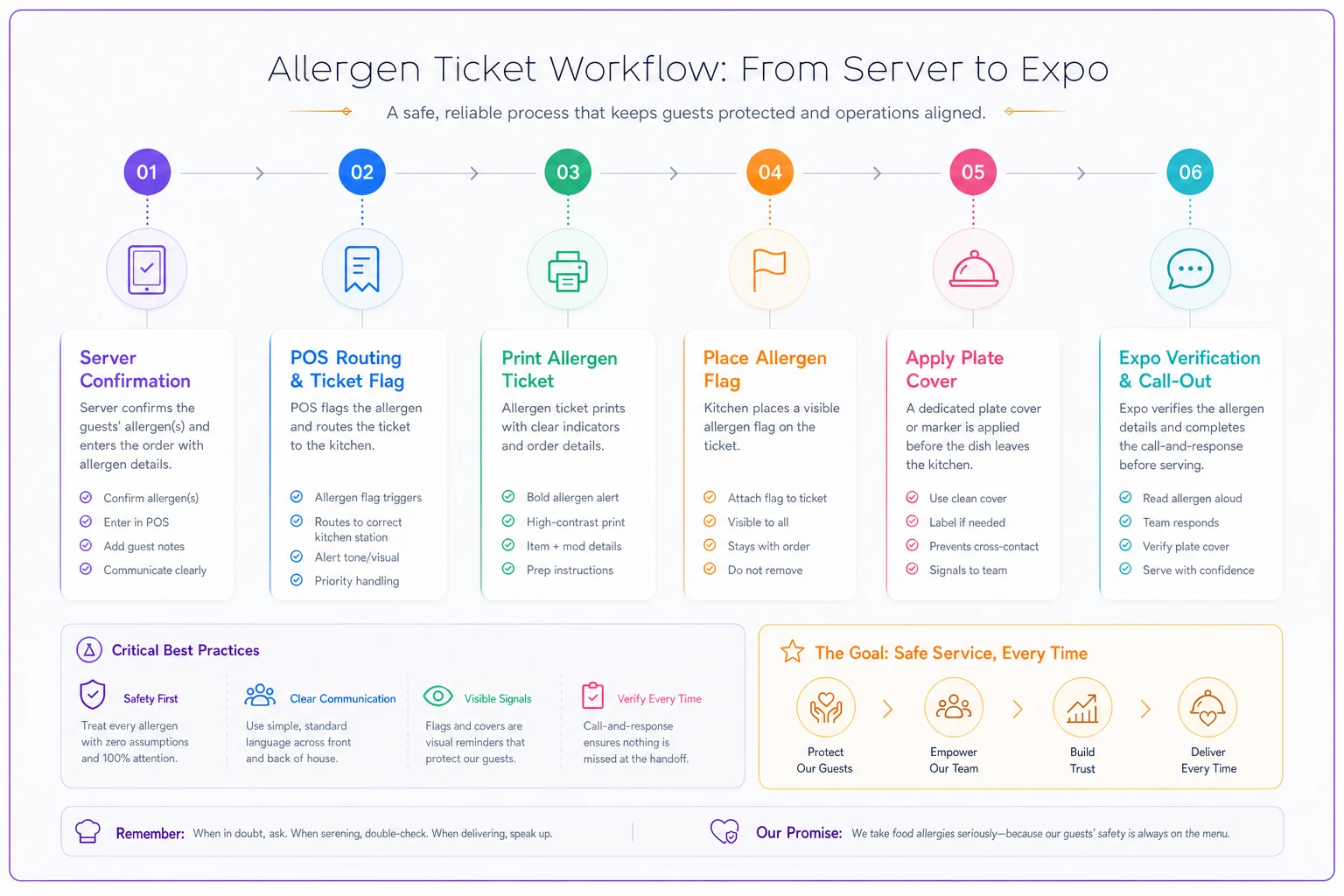
The image maps the route the allergen flag takes, from server read-back to expo call-and-response.
FOH confirmation scripts (say it back, every time)
The single highest-leverage change most restaurants can make is a read-back confirmation at the table. It takes about seven seconds and catches mishearings before they ever reach a printer.
At the table, after the guest states an allergy:
> "Just to confirm — you have a peanut allergy, and this is severe, is that right? I'm going to mark this so the kitchen treats it as an allergen order."
Two things are happening. You're confirming the allergen and the severity, and you're setting the expectation that this order is handled differently — which slows the guest down enough to correct you if you got it wrong.
When the plate is delivered:
> "This is your peanut-allergen plate — prepared separately. Can I get anything else for you before you start?"
Announcing it at drop-off closes the loop on the runner handoff. If the wrong plate somehow made it to the tray, the guest often catches it here ("I didn't order the salad").
If the guest is vague ("I can't have dairy but a little butter is fine"): Don't interpret it. Mark it exactly as stated and flag it for the manager or chef to clarify. "A little butter is fine" is not a spec a line cook can safely act on. Push ambiguity up, never sideways.
Worth noting: these read-backs are part of the same discipline as tight real-time FOH→kitchen coordination protocols — the difference is that allergen confirmations are non-negotiable and never get fast-tracked out of the flow during peak.
Expo checks: the two hard stops
Expo is where allergen safety is won or lost, because it's the last point where someone sees both the ticket and the plate together. Build in two hard stops that expo cannot skip.
Hard stop 1 — Ticket check (before firing):
When an allergen ticket lands, expo says out loud to the line: > "Allergen on the board — peanut, Bowl 4, severe. Confirm clean station and clean gloves." The cook confirms back: "Peanut, Bowl 4, heard — clean station." That call-and-response is the whole point. Silence is not confirmation.
Hard stop 2 — Plate check (before it leaves the pass):
-
Ticket flag matches the plate cover color? ✔
-
Allergen plate is physically separated from other plates on the pass? ✔
-
Expo verbally hands it off
"This is the peanut-allergen plate — hand to guest directly." ✔
The mistake that comes up most at expo is batching. Four bowls come up together, one is the allergen bowl, and they get lined up identically. The cover and the separate ticket exist precisely so that never happens. If the allergen plate ever sits in a lineup of identical plates without a cover, the system has already failed — fix that before anything else.
Rapid-recall steps for a suspected cross-contact incident
This is the part everyone skips until they need it. When a server realizes mid-service that an allergen plate may have been contaminated — shared fry oil, wrong utensil, a garnish that shouldn't have been there — you need a recall sequence that anyone can run without stopping to think.
The recall sequence:
-
Stop the plate. If it hasn't reached the guest, pull it immediately. If it's already at the table and untouched, the server removes it: "I want to double-check something in the kitchen — one moment." Calm, no alarm.
-
Call it to the manager and expo at once. Not later. Not after the rush. The words are: "Possible cross-contact, Bowl 4, peanut."
-
Quarantine the plate. Don't dump it. If there's a reaction, the plate is evidence for the medical team. Set it aside, labeled.
-
Remake from a clean station — new gloves, sanitized surface, fresh utensils, ingredients confirmed against the allergen.
-
If the guest has already eaten and reports symptoms, follow your medical protocol immediately — EpiPen if they carry one and it's warranted, call emergency services, do not wait to "see if it gets worse."
-
Log it the same shift. Time, plate, allergen, what went wrong, who was on the station, corrective action. An incident with no log is an incident that will happen again.
The reason a written sequence matters: during a real scare, adrenaline erases judgment. People who know exactly what to do still freeze if they've never rehearsed the order. Walk the line through this once a month. It takes ten minutes at pre-shift.
A real scenario
A 90-seat farm-to-table spot kept its allergy handling "in the servers' heads" — verbal to the kitchen, a note in the POS comment field. Over about six months they had three near-misses that made it to the pass, and one plate that reached a guest with a garnish containing tree nut before a server caught it at the table. Nobody was hurt, but it was luck, not process.
They changed three things: separate single-guest allergen tickets with a caps header, red chit clips plus plate covers, and the call-and-response at expo. The table read-back script got added too. Over the next quarter, near-misses that reached the pass dropped to essentially zero, and the two that did get flagged were caught at the read-back stage — exactly where you want them caught, before the kitchen ever touched them. The owner's take afterward was blunt: the system didn't slow service down noticeably, it just moved the catching earlier, where it's cheap.
When to run the full protocol — and when it's overkill
Run every step when: you have any life-threatening allergies stated, a busy multi-station line, high server turnover, or you serve dishes with hidden allergen risk (shared fryers, nut oils, cross-contact-prone garnishes). That's most full-service restaurants.
You can lighten it when: you're a tiny operation where one person takes the order, cooks it, and delivers it — the handoff count is low, so the failure surface is small. Even then, keep the read-back and the separate ticket. Those two cost nothing.
-
Run every step when
you have any life-threatening allergies stated, a busy multi-station line, high server turnover, or you serve dishes with hidden allergen risk (shared fryers, nut oils, cross-contact-prone garnishes).
-
You can lighten it when
you're a tiny operation where one person takes the order, cooks it, and delivers it — the handoff count is low, so the failure surface is small.
Who should not try to simplify this away: anyone running a line where the person who hears the allergy is not the person who plates it. The moment there's a handoff, silent handoffs will eventually drop the flag. The confirmations are the entire safety margin.
Making it auditable without adding paperwork
Auditability scares people because they picture binders. It's simpler than that. You need to be able to answer, for any allergen order: what was flagged, who confirmed it, and did anything go wrong?
On paper, a single line per allergen order works — date, table, allergen, expo initials, incident (y/n). If you're running a digital ticketing or kitchen-display setup, the allergen flag and confirmation timestamp should be captured automatically as part of the order record, so the log builds itself instead of relying on someone remembering to write it down after a double. The point isn't the tool — it's that the record exists without adding a task to a shift that's already full.
Whatever you use, review the incident lines monthly. A near-miss that keeps recurring at the same station is telling you something specific about that station's setup, not about that cook's attitude.
Closing thought
An allergen protocol isn't a document you write once and file. It's a set of small, repeatable frictions — a read-back, a red clip, a call-and-response — placed exactly at the handoffs where information tends to disappear. The formats above are deliberately rigid because rigidity is what holds up at 8pm on a Saturday when everyone's slammed. Adopt the ticket format and the two expo hard stops first; those two changes alone will catch most of what currently slips through. Add the rest as the line gets comfortable, and rehearse the recall steps before you ever need them.
Ready to elevate your restaurant operations?
Join 2,000+ restaurants using Dineoly to enhance efficiency, increase table turnover, and delight diners.