

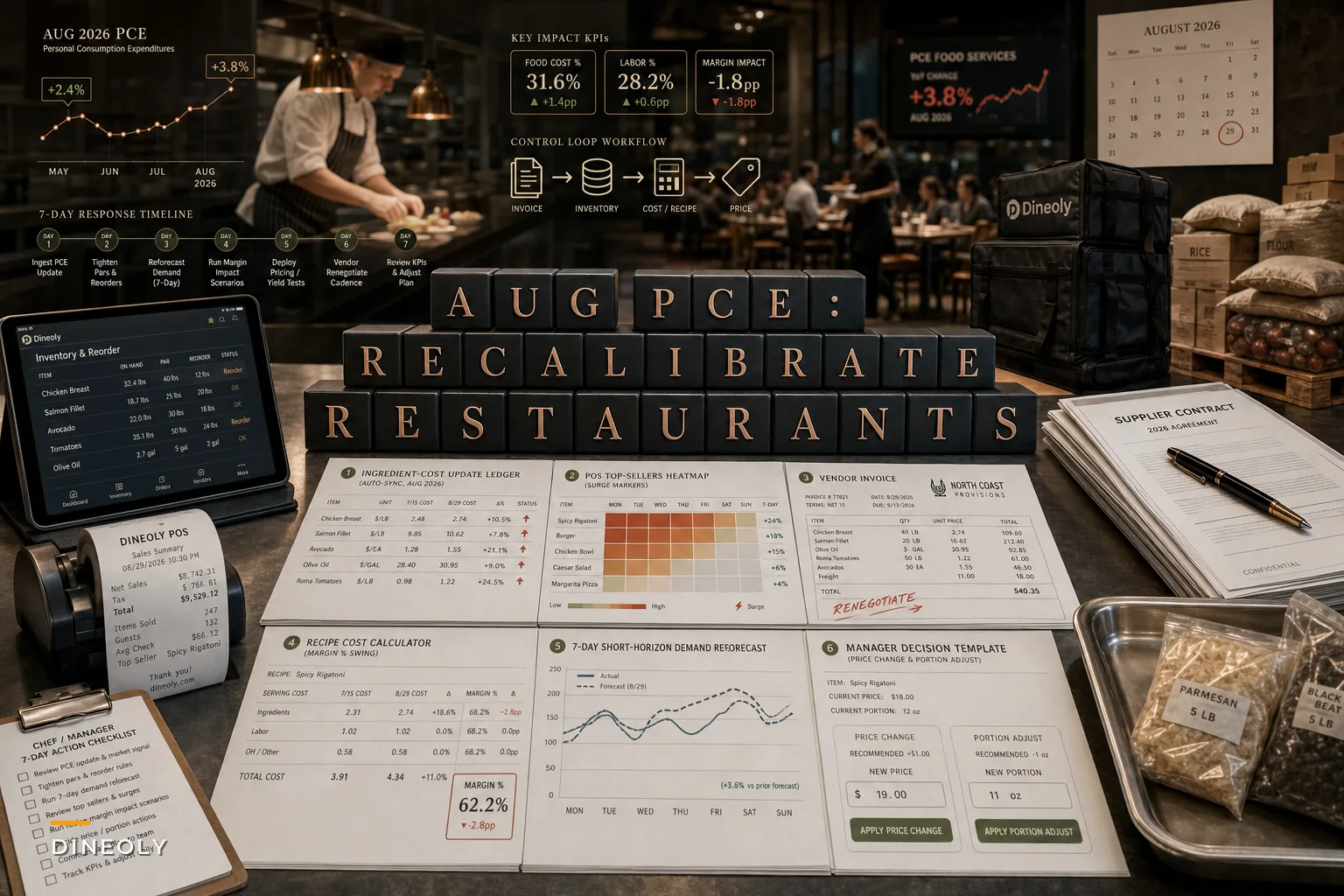

Most operators treat an inflation report like background noise — something for the accountant to sort out at month-end. That's a costly mistake right now. The August 2026 Personal Income and Outlays data released by the BEA on September 30 showed headline PCE up 0.3% for the month, core PCE up 0.2%, and 12-month core sitting around 3.0%. Translation: input costs aren't cooling, and consumers are still spending more than you'd expect given how stretched real incomes actually are.
That combination — sticky costs plus resilient demand — is trickier to manage than a plain slowdown. It lulls you into a false sense of security because sales look fine. Meanwhile your food cost percentage is quietly creeping, your labor dollars are buying fewer hours, and the menu prices you set six weeks ago no longer reflect reality.
So skip the macro lecture. Here's what actually changes on your floor and in your prep kitchen this week.
Why "spending is up" is the dangerous part
This report is the opposite problem. A recent CNBC preview of the release framed the tension well: spending momentum staying firm while inflation refuses to fully break. For a restaurant, strong top-line revenue hides a margin leak. You can post a solid Saturday and still lose ground if your plate costs rose 4% and your prices didn't move.
Revenue growth tends to mask margin erosion for a month or two before anyone catches it — because owners track sales daily but recalculate true plate cost quarterly. By the time the P&L confirms the damage, you've served tens of thousands of under-priced plates.
The problem isn't inflation itself. It's the lag between when your costs change and when your operational decisions catch up. Closing that lag is the whole game right now.
The lag problem, broken down
Think about how a cost increase actually travels through a typical restaurant:
Eliminate operational bottlenecks effortlessly.
Dineoly helps you manage every reservation, order, and staff shift seamlessly.
- Unified reservation and order management
- Real-time staff scheduling
- Inventory and sales tracking
No credit card required
-
Your distributor raises the price on proteins, dairy, or cooking oil.
-
The invoice gets filed, but nobody flags the unit-cost change.
-
Your recipe costing still runs on last quarter's numbers.
-
Menu prices stay put because "we just updated them."
-
Six to eight weeks later, month-end P&L shows food cost up 2–3 points and nobody knows which items caused it.
Every step in that chain is a place where the signal gets lost. Distributors move fast. Most kitchens move slow. That gap is where margin dies.
The operators who handle this environment well aren't smarter — they've just shortened that chain so a cost change triggers a visible decision within days, not weeks.
In-shift moves: what managers should do this week
In-shift decisions are where you recover margin you'd otherwise lose. These don't require a pricing committee or corporate sign-off — they happen on the floor.
-
Re-check your top 10 movers against current cost. You don't need to re-cost the whole menu. Pull your 10 highest-volume items and verify today's plate cost against this week's invoices. If anything shifted more than a point or two, flag it for the weekly pricing review.
-
Tighten prep-par on volatile ingredients. If protein and oil prices are moving, over-prepping on those items is now more expensive per mistake. Trim par levels slightly and lean on top-up prep mid-shift.
-
Watch comp and void creep in real time. When budgets tighten for guests, send-backs and "make it right" comps tend to rise. A 1.5% comp rate feels harmless until you realize it's eating a real chunk of an already-thin margin.
-
Give expo authority to cut waste at the pass. Small portion drift during busy shifts is a silent cost. A quick visual standard at the pass holds the line.
-
Flag any 86'd item that's selling out too early. Running out isn't just lost revenue — it often means your prep math is off, which compounds in a high-cost environment.
Pull today's invoices for your top sellers mid-shift to spot immediate cost shifts.
None of this is dramatic. That's the point. In a sticky-inflation stretch, margin gets protected through dozens of small, consistent in-shift decisions — not one big move.
Weekly moves: forecasting, purchasing and pricing cadence
The weekly layer is where you reset the assumptions your shifts run on. This is also where most operators fall behind, because they treat forecasting and purchasing as set-it-and-forget-it.
| Decision area | Typical cadence | Recommended cadence right now |
|---|---|---|
| Plate re-costing | Quarterly | Every 2 weeks on top sellers |
| Menu price review | 1–2x per year | Monthly, triggered by cost thresholds |
| Reorder par levels | Static / seasonal | Weekly on volatile categories |
| Vendor price audit | Ad hoc | Every delivery, flagged on change |
| Short-horizon demand forecast | Weekly, gut-based | Weekly, data-anchored with recent trend |
The shift isn't about doing more work — it's about moving the trigger closer to the cost event. A plate re-cost every two weeks on your top movers catches drift before it becomes a P&L problem.
On forecasting specifically: this is a bad moment to rely on last-year comparisons alone. Spending patterns are choppy right now. Real incomes are strained even though outlays rose, which means guests may trade down within your menu — same cover count, lower check average, different item mix. Your forecast needs to account for mix shift, not just headcount.
A realistic scenario
Take a mid-volume neighborhood bistro doing roughly $95k–$110k in monthly sales. Going into fall, their food cost was tracking around 31%, which they were comfortable with.
Over about six weeks, protein and dairy invoices crept up — nothing dramatic per delivery, just the drip you don't notice. Because they re-costed recipes quarterly, their menu prices didn't move. Covers actually ticked up slightly, so the owner felt good about where things stood.
When they finally ran month-end, food cost had climbed to roughly 34%. On their volume, that's somewhere around $3k of margin quietly gone in a single month — on higher sales. The revenue growth had completely camouflaged the damage.
The fix wasn't complicated. They pulled their 12 top-selling items, re-costed them against current invoices, and found four plates where margin had collapsed. Three got modest price bumps, one got a small portion adjustment. Within two periods food cost settled back near 31.5% — not perfect, but most of the leak was sealed.
The lesson wasn't about pricing genius. It was that their detection cadence was too slow for the environment.
Where connected systems actually earn their keep
The reason this is hard isn't that operators don't understand costing. It's that the data lives in separate places — invoices in one system, recipes in another, sales in the POS, par levels in someone's head. Connecting a cost change to a pricing decision means manually stitching those together, which is exactly why it only happens quarterly.
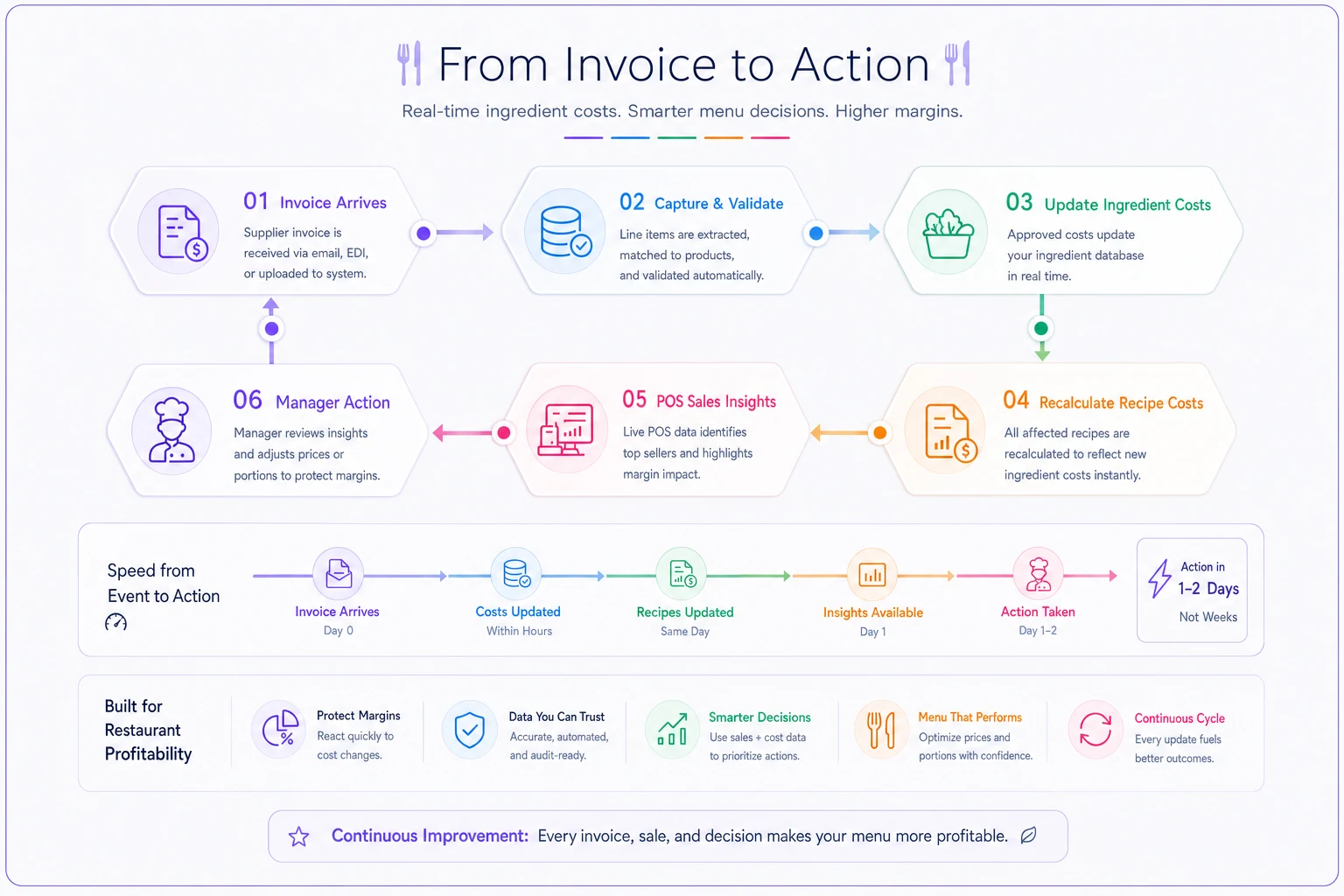
When reservations, staffing, orders, and inventory sit in one operational layer, a cost spike on an invoice can surface against the recipes that use it and the items that sell most — so the decision trigger fires in days instead of at month-end. That's the practical value: not fancy analytics, just collapsing the lag between a cost event and a defensible manager action.
Here's a simple workflow that shows how an invoice price change can flow to a manager pricing action in days.
If you want the deeper framework for wiring these daily control loops directly to your P&L, we broke that down in our guide on mapping daily control loops to your P&L with in-shift margin impact templates.
When to act hard — and when to hold
Not every inflation print demands a menu overhaul. Over-reacting burns goodwill and confuses your team.
Act decisively when:
-
Food cost on your top movers has drifted more than 2 points
-
A specific category (proteins, oils, dairy) jumped sharply in a single cycle
-
Check averages are falling even as covers hold steady — that's trade-down behavior you need to price around
Hold and monitor when:
-
The movement is broad but small, and your margins have buffer
-
You raised prices recently and risk guest fatigue
-
The cost spike looks like a one-off delivery anomaly rather than a trend
The judgment call is whether you're seeing a trend or noise. One pricey invoice isn't a trend. Three deliveries moving in the same direction is.
The through-line
Persistent inflation alongside firm spending is an awkward combination because the usual warning signal — falling sales — isn't flashing. That's exactly why this stretch quietly damages restaurants that feel like they're doing fine.
The move isn't to panic or overhaul your menu overnight. It's to shorten your detection cycle: re-cost top movers more often, audit vendor prices on every delivery, review pricing against thresholds instead of calendars, and give your floor managers in-shift authority to protect margin plate by plate. Do that consistently, and a report like this one becomes something you act on in days — not a surprise you discover weeks too late on the P&L.
The move isn't to panic or overhaul your menu overnight. It's to shorten your detection cycle: re-cost top movers more often, audit vendor prices on every delivery, review pricing against thresholds instead of calendars, and give your floor managers in-shift authority to protect margin plate by plate. Do that consistently, and a report like this one becomes something you act on in days — not a surprise you discover weeks too late on the P&L.
Ready to elevate your restaurant operations?
Join 2,000+ restaurants using Dineoly to enhance efficiency, increase table turnover, and delight diners.