


Most restaurants run two completely separate realities. There's the operational reality — covers, ticket times, prep lists, call-offs, the walk-in that's running warmer than it should be. And then there's the financial reality — the P&L that shows up weeks later, after the accountant closes the month, when nobody remembers why food cost landed at 32.4% instead of 29%.
The gap between those two realities is where money quietly disappears. A line cook portioning by feel, a manager comping too aggressively on a slow Tuesday, a $14/hour body kept on the floor for two dead hours "just in case" — none of these feel like financial decisions in the moment. They feel operational. But every one of them lands on a P&L line eventually, and by then the shift where it happened is long gone.
Restaurant FinOps is the discipline of closing that gap: connecting the small decisions made during a shift to the margin they move, while the shift is still happening. Not a monthly autopsy. A live feedback loop.
Why the monthly P&L is basically useless for operators
The P&L your accountant produces is a legal and tax document. It's accurate. It's also almost worthless for changing behavior, because it arrives 20–45 days after the decisions that created it, aggregated into buckets so broad that no manager can trace a number back to an action.
Say food cost comes in at 31.5% for the month and your target is 28.5%. That three-point miss might be roughly $9k–$12k on a shop doing $350k a month. Where did it come from? The P&L can't tell you. It could be:
-
Over-portioning on your three highest-volume plates
-
Supplier price creep nobody flagged
-
Spoilage from over-prepping on soft nights
-
Comps and voids running hot
-
Yield loss on proteins you're breaking down in-house
All five feed the same line. By the time you see the number, the shifts are gone and the memory is gone with them. You end up "talking to the team about food cost" — which does nothing, because you're addressing a symptom averaged across 60 different services.
What shows up consistently across a lot of operations is that owners don't lack financial data. They lack timed, attributable financial data. The information exists. It just arrives too late and too blended to act on.
The core idea: control loops that already touch money
If you've read the operational backbone playbook on control loops, you already know a shift is a series of small control loops — reservations feeding staffing, staffing feeding throughput, orders feeding inventory. Operational FinOps adds one thing to each loop: a margin tag.
Eliminate operational bottlenecks effortlessly.
Dineoly helps you manage every reservation, order, and staff shift seamlessly.
- Unified reservation and order management
- Real-time staff scheduling
- Inventory and sales tracking
No credit card required
Every operational decision has a dollar consequence that's usually knowable before the P&L confirms it. The trick is pre-calculating that consequence so the person making the decision sees it in real terms.
A few examples of loops that already touch money, whether you measure it or not:
| In-shift decision | Operational trigger | Hidden margin impact |
|---|---|---|
| Cutting or keeping a floor server | Covers running below forecast | Every idle labor hour ≈ its full loaded wage against zero incremental sales |
| Comping a table | Guest complaint, long tickets | Full menu cost + the margin you'd have earned on the recovery |
| Over-prepping a soft night | "Better to have it" instinct | Spoilage risk = 100% of ingredient cost on anything unsold |
| Portioning by eye | Rush, muscle memory | 5–8% overpour across a high-volume plate compounds fast |
| 86'ing a high-margin item early | Prep ran short | Guests default to lower-margin substitutes or walk |
None of these show up as "decisions" in most restaurants. They show up as variance three weeks later. The whole point of restaurant FinOps is to move the number to the moment.
Building margin-impact templates for in-shift decisions
A margin-impact template is a small, pre-built calculation that turns a fuzzy operational choice into a dollar figure a manager can react to during service. You build these once, calibrated to your own menu and labor costs, and they run in the background from there.
Labor cut/keep template. Loaded labor cost per person per hour on one side, incremental contribution margin per cover on the other. If your forecast says the next two hours will do 18 covers and your break-even for keeping that fourth server is 26 covers, the template tells you to cut — and roughly what keeping them costs. This connects naturally to anything you've built to stop overtime creep with in-shift threshold rules, since the same live labor data drives both.
Comp/void margin template. A comped $16 entrée isn't a $16 loss — it's the food cost you already spent plus the contribution you'll never recover, minus whatever goodwill it buys. Managers who see comps as "just food cost" comp way more freely than managers who see the full number. A shop running comps at 3% of sales versus a healthy 1% is bleeding real contribution, not petty cash.
Prep-to-margin template. Ties tonight's forecast confidence to prep quantities and shows the spoilage exposure of over-prepping perishables. This pairs directly with how you've approached menu engineering and yield-adjusted costing — the yield numbers you calculated for costing are the same inputs that make the prep template accurate.
You don't need penny-accurate math mid-rush — a range and a direction is enough to drive the right call.
The common mistake is building templates that are too precise to be usable. You don't need penny-accurate math mid-rush. You need a range and a direction. "Keeping this person costs roughly $60–$90 over the next two hours and covers don't support it" is enough to make a good call. Chasing exactness kills adoption because managers won't stop to run a spreadsheet at 7:40pm on a Friday.
The cost-to-serve calculator: the number almost nobody has
Here's a number most operators genuinely can't produce: what does it actually cost to serve one guest, or one specific dish, all-in?
Not food cost. Cost-to-serve. Food plus the labor minutes to prep and fire it, plus the fractional labor to serve it, plus packaging if it's off-prem, plus the card processing fee, plus allocated overhead. When you build this out even roughly, some ugly things surface.
A mid-volume bistro assumed their signature short rib was a hero item because it sold well and had a "good" food cost around 30%. But it took a long cook, occupied a station during peak, and got comped more than anything else on the menu because it was inconsistent. Once they built cost-to-serve — labor minutes, station occupancy, comp rate — the actual contribution per plate was well below three other entrées that got no attention. Their menu was steering guests toward their worst-performing item on a true-cost basis.
To build a cost-to-serve calculator that's actually usable:
-
Pull ingredient cost per plate using yield-adjusted numbers, not raw invoice prices.
-
Add labor minutes — prep time plus a share of line and service time per cover.
-
Convert minutes to dollars at your loaded labor rate.
-
Layer in transactional costs — processing fees, packaging, delivery commissions if applicable.
-
Allocate a flat overhead per cover so nothing looks artificially profitable.
-
Compare true contribution per item and flag anything below your menu-average contribution.
The insight most people miss: cost-to-serve is not static. Delivery orders carry a 15–30% commission that torches the contribution on items priced for dine-in. A dish that's profitable on-prem can be a loss leader on a third-party app, and the blended P&L hides it entirely because it's all just "sales." Run cost-to-serve by channel, not just by item, or you'll keep promoting the exact orders that lose you money.
The weekly audit loop: tying variance back to forecast
Templates handle in-shift decisions. The cost-to-serve calculator handles menu-level truth. The weekly audit loop is what keeps the whole thing honest — it compares what you forecasted margin would be against what actually happened, and forces you to attribute the difference.
This is the piece almost everyone skips, and it's the most important one. A weekly cadence is close enough to the action that people still remember the shifts, but far enough back to see patterns a single service can't reveal.
-
Start
-
Pull forecasted margin for the week
-
Pull actual margin from real numbers
-
Calculate variance → split into buckets (labor / food-yield / comps-voids / waste / mix shift)
-
Attribute each bucket to specific shifts or decisions
-
Write one sentence per bucket explaining the driver
-
Can you write the sentence?
-
→ No
data isn't attributable enough — fix sourcing first
-
→ Yes
set one corrective action tied to a template or threshold
-
Carry into next week's loop
Visual of the weekly audit loop:
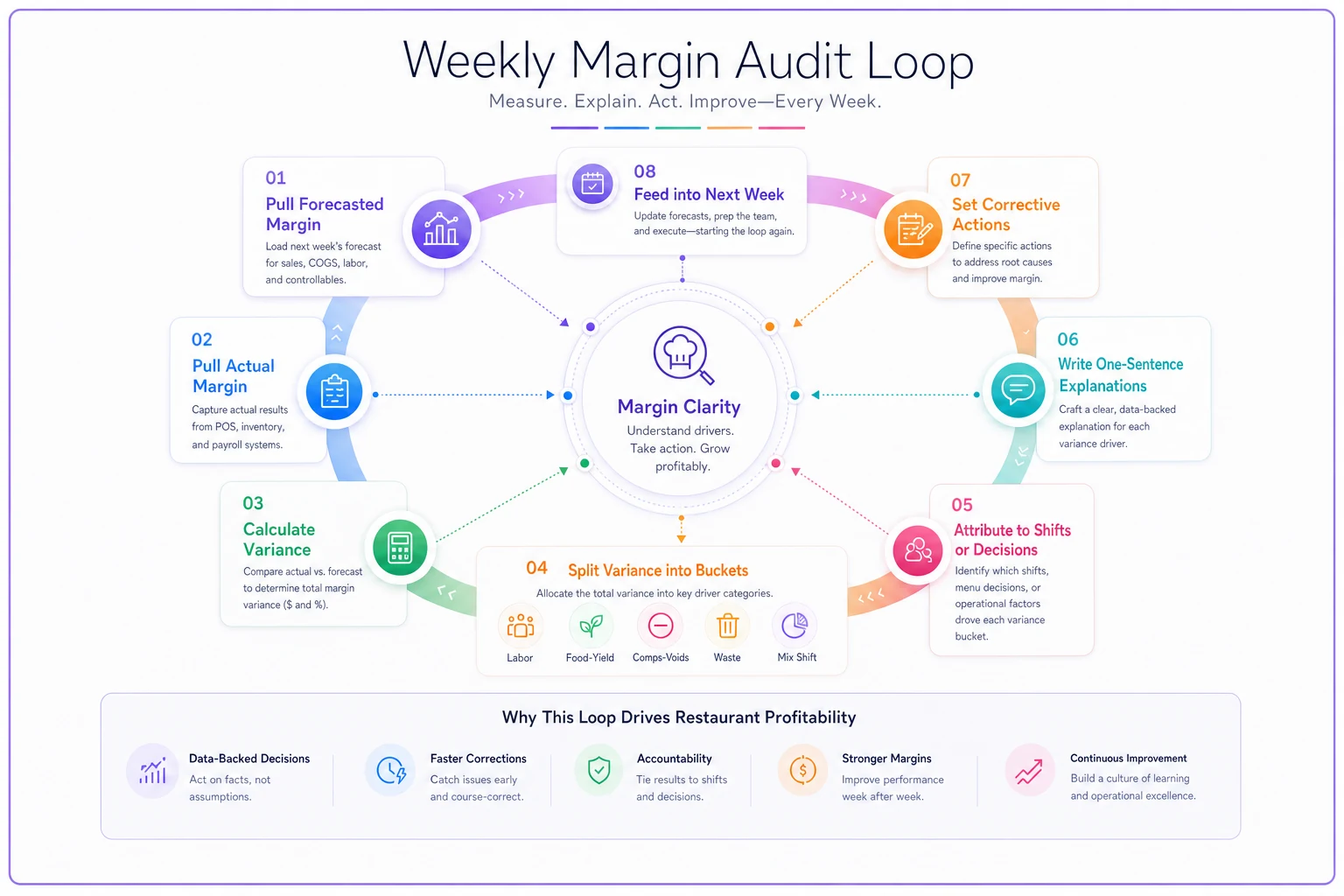
The discipline that makes this work is the one-sentence rule. "Food variance +$1,800, driven by over-prep on Sunday and Monday plus protein over-portioning on the burger" is actionable. "Food cost was high" is not. When managers know they'll have to explain variance by driver every Monday, their in-shift decisions tighten up on their own — without any speech about "watching the numbers."
When this actually makes sense — and when it doesn't
Operational FinOps is powerful, but it's not free to run, and a lot of shops try to implement it before they're ready.
It makes sense when:
-
You already have clean POS and labor data you trust. Bad inputs make margin templates worse than gut, because they add false confidence.
-
You're doing enough volume that variance is measured in thousands, not hundreds. The effort has to pay for itself.
-
Your managers can read a simple number and act on it without needing it explained every time.
It's a bad idea when:
-
Your data is a mess. Fix reconciliation and required fields first. A margin template built on unreliable inventory counts will confidently point you the wrong direction.
-
You're a small owner-operated spot where the owner is on the line every service and already sees everything. Formalizing loops that one person is already running in their head adds overhead for no gain.
-
You'd use it as a stick. If the weekly variance review becomes a blame session, managers will start gaming the attribution instead of fixing the drivers, and you'll end up with worse data than you started with.
Any operation still fighting basic data hygiene should hold off entirely. Attribution requires trustworthy source numbers. Get the plumbing right before you install the dashboard.
A real scenario: what closing the loop looked like
A two-location casual concept, roughly $310k–$340k a month combined, had food cost bouncing between 30% and 33% with no explanation anyone could pin down. Labor was "fine on paper" but the GMs kept overstaffing soft weeknights out of habit.
They didn't buy anything new at first. They built three margin templates — labor cut/keep, comp impact, prep-to-margin — a rough cost-to-serve on their top 15 items, and started a 30-minute Monday variance review with the one-sentence rule.
First month, the review surfaced that two servers were comping at roughly triple the rate of everyone else — not maliciously, just leaning on comps to smooth over kitchen delays. Cost-to-serve flagged that their two best-selling appetizers had thin true contribution once labor minutes were counted, so they nudged the menu layout toward higher-contribution starters. Prep templates cut the reflexive over-prep on Sundays and Mondays.
Nothing dramatic in any single week. Over a quarter, food cost settled into the 28.5–29.5% band and stopped swinging, and labor tightened by close to a point without cutting service quality. Somewhere in the range of $6k–$9k a month in recovered margin across both stores — not from any big move, but from a hundred small decisions finally being made with their real cost visible.
Where software quietly earns its place
You can run all of this manually. Plenty of good operators do, with a whiteboard and a Monday meeting. But the manual version breaks at scale — the moment you have more than one or two locations, or managers who rotate, the templates only get used when the disciplined GM happens to be on. The audit loop slips the week everyone's slammed.
That's the honest case for an AI-assisted operational platform: the margin templates run automatically off your live POS and labor feeds, so the cut/keep number is just there on the manager's screen at 7:40pm without anyone stopping to calculate it. The weekly variance gets pre-bucketed and attributed to specific shifts before your Monday review even starts, so the meeting is about decisions instead of data entry. The automation doesn't make the calls — it makes the cost of each decision visible at the moment it's being made, and keeps the loop running even on the weeks your best people are buried.
The value isn't the technology. It's that the connection between an in-shift call and its margin consequence stops depending on someone remembering to do the math.
The real shift in thinking
Restaurant FinOps isn't about staring at the P&L harder. It's about accepting that the P&L is a lagging record of decisions already made, and moving the financial signal upstream — into the shift, into the moment a manager decides to cut a server or comp a table or prep an extra six portions "to be safe."
Operators who get this right don't manage margin at month-end. They've wired margin awareness into the daily control loops that were already running anyway. Every loop gets a dollar tag. Every week, variance gets attributed to real drivers. And slowly, the two realities — what happens on the floor and what shows up on the statement — stop being separate things you reconcile after the fact, and start being one system you actually steer.
Operators who get this right don't manage margin at month-end. They've wired margin awareness into the daily control loops that were already running anyway. Every loop gets a dollar tag. Every week, variance gets attributed to real drivers. And slowly, the two realities — what happens on the floor and what shows up on the statement — stop being separate things you reconcile after the fact, and start being one system you actually steer.
Ready to elevate your restaurant operations?
Join 2,000+ restaurants using Dineoly to enhance efficiency, increase table turnover, and delight diners.