

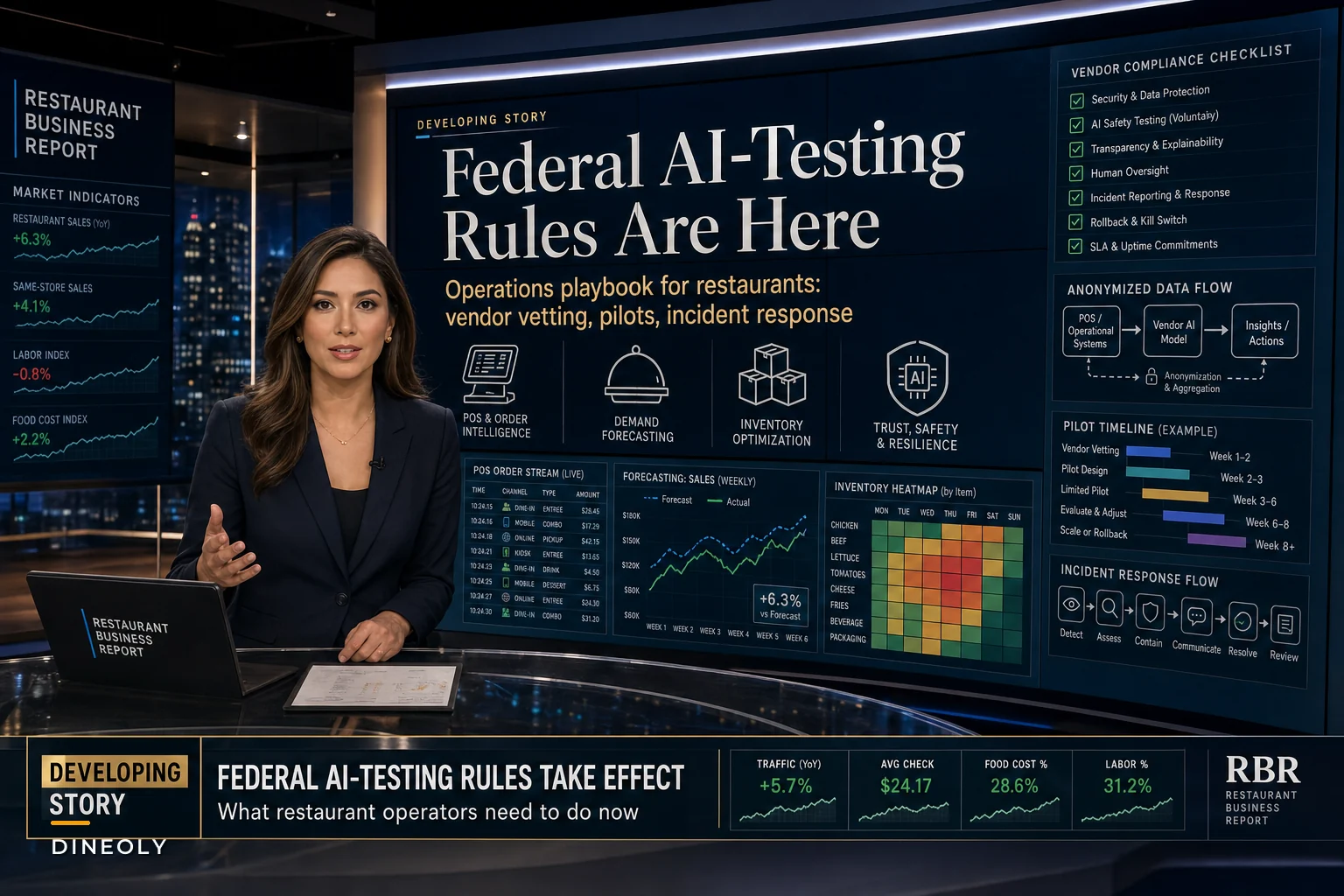

Early this month the White House convened the major AI firms to walk through a finalized voluntary framework for safety and cybersecurity testing on advanced "frontier" models. CNBC reported on the meeting, which builds on an executive order from June directing federal agencies to set up security benchmarks and an early-access testing pathway for the largest models.
If you run a restaurant, your first reaction is probably "this has nothing to do with me." Fair. But it does, and in a pretty specific way most operators aren't thinking about.
Almost every AI feature you touch — demand forecasting in your inventory software, the chatbot handling reservation questions, the tool drafting your social posts, the labor scheduler that "learns" your patterns — is built on top of a handful of large models owned by a few companies. When those companies start running new safety tests, adjusting release timelines, and renegotiating what data they'll accept, that pressure flows downhill. It lands on your SaaS vendors first, then eventually on you.
This isn't a reason to panic. It's a reason to get organized before your vendors do it for you, on their terms.
What actually changes for you (and what doesn't)
The practical surface area here is narrower than you might expect. You're not going to be filling out federal compliance paperwork. The framework is voluntary and aimed at model developers, not restaurants.
What changes is the behavior of the companies between you and those models — your point-of-sale add-ons, your forecasting tool, your marketing platform. A few things tend to happen when the underlying model layer gets more regulatory attention:
-
Feature rollouts slow down. A vendor waiting on a model provider's testing cycle may push a promised feature from Q3 to "later." If your Q4 planning assumed that feature, that's a problem.
-
Contracts get rewritten. Vendors adapting to new security expectations often pass down updated data-processing terms, sometimes quietly buried in a renewal.
-
Data-sharing expectations tighten. What you can send a vendor, and what they promise to do with it, becomes more restrictive — or at least more explicitly spelled out.
-
Model behavior shifts under you. This is the one operators underestimate. When a model gets updated for safety reasons, its outputs can change. A forecasting tool that was reliably conservative might suddenly get more aggressive, or vice versa.
That last point is the real operational risk. Everything else is paperwork. A model quietly changing behavior mid-service-week is the thing that actually burns you.
The underlying problem: you don't own the thing you depend on
When you buy AI-powered operational software, you're renting a capability that sits on a foundation you have no control over and often no visibility into.
Eliminate operational bottlenecks effortlessly.
Dineoly helps you manage every reservation, order, and staff shift seamlessly.
- Unified reservation and order management
- Real-time staff scheduling
- Inventory and sales tracking
No credit card required
Compare that to your walk-in cooler. You own it. You know its behavior. When it breaks, you know it broke. AI features aren't like that. They can degrade or drift without anything appearing broken. Your forecasting number still shows up. It's just wrong now, in a way it wasn't three weeks ago.
Nobody notices for a while. The purchasing manager keeps trusting the number because it's always been fine. Waste creeps up. Or you 86 items on a Friday because the model under-ordered. By the time someone connects the dots, you've eaten a month of small losses.
The framework news is really just a spotlight on a dependency you already had. The right move isn't to abandon AI tools — the good ones genuinely save labor and reduce mistakes. The move is to treat them like any other critical supplier: vet them, monitor them, and have a plan for when they fail.
A vendor due-diligence checklist for AI features
This is the part to actually use. Before you sign or renew anything with an AI component, run through this. It takes maybe 30 minutes on a call and separates the serious vendors from the ones bolting AI on for the sales deck.
Ask every AI vendor:
-
Which underlying model or provider powers this feature? (If they dodge, that tells you something.)
-
What happens to my data — is it used to train models, and can I opt out?
-
Where is my data stored and processed?
-
When you update or swap the underlying model, do you notify us, and how far in advance?
-
Can I see version history or change logs for the AI features?
-
What's your rollback process if a model update breaks something for customers?
-
What's the SLA specifically for AI features, separate from the core software?
-
If the feature becomes unavailable for a week, what's my manual fallback?
That last one matters most. A vendor who can't tell you how you'd operate without their AI feature is selling you a dependency, not a tool.
Building the procurement and governance layer
Most restaurants handle software contracts reactively — someone signs up, it gets billed to a card, and nobody looks at it again until a price hike. Fine for a reservation widget. Not fine for anything making purchasing or labor decisions.
A simple tiering system helps sort your AI tools by how much scrutiny they actually need:
| Tier | Description | Governance needed |
|---|---|---|
| Tier 1 — Decision-driving | Feeds forecasting, ordering, or labor decisions | Full due diligence, contract review, monitoring, manual fallback documented |
| Tier 2 — Guest-facing | Chatbots, review responses, marketing copy | Data-handling review, brand/tone guardrails, human approval on anything published |
| Tier 3 — Convenience | Internal drafting, summaries, scheduling helpers | Basic data check, low priority |
For Tier 1 tools, keep a one-page document listing data sources, owners, and the manual fallback steps so handoffs are clear during audits or absences.
The mistake operators make is treating everything as Tier 3 because it "feels like just a feature." A tool that decides how much protein you buy on a Tuesday is not a convenience tool. It's part of your P&L.
For Tier 1 tools especially, your data-governance basics matter more than the AI itself — clean, consistent inputs are what make these tools reliable in the first place. If that side isn't tight, the reliability of any forecasting feature is already shaky before you factor in model testing.
Protecting operations during vendor model updates
Model updates are going to happen more often, and more of them will be silent. You need a lightweight process so a change upstream doesn't quietly cost you.
Here's a workflow that holds up without adding real overhead:
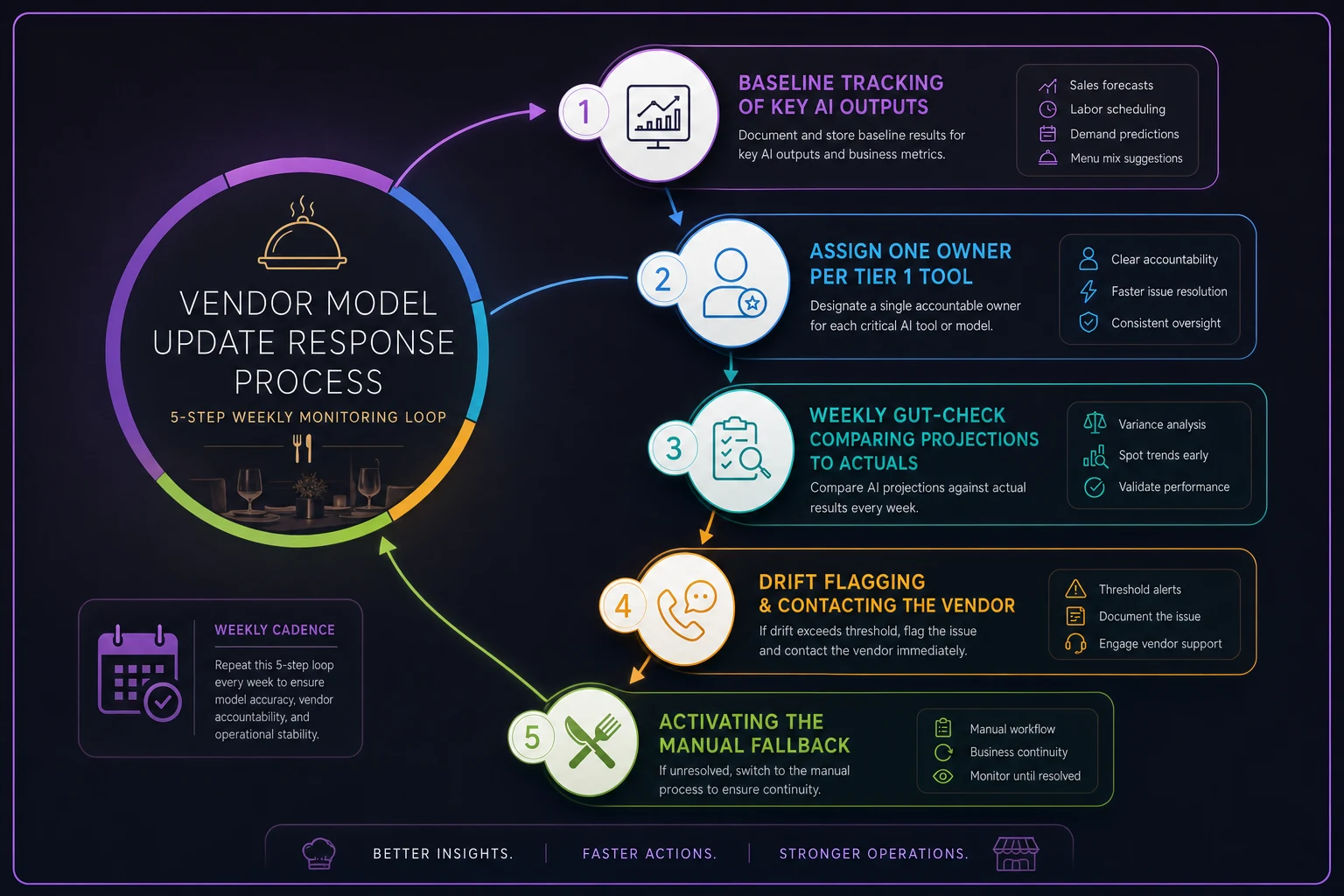
Use this 5-step weekly loop as a lightweight monitoring process you can run without adding real overhead.
-
Baseline your key AI outputs. For your forecasting tool, write down what a normal week's projections look like versus actuals. Get a rough sense of its usual accuracy — say it's typically within 8–12% on center-of-plate proteins.
-
Assign one owner per Tier 1 tool. Not a committee. One person who knows what "normal" looks like for that tool.
-
Run a weekly gut-check. Five minutes. Did the forecast track reality this week the way it usually does? Log a yes or no.
-
Flag drift, don't guess at it. If the tool is suddenly off by 20%+ for two weeks running, treat it as a possible model change, not a fluke. Contact the vendor and ask directly: "Did anything change in the model behind this feature recently?"
-
Keep the manual fallback warm. For anything Tier 1, your team should be able to run the old manual method for a week without drama. If they can't, you're too dependent.
The point isn't paranoia. A five-minute weekly check catches a problem that costs a few thousand dollars a month before it turns into a quarter of losses.
A real scenario
A mid-size neighborhood Italian spot — roughly 90 seats, doing around $2.1M a year — had leaned into an AI-driven ordering tool for produce and proteins. For about eight months it ran clean, cutting weekly waste noticeably and freeing their kitchen manager from a lot of spreadsheet time.
Then the vendor pushed a backend update. Nobody announced it; there was no visible feature change. Over about three weeks the tool started under-forecasting weekend demand. The kitchen manager, trusting something that had been solid, kept ordering to its numbers. They 86'd two popular pasta dishes on consecutive Saturdays and burned goodwill with regulars.
Once they traced it back, the fix was simple — the vendor confirmed a model change and they recalibrated. But the lesson stuck: they built a weekly 10-minute check comparing the tool's projection against the prior week's actuals, and named the kitchen manager as the owner. Since then, when the tool drifts, they catch it in days instead of weeks. Their estimated cost of that three-week blind spot was somewhere in the $3k–$5k range between waste and lost sales. The check that prevents a repeat costs about 40 minutes a month.
When to lean in, and when to hold off
When leaning into AI features makes sense: you have clean, consistent operational data, a clear owner who understands the tool, and a manual fallback that still works. In that setup, these tools genuinely reduce labor and operational mistakes.
When it's a bad idea: your underlying data is messy, nobody truly owns the tool, or the feature makes decisions your team can no longer make manually. Adding AI on top of chaos just automates the chaos faster.
Who should hold off entirely: if you're a single location still fighting basic data hygiene, fix that first. An AI feature is only as good as what you feed it, and no amount of model testing upstream fixes garbage inputs on your end.
If you're weighing whether to adopt forecasting AI at all, a phased pilot beats a full rollout — especially when the vendor's underlying models are in flux. We walked through that approach in detail in our phased pilot roadmap for AI forecasting.
The takeaway for operators
The federal testing framework isn't something you need to comply with. It's a signal. The AI layer your software depends on is becoming more regulated, more scrutinized, and — for a while at least — more prone to change underneath you.
Restaurants that treat AI vendors like any other critical supplier will be fine. Vet them the way you'd vet a new produce distributor. Know what powers the feature, know what happens to your data, know how you'd run without it, and check the outputs regularly. The operators who get burned over the next year won't be the ones using AI — they'll be the ones who forgot they were depending on something they couldn't see and couldn't control.
The federal testing framework isn't something you need to comply with. It's a signal. The AI layer your software depends on is becoming more regulated, more scrutinized, and — for a while at least — more prone to change underneath you.
Restaurants that treat AI vendors like any other critical supplier will be fine. Vet them the way you'd vet a new produce distributor. Know what powers the feature, know what happens to your data, know how you'd run without it, and check the outputs regularly. The operators who get burned over the next year won't be the ones using AI — they'll be the ones who forgot they were depending on something they couldn't see and couldn't control.
Ready to elevate your restaurant operations?
Join 2,000+ restaurants using Dineoly to enhance efficiency, increase table turnover, and delight diners.