

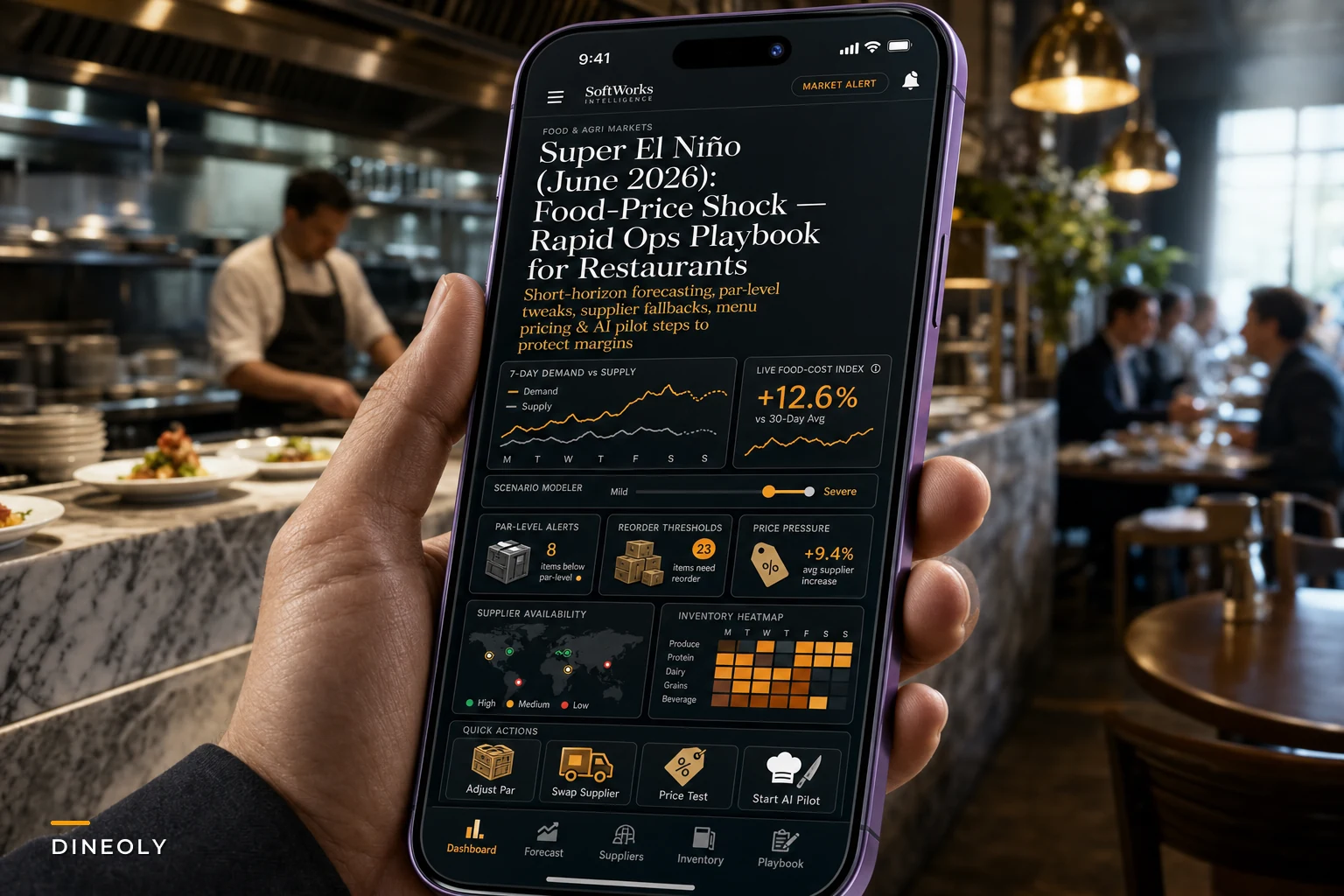

Three weeks ago, I watched a restaurant owner in Phoenix stare at his lettuce invoice like it was written in another language. Romaine hearts up 47% in two weeks. His reaction was pretty typical — blame the distributor, call around for quotes, hope it blows over.
But it won't blow over. Not this time.
Reuters reported this week that climate models are signaling what they're calling a "Super" El Niño pattern, with drought conditions hitting California's Central Valley while floods threaten Midwest grain production. The last comparable event in 2015-2016 drove commodity prices up 30-60% across multiple categories. This one's tracking stronger.
For restaurants, this isn't just about paying more for tomatoes. Your entire operational framework gets stress-tested at once — purchasing protocols that assume stable pricing, par levels built on predictable lead times, menu engineering that takes months to execute, and margin calculations that become fiction overnight.
The restaurants that survived the 2015 price shock weren't the ones with the deepest pockets. They were the ones that moved fastest to restructure their operations. Most of them did it wrong at first, then figured it out through expensive trial and error.
The cascade effect nobody talks about
Your prep cook notices you're out of red peppers on Tuesday morning. The usual backup supplier is also out. Your chef pivots to yellow peppers at 1.8x the cost. Your food runner doesn't know about the substitution and tells three tables the wrong information. A regular customer complains their favorite dish tastes different. Your Yelp review average drops 0.2 stars over the next month.
That's from one vegetable shortage.
Multiply that across 15-20 ingredients experiencing simultaneous volatility, and you start to understand why El Niño-driven food price shocks cause restaurant failures to spike 22% in affected regions. It's death by a thousand operational cuts.
The textbook response — raise prices to maintain margins — usually backfires. A family-owned Mexican restaurant I worked with in 2015 raised entrée prices 18% to offset corn and avocado costs. They lost 35% of their regular customers within six weeks. By the time they reversed course with promotions, their reputation as "the expensive place" had already solidified. They closed four months later.
Meanwhile, their competitor down the street completely restructured their menu around price-stable proteins and root vegetables, communicated transparently with customers about temporary changes, and actually gained market share during the crisis.
Forecasting breaks first (and why that's actually useful)
Your AI forecasting systems are about to start throwing errors. Good. That's your early warning system.
Eliminate operational bottlenecks effortlessly.
Dineoly helps you manage every reservation, order, and staff shift seamlessly.
- Unified reservation and order management
- Real-time staff scheduling
- Inventory and sales tracking
No credit card required
Traditional restaurant forecasting assumes relatively stable input costs with predictable seasonal variations. When romaine lettuce jumps from $28 to $65 per case in ten days, your algorithms flag it as an anomaly and either ignore it or overcorrect. Most restaurants then make the mistake of overriding the system manually, which creates chaos downstream.
Instead, treat forecasting failures as operational triggers. When your system flags three or more ingredients with >20% weekly price variance, that should automatically initiate your crisis purchasing protocols. Not emergency mode — crisis mode.
Emergency mode is reactive: calling suppliers, negotiating spot prices, making substitutions on the fly. Crisis mode is systematic: pre-negotiated alternate suppliers activate, menu engineering shifts to B-list recipes, staff receives specific substitution scripts, and purchasing authority temporarily centralizes.
A steakhouse group in Dallas built this framework after getting burned in 2011. When beef prices spiked 40% in 2014, their crisis protocols kicked in within 48 hours. They shifted purchasing from prime to choice cuts on specific items, activated preset menu inserts explaining the changes, and gave servers talking points about "featuring exceptional choice cuts selected for optimal flavor." Sales dipped 3% for two weeks, then fully recovered. Their margin only compressed by 140 basis points versus the 400+ they watched their competitors lose.
The three-wave purchasing strategy
Forget everything you know about just-in-time inventory during price shocks. That's peacetime thinking.
Wave one: Lock in stability (Weeks 1-2)
The moment you see sustained 15%+ price volatility across multiple categories, your goal shifts from optimization to stabilization. Identify your five most price-stable ingredients that can anchor dishes across your menu. Lock in 6-8 week contracts even if they're slightly above market. You're buying predictability, not getting the best price.
A Korean BBQ restaurant in LA executed this perfectly in 2022. While everyone else was chasing daily produce deals, they locked in pricing on pork shoulder, chicken thighs, tofu, rice, and cabbage. These became their operational foundation while everything else fluctuated.
Wave two: Create flexibility (Weeks 3-6)
Build what I call "swing dishes" — menu items that can accommodate 3-4 different protein or vegetable combinations without changing the fundamental preparation. Think grain bowls where the base stays constant but toppings rotate, or pasta dishes where the sauce remains but proteins swap based on availability.
This isn't about lowering quality. It's about designing optionality into your operations. Train your kitchen on these variations before you need them. Print modular menu inserts that can be swapped daily. Brief your servers on selling the flexibility as "market-fresh selections."
Lock shorter-term contracts early to buy predictability rather than chasing daily spot prices.
Wave three: Systematic substitution (Week 7+)
By now you have enough data to build substitution matrices. Not generic ones — specific to your operational reality. If roma tomatoes exceed $32/case, you automatically shift to canned San Marzanos for sauce but keep fresh for salads. If chicken breast hits $4.20/lb, dark meat becomes your default with upcharge options for white meat.
The key is making these substitutions systematic, not situational. Your prep team should have laminated charts. Your purchasing manager should have preset reorder triggers. Your expeditor should have plating modifications mapped out. Every decision should be pre-made, just waiting for price triggers.
Menu engineering at combat speed
Traditional menu engineering takes 2-3 months. During price volatility, you have 2-3 weeks max before margins evaporate.
Start with your dogs — low margin, low popularity items. These should disappear immediately, but don't just remove them. Replace them with simplified versions using your price-stable ingredients. That underperforming lamb shank becomes a braised pork shoulder. Same position on the menu, similar price point, 400 basis points better margin.
Next, create what I call "margin defenders" — dishes specifically designed to protect profitability during volatility. They share common ingredients, require minimal skilled labor, and can absorb price increases without obvious quality changes. A pizza place in Chicago developed three margin defenders during the 2015 shock: a white sauce pizza (no tomato price risk), a breakfast pizza (egg prices remained stable), and a dessert pizza (flour and sugar had locked contracts). These three items carried them through six months of chaos.
The psychological component matters too. Customers accept "market price" on seafood and steaks. They revolt when burger prices fluctuate weekly. Know your perception boundaries.
A gastropub found they could vary their craft burger price by $3 without complaints if they also varied the included sides and positioned it as "chef's selection." The same $3 increase on their regular menu caused customer defections.
Information architecture for crisis operations
Most restaurant communication systems break down exactly when you need them most. During price volatility, information velocity determines survival.
Build three distinct communication channels:
Supplier intelligence network
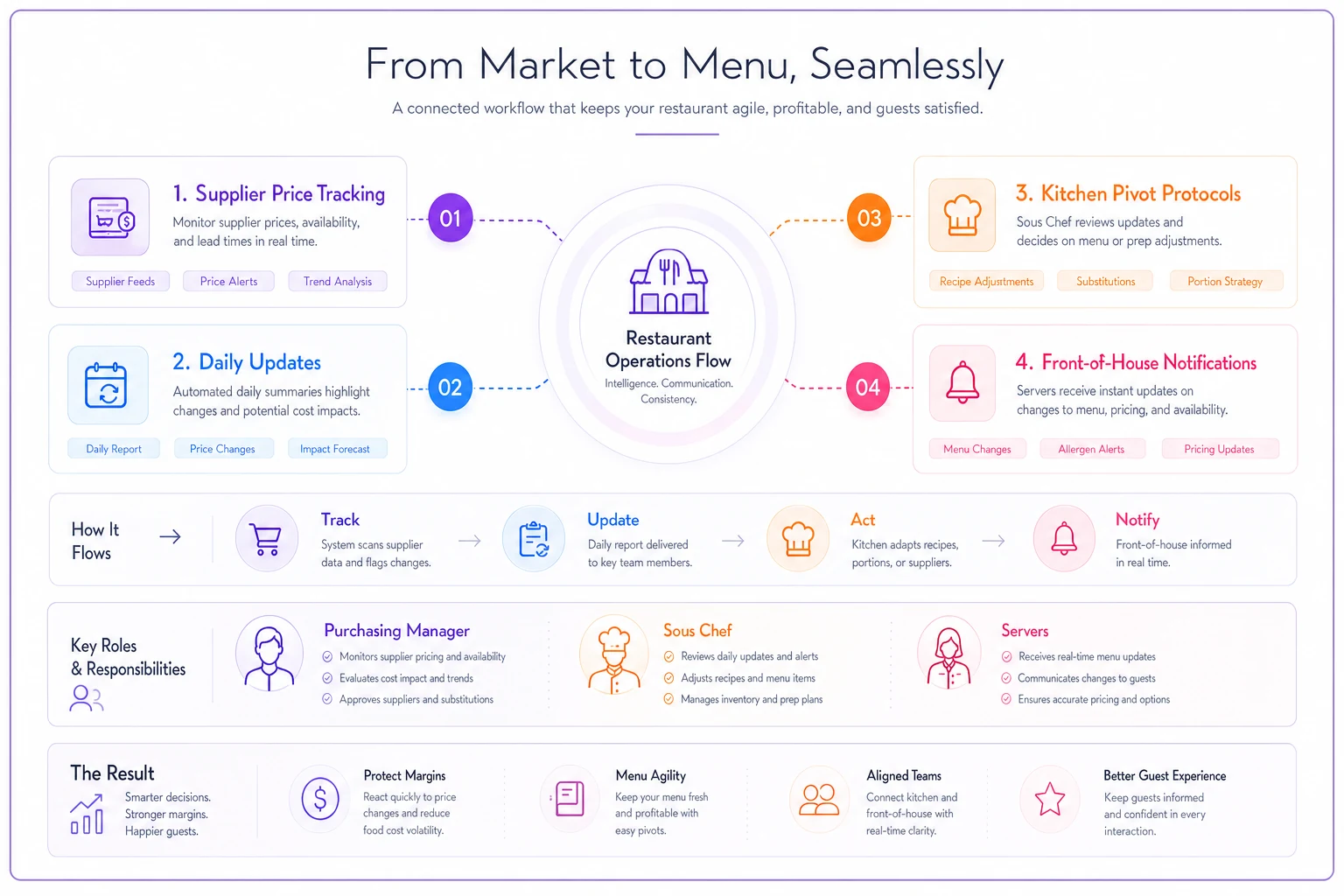
Create a shared spreadsheet that pulls pricing from your top 5 suppliers daily. Not weekly — daily. Include substitution options and quality notes. Give your sous chef and purchasing manager edit access. Everyone else gets read-only. Update triggers should generate notifications, not emails.
One restaurant group built this in Google Sheets with basic scripts. It took four hours to set up and saved them approximately $31,000 during a six-week produce shortage by identifying price disparities between suppliers they wouldn't have caught otherwise.
Here's a simple workflow diagram tying supplier alerts to kitchen and front-of-house actions.
Kitchen pivot protocols
Your prep team needs to know about substitutions before they start chopping. Your line cooks need to know before service. Your servers need to know before they greet tables.
-
7 AM
Purchasing manager updates the substitution board
-
7
30 AM: Sous chef adjusts prep lists and posts photos of any visual changes
-
2
30 PM: Front-of-house manager briefs servers using the actual dishes
-
4
00 PM: Final confirmation of 86'd items and substitutions
-
5
00 PM: Service begins with everyone aligned
Customer transparency tools
Stop hiding price changes and substitutions. Customers aren't stupid. They know food costs are rising. What irritates them is feeling deceived.
Design menu inserts that can be printed daily. Not apologetic — informative. "Today's market selections feature locally available ingredients chosen for peak quality and value." Train servers to discuss substitutions as features, not compromises. "The chef is featuring grass-fed beef tips today instead of tenderloin — it's actually got more flavor and pairs better with our chimichurri."
The staffing paradox
Price volatility actually increases labor needs temporarily, even as margins compress. Most people don't expect this.
You need experienced cooks who can handle substitutions without constant supervision. You need additional prep time for unfamiliar ingredients. You need servers who can sell changes confidently. You need managers who can make rapid purchasing decisions.
Most restaurants do the opposite — they cut labor to offset food costs. This accelerates the death spiral. Quality drops, service suffers, customers leave, revenue falls, margins compress further.
| Role | Purpose | Duration | Weekly Cost | ROI |
|---|---|---|---|---|
| Purchasing coordinator | Vendor management & price tracking | 12-16 weeks | $800-1,200 | ~$3,400 savings |
| Additional prep cook | Handle unfamiliar ingredients | 8-10 weeks | $600-900 | Reduces remakes 65% |
| Chef coverage overlap | Ensure consistency during changes | 6-8 weeks | $1,000-1,400 | Maintains quality standards |
| Dedicated expeditor | Catch substitution errors | 10-12 weeks | $500-700 | Eliminates 80% of mistakes |
A family restaurant in Austin tried cutting labor during the 2020 supply chain crisis. They lost $47,000 in three months from complaints, remakes, and customer defection. When they reversed course and added strategic positions, their labor cost increased $8,000 monthly but their revenue recovered by $34,000.
Technology integration without disruption
This is not the time for massive system overhauls, but small technology additions can multiply your response capacity.
Start with pricing intelligence. Tools like supplier price tracking APIs can monitor fluctuations across multiple vendors without manual checking. Set variance alerts at 15% weekly change. Integration takes about two days and costs less than $400/month for most restaurant-scale operations.
Inventory management systems become critical when you're juggling substitutions. But don't switch systems mid-crisis. Instead, add basic automation to whatever you're using now. If you're on spreadsheets, add scripts for automatic reorder points. If you have restaurant management software, turn on every alert and report you've been ignoring.
The real multiplicative effect comes from connecting these systems to your operational response. When the pricing tracker flags volatility, it should automatically trigger your crisis purchasing protocols. When inventory hits new reorder points, it should generate substitution recommendations. When substitutions are confirmed, they should push to your POS system for server visibility.
None of this requires complex automation initially. Basic integrations and rule-based triggers handle 80% of what you need. You can layer in predictive systems once you've stabilized.
Margin protection beyond menu prices
The obvious response to cost increases — raising menu prices — is usually wrong. Or at least incomplete.
-
Portion control becomes critical (2-3% margin improvement available)
-
Prep waste reduction (1-2% improvement)
-
Cross-utilization increases (3-4% improvement)
-
Service timing optimization (2-3% labor efficiency)
A concrete example: A Mediterranean restaurant facing 40% produce cost increases couldn't raise prices in their competitive market. Instead, they:
-
Standardized protein portions using pre-portioned bags (saved 2.3%)
-
Created stocks from vegetable trim that previously went to waste (saved 1.8%)
-
Designed "family meal" staff dishes from ingredients approaching expiry (saved 2.1%)
-
Reduced table turns from 95 to 85 minutes through better pacing (saved 2.7% on labor)
Combined impact: 8.9% margin improvement without touching menu prices.
Early warning systems
The restaurants that navigate price shocks successfully don't react to them — they anticipate them.
Commodity futures monitoring You don't need to become a trading expert, but understanding basics helps. When corn futures spike, your tortilla costs follow in 6-8 weeks. When diesel prices rise, your delivery fees increase within 2-3 weeks. Set up Google alerts for your top 10 ingredients + "futures" or "commodity prices."
Supplier relationship mapping Know your suppliers' suppliers. If your produce vendor sources from California's Central Valley and drought conditions emerge, you have 2-4 weeks before impacts hit your invoices. Ask your suppliers for their sourcing geography. Map it against weather patterns and trade routes.
Regional restaurant performance Watch what's happening to restaurants in regions hit first. If Phoenix restaurants start menu changes or closures, similar impacts will hit Las Vegas in 2-3 weeks, then Southern California. Join restaurant owner forums and Facebook groups for early intelligence.
According to recent service sector reports, input cost pressures are already building across multiple industries. The food service sector is typically hit hardest and fastest when commodity disruptions begin cascading through supply chains.
The recovery phase everyone forgets
Price shocks end. Eventually. The restaurants still operating when normalcy returns often capture significant market share from those that didn't survive.
But recovery requires different protocols than crisis. You need to gradually restore original menu items (customer memory is roughly 90 days), renegotiate supplier contracts from a position of stability, document what worked and what didn't for next time, rebuild margins systematically not suddenly, and retain the operational improvements you developed.
A BBQ restaurant in Texas emerged from the 2014 beef crisis with 20% higher sales than before. They kept their crisis-mode efficiency improvements, maintained the supplier relationships they'd built during shortage, and captured customers from two competitors who'd closed. Their margin was actually 200 basis points better than pre-crisis.
Making the decision cascade work
The difference between restaurants that survive price shocks and those that fail isn't resources — it's decision velocity.
Create clear escalation triggers:
-
<10% ingredient price increase
Purchasing manager handles independently
-
10-20% increase
Requires chef consultation for substitutions
-
20-30% increase
Triggers menu engineering review
-
>30% increase
Initiates crisis protocols with owner involvement
Each level should have pre-documented responses. Not guidelines — specific actions. When chicken breast hits $4.40/lb, you automatically shift to thighs for sandwiches but maintain breast for entrées. When it hits $4.80/lb, all chicken dishes move to dark meat with upcharge options.
This isn't theoretical. Two identical franchise locations handled the same shortage differently. Location A required owner approval for every substitution. They hemorrhaged $12,000 in two months from decision delays. Location B had clear delegation with triggers. They lost $3,000 and maintained customer satisfaction scores within 5% of normal.
El Niño food price shocks aren't weather events — they're operational tests. The restaurants that pass don't have better predictions or deeper pockets. They have faster response cycles and clearer decision frameworks.
Your forecasting will break. Your suppliers will fail you. Your margins will compress. Your customers will complain. These are constants, not variables.
The variable is how quickly you restructure operations around new realities. Most restaurants need 6-8 weeks to fully adapt. You can't afford that timeline. Build your crisis protocols now, while you have clarity. Test them with small price fluctuations before the big waves hit.
Because when romaine lettuce hits $70 a case and your chef is standing in the walk-in at 6 AM trying to figure out today's special, it's already too late. The restaurants that survive will be the ones who turned operational flexibility into muscle memory before they needed it.
The Super El Niño pattern is weeks away from impacting supply chains. Your competition is hoping it won't be that bad. Hope isn't an operational strategy.
Speed is.
Ready to elevate your restaurant operations?
Join 2,000+ restaurants using Dineoly to enhance efficiency, increase table turnover, and delight diners.