

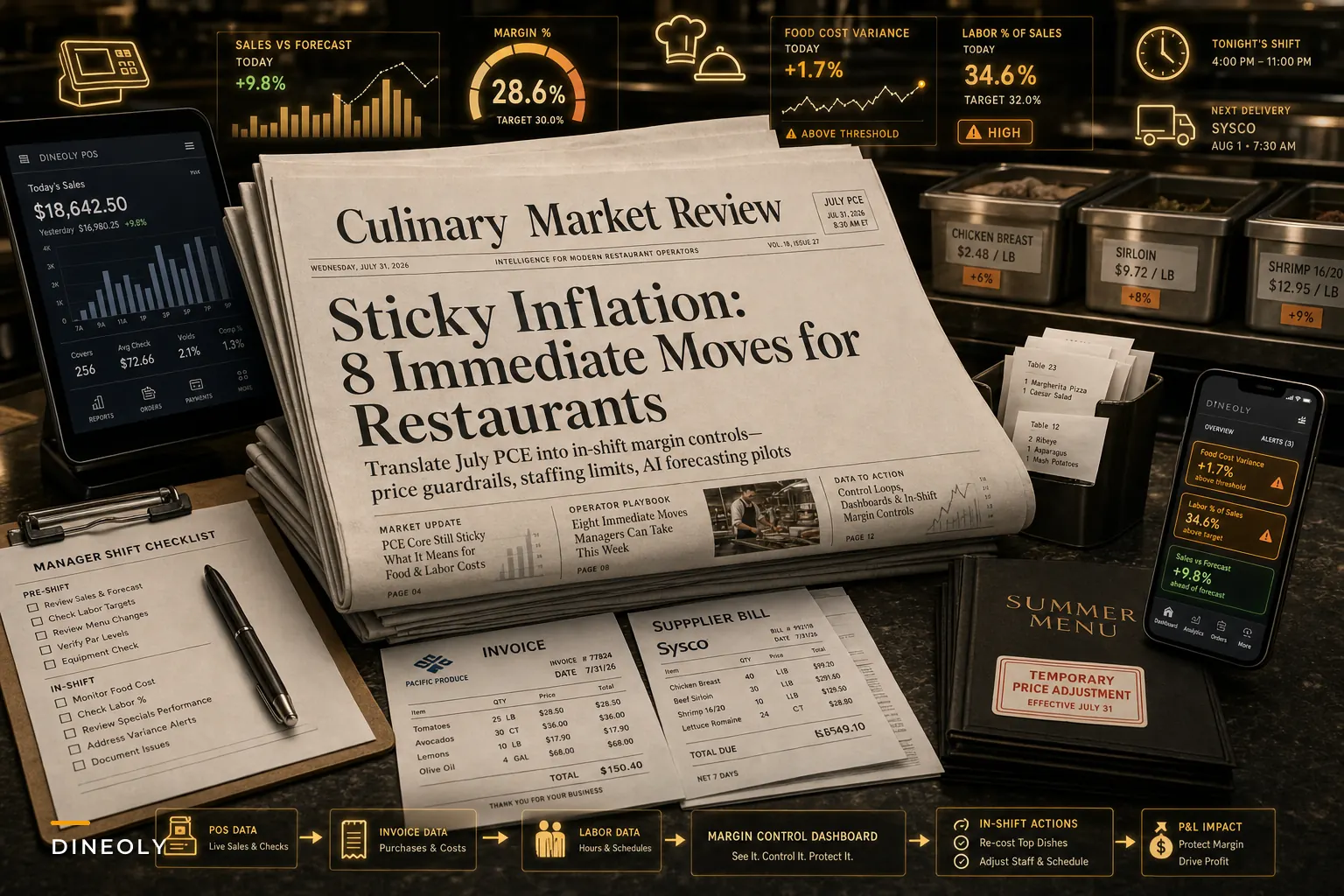

The July PCE numbers landed on August 26 and they weren't the relief anyone in food service was hoping for. Core PCE — the Fed's preferred inflation gauge — came in around 3.3% annually, with headline running elevated too. CNBC reported that prices are stickier than most forecasts expected, and Reuters noted that the GDP outlook stayed unrevised alongside it — meaning cost pressure without any corresponding boost in consumer confidence.
For most industries that's an abstract data point. For restaurants it's a direct hit on two of your three biggest line items. When inflation stays warm like this, it doesn't show up as one dramatic price jump. It shows up as your produce invoice creeping 4% one week, your protein supplier quietly adding a "temporary surcharge," and your best line cook asking for a raise because their rent went up. Individually, none of these are alarming. Stacked over eight weeks, they quietly eat your entire net margin.
This isn't a piece about macroeconomics. It's a set of moves you can actually execute before your next food order goes out.
First, understand what "sticky" actually changes for you
There's a meaningful difference between a price spike and sticky inflation, and it changes how you should respond.
A spike is temporary — you eat the cost for a few weeks, maybe trim the menu, and wait it out. Sticky inflation means the elevated cost becomes your new baseline. There's no "after" to wait for. If you're still running the menu prices and portion specs you set eight months ago, you're operating on a cost structure that no longer exists.
The mistake that keeps showing up: owners treat every cost increase as temporary and keep absorbing it, assuming next month normalizes. Then they look at a quarterly P&L and can't figure out why food cost drifted from 29% to 33% without a single obviously bad month. It wasn't one month. It was the drip.
The move here is a mindset shift before any tactic: assume these costs are permanent until proven otherwise, and reprice against the new baseline. Everything below flows from that.
Move 1: Re-cost your top 15 sellers against current invoices — not last quarter's
Most kitchens cost a plate once, when it goes on the menu, and never revisit it. In a stable market that's fine. Right now it's the fastest way to bleed.
Eliminate operational bottlenecks effortlessly.
Dineoly helps you manage every reservation, order, and staff shift seamlessly.
- Unified reservation and order management
- Real-time staff scheduling
- Inventory and sales tracking
No credit card required
Pull your actual invoices from the last three weeks. Not the theoretical costs sitting in your POS — the real numbers you paid. Re-cost your 15 highest-volume dishes using those figures. You'll usually find two or three plates where margin has quietly collapsed while the menu price stayed frozen.
A typical example: a pasta dish costed at $4.10 when it launched, now landing at $5.60 because of cheese, olive oil, and a protein bump. Same $18 menu price. That's roughly 8 points of margin gone on one of your best-moving items. Multiply by covers and it's real money.
You don't need to re-cost the whole menu. Focus on volume. The dishes you sell 200 times a week are where a $1 cost swing matters most.
Move 2: Tighten your supplier cadence and build a "compare" habit
When prices are stable, ordering from your primary vendor on autopilot is efficient. When prices are moving weekly, autopilot means you never notice you're overpaying.
For your top-cost categories — proteins, dairy, oils — get a second quote every single week, not every quarter. It takes maybe 20 minutes. What you're really doing is keeping your primary vendor honest. Suppliers know which accounts check prices and which ones don't, and the ones that don't check tend to see surcharges appear first.
A simple weekly cadence that works without adding hours to your week:
| Category | Order frequency | Price check | Action trigger |
|---|---|---|---|
| Proteins | 2–3x weekly | Weekly, 2 vendors | Switch/negotiate if >5% gap |
| Dairy & oils | Weekly | Weekly | Flag for menu review if trending up 3 wks |
| Produce | 3x weekly | Spot-check high-use items | Sub or 86 if cost spikes hard |
| Dry goods | Weekly/biweekly | Monthly | Buy ahead if stable pricing available |
Pro-tip: Save weekly quotes in a shared sheet so you can spot larger-than-normal gaps quickly.
The trigger column matters more than the check itself. A price you notice but don't act on is just anxiety.
Move 3: Reprice with psychology, not panic
The instinct when costs rise is to bump every price by a dollar. Guests notice across-the-board increases immediately, especially now — the BEA data showed spending holding but not accelerating, which means diners are more value-sensitive than they were a year ago.
-
Raise on high-margin-lost dishes (the ones from Move 1) — often $1–$2 goes unnoticed on a well-loved specialty
-
Hold your most-ordered "signature" dish even if margin is tight — it's your value signal
-
Adjust in odd increments ($17 → $18.50, not $17 → $19) so the jump reads smaller
-
Bundle where you can — a fixed-price pairing hides individual price movement and lifts check average
The goal isn't to squeeze every plate. It's to protect overall margin while keeping the guest's perception of value intact. One repriced appetizer can quietly recover what three menu-wide increases would cost you in goodwill.
Move 4: Attack portion drift before you attack portion size
There's a difference between reducing portions and controlling them. Reducing portions is a decision guests can feel. Controlling drift is invisible — it just recovers money you were already losing.
Portion drift happens when line cooks plate "generously" during a rush. A protein spec that says 6 oz becomes 7 when someone's slammed and eyeballing it. On a busy night across 150 plates, that extra ounce of a $12/lb protein is real cost walking out the door — often several hundred dollars a week nobody logged as waste, because it went to guests, not the trash.
Before you cut anything, verify you're actually serving the portion you spec'd. Re-weigh your key proteins during live service for two nights. If your 6 oz is running 6.8, you have margin to recover without touching a single recipe or annoying a single guest.
Only after drift is under control should you consider actual portion changes — and if you do, change the least-noticed components first. Starch and sauce before protein.
Move 5: Move labor from "scheduled" to "demand-matched"
Labor is the other half of the squeeze. With wage pressure staying elevated, you can't out-schedule inflation — but you can stop paying for slack hours.
Most schedules are built to the busiest realistic version of each shift, just in case. That safety margin made sense when labor was cheaper. Now the Tuesday that turns out slow costs you two extra bodies for three hours, and that happens more often than owners want to admit.
Match staffing to actual demand patterns from your own sales data, not to habit. Look at the last eight weeks by daypart:
-
Identify your true slow windows — the 90-minute stretches where sales don't justify full staffing
-
Build a clear "release" plan — a rule for who goes home when covers drop below a threshold
-
Give one manager per shift authority to cut early without a phone call to the owner
-
Cross-utilize instead of over-staffing — one person covering two light stations beats two people standing around
The savings aren't dramatic per shift. They're consistent. Trimming three or four unnecessary labor-hours a day across a week adds up faster than a menu price increase, and guests never feel it.
Move 6: Run a real daily margin loop
The underlying problem sticky inflation exposes is that most restaurants can't see margin erosion until the monthly P&L — and by then it's a month too late to fix anything. When costs were stable, monthly was fine. Now, a month of drift is a month of damage.
The fix is a daily control loop — a short, repeatable check that ties what happened in the shift back to your margin, same day. Food cost variance, labor as a percent of sales, a few key invoice movements. Not a full accounting exercise. Just enough to catch drift while you can still respond.
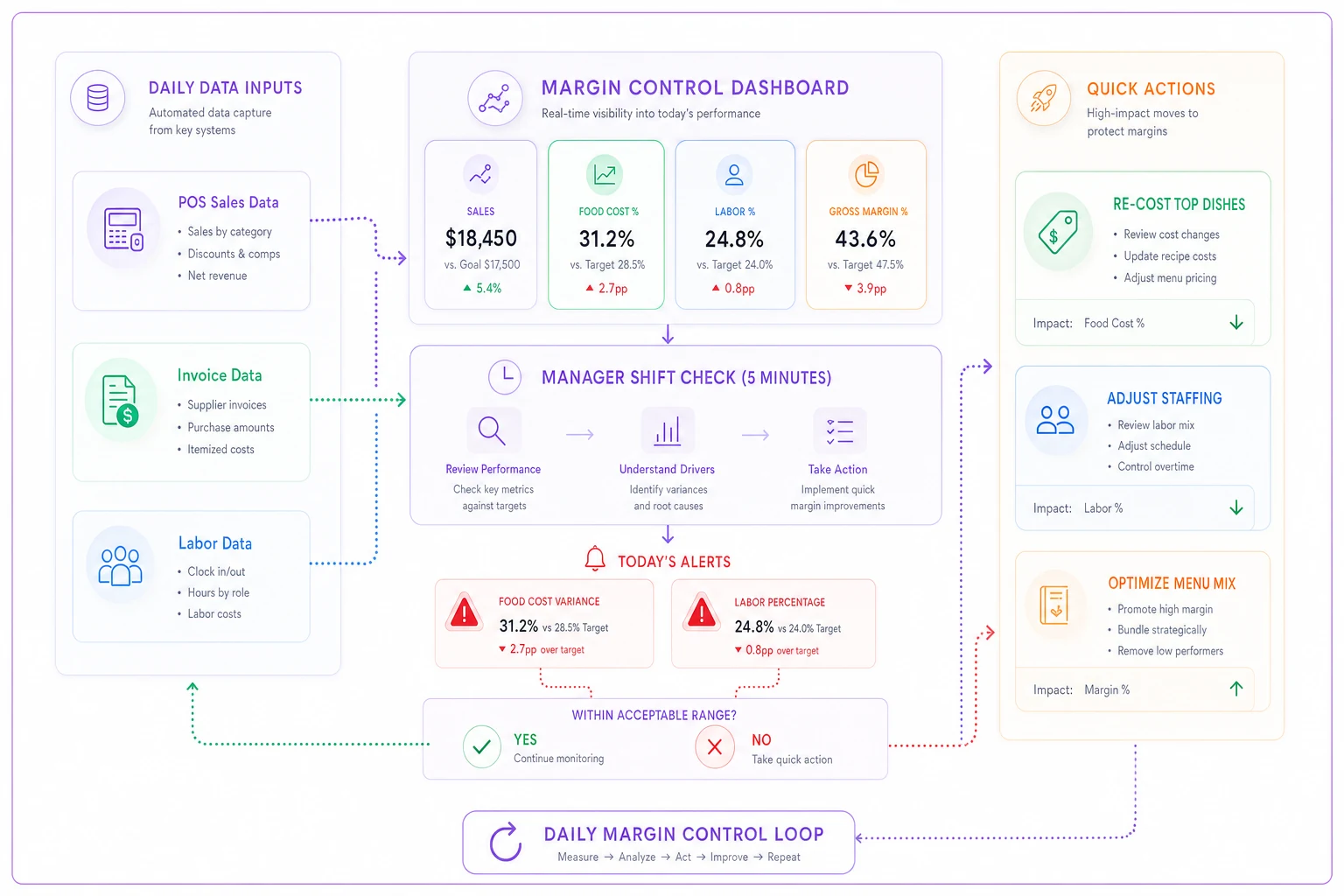
Here's a quick visual of the daily margin loop.
We broke down how to build these in-shift checks in our guide to Operational FinOps and mapping daily control loops to your P&L, and it's worth reading alongside this if you don't already have a daily rhythm. The core idea: the shorter the gap between "cost changed" and "you noticed," the less any single price increase can hurt you. In a sticky-inflation environment, that loop length is basically your margin protection.
This is also where operational software earns its keep. When your POS, invoices, and labor data feed one dashboard, that daily check takes five minutes instead of an hour of spreadsheet reconciliation — and the manager actually does it, because it isn't painful. Automated cost-flagging tools catch invoice creep a human would miss on a busy day. Not because software is magic, but because it removes the friction that makes daily reviews get skipped.
Move 7: Defend your value perception with targeted offers, not blanket discounts
With spending cautious but holding, guests are hunting for value — but blanket discounts train them to only visit on deals and torch your margin faster than inflation does.
-
Regulars a small comp or early access to specials — costs little, retains high-value guests
-
Slow-daypart offers move demand into your dead windows instead of discounting your busy ones
-
Lapsed guests a targeted return offer, not a permanent price cut
-
Never the broad "20% off everything" that erodes the margin you're fighting to protect
A promotion that fills a Tuesday that was going to be slow costs you almost nothing in real margin. A discount on a Saturday that was already going to be packed is pure loss. Know the difference before you print anything.
Move 8: Renegotiate the fixed costs everyone forgets
While everyone's focused on food and labor, fixed costs sit unexamined. Sticky inflation is exactly the moment to revisit them — contracts signed in a lower-cost period may now be worth renegotiating, and vendors expect the conversation.
Linen, waste hauling, POS processing fees, delivery-platform commissions, equipment leases. None of these are glamorous. But a half-point off your card processing rate or a renegotiated hauling contract shows up every single month with zero impact on the guest experience. Pull every recurring vendor contract and ask two questions: is this rate current, and is there a better option? You'll be surprised how many were set and never touched again.
A real scenario
A mid-size neighborhood Italian spot — around 120 seats, doing roughly $2.1M a year — noticed net margin slipping over a couple of months without an obvious cause. Food cost had drifted from about 30% to just under 34%.
They didn't overhaul anything dramatic. They re-costed their top 12 dishes against current invoices, found three where margin had collapsed, and repriced two of them by $1.50 while holding their signature dish flat. They re-weighed proteins during service and found the line was running about an ounce heavy on two dishes. They added a five-minute daily margin check and tightened protein ordering to weekly price comparisons.
Nothing revolutionary. Over roughly six weeks, food cost settled back toward 31% and net margin recovered most of what it had lost. No guest complained about value — most didn't notice anything changed. The recovery came almost entirely from cost drift they'd stopped tracking, not from charging guests more.
When to move fast — and when to hold
Not every restaurant should reprice immediately. If food cost is still holding near target and your daily numbers look clean, aggressive repricing right now can cost you goodwill you don't need to spend.
Move fast if your food cost has drifted 2+ points, you haven't re-costed in six months, or you're absorbing surcharges you haven't passed through anywhere. Hold and monitor if margins are stable and your daily loop is already catching movement early.
The restaurants that get hurt in a sticky-inflation stretch aren't the ones that reprice — they're the ones that don't notice they need to until the quarter closes. Sticky inflation punishes slow feedback loops more than it punishes high costs. Tighten the loop, watch the right numbers daily, and you can protect your margin through this without your guests ever feeling the squeeze.
Ready to elevate your restaurant operations?
Join 2,000+ restaurants using Dineoly to enhance efficiency, increase table turnover, and delight diners.