

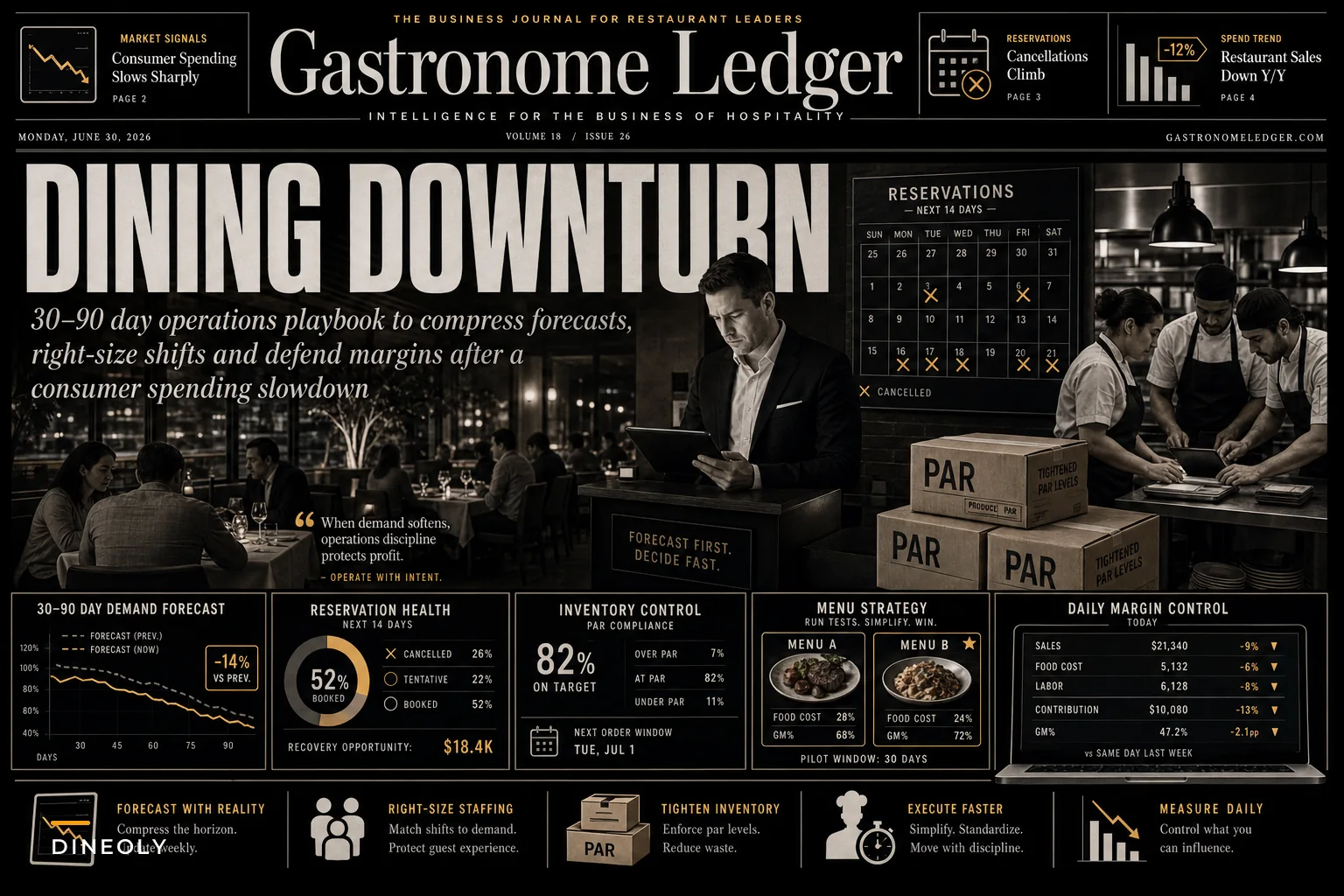

The latest GDP revision from Reuters told a story restaurant operators need to pay attention to: consumer spending growth nearly stalled in the first quarter, even while the economy technically expanded. Stack that against June's fragile consumer confidence numbers and you've got a pretty clear picture of what this summer and fall could look like.
The pattern that kills margins during pullbacks is almost always the same: operators wait too long to adjust. They run February's staffing model in July. They hold winter menu pricing through a summer slowdown. They order inventory based on last year's covers instead of next week's reality.
Restaurants that actually survive these periods don't just cut costs randomly. They recalibrate every operational lever—systematically, within 30 to 90 days. Not panic cuts. Deliberate adjustments that protect both margins and the guest experience.
Days 1-30: Immediate Forecast and Staffing Recalibration
Your first move isn't cutting staff. It's fixing your forecasting horizon.
Most restaurants forecast weekly covers on a 6-8 week rolling average. During a demand shift, that historical data starts working against you. Compress your forecast window to two to three weeks maximum.
Pull your POS data from the last 21 days. Compare average daily covers to the same period last year. If you're down more than 8%, that's your new baseline—not a blip. Adjust all forward projections down immediately.
Now comes the staffing move most operators fumble. They either overreact and run skeleton crews that wreck service, or they under-react and keep full staffing while covers quietly erode. The right approach is graduated compression—reducing hours proportional to cover decline, but weighting cuts toward non-peak periods.
Here's a framework worth building into your scheduling process:
| Cover Drop | Peak Hour Adjustment | Off-Peak Adjustment | Support Role Adjustment |
|---|---|---|---|
| 5-10% | No change | -15% hours | -10% hours |
| 10-15% | -5% hours | -25% hours | -20% hours |
| 15-20% | -10% hours | -35% hours | -30% hours |
| 20%+ | -15% hours | -45% hours | -40% hours |
Cutting equally across all dayparts is the most common mistake operators make. Your Friday dinner rush still needs proper coverage even if overall volume drops 15%. But that Tuesday lunch shift? Compress it hard.
Cross-training stops being optional at this point. Every server needs to handle basic bar tasks. Every host should be able to bus tables. Kitchen prep needs to flex to the line when volume is low. This isn't about pushing people harder—it's about deployment flexibility when you're running leaner.
One 120-seat bistro facing a 22% cover drop created "swing shifts" where experienced staff worked four to six hour blocks that could move between stations based on real-time need. Instead of dedicated roles, they built coverage pools. They ended up running with roughly 30% fewer scheduled hours while keeping service quality intact.
Days 31-60: Inventory and Menu Reconfiguration
Month two is where cashflow protection gets serious. Most restaurants carry five to seven days of inventory. During a slowdown, that needs to compress to three to four days. Anything more and you're tying up cash in product that might spoil before it sells.
Eliminate operational bottlenecks effortlessly.
Dineoly helps you manage every reservation, order, and staff shift seamlessly.
- Unified reservation and order management
- Real-time staff scheduling
- Inventory and sales tracking
No credit card required
Start with proteins. That twice-weekly seafood delivery? Move to once weekly with a smaller mid-week top-up if needed. A standard 40-pound beef order becomes 25 pounds with the option to supplement. The goal isn't to run out—it's to reduce the gap between purchase and plate.
Par levels need a full rebuild, not just a percentage reduction. Take your new baseline covers and start from scratch. Rebuilding pars from current consumption data is different from trimming existing ones by a percentage—the second approach just carries old inefficiencies forward at smaller scale.
Then comes the call most operators avoid: cutting low-velocity menu items. Pull your product mix report. Any dish moving less than 3% of total covers needs to go, regardless of margin. During a slowdown, operational complexity costs more than the occasional lost sale on a specialty item.
A tapas restaurant trying to maintain a 47-item menu through a 25% demand drop illustrates this perfectly. They were buying 31 different proteins, managing complicated prep lists, and throwing out specialty ingredients every week. After cutting to 28 core items, food cost improved by 3 points despite lower volume—purely from waste reduction and simplified purchasing.
Call your primary vendors now. Explain you're moving to smaller, more frequent orders and see who's willing to flex. Some will. The ones that won't should become secondary suppliers going forward.
On pricing: blanket increases during a slowdown drive away exactly the customers you can't afford to lose. Instead, think about margin architecture. Protect margins on high-velocity items. Use lower-margin promotional items strategically to maintain traffic.
Days 61-90: Demand Recovery and Margin Protection Systems
The third month is about actively building demand without unwinding the margin work you've done. Not desperate discounting—traffic generation that keeps check averages intact.
Fixed-price offerings outperform percentage discounts during pullbacks. A $35 three-course prix fixe protects your check average better than 20% off the full menu. Guests feel like they're getting value; you maintain margin control through portion and item selection.
Happy hour becomes a real traffic driver—not a margin drain—if you structure it right. Expanding the window slightly while tightening the menu to five or seven high-margin items tends to work well. One gastropub stretched happy hour from 4-6 PM to 3-6:30 PM with a focused menu of high-margin appetizers and well drinks. Traffic in that daypart went up around 18% and margins actually held.
No-show rates typically climb 20-30% during slowdowns. Tighten your reservation protocols—confirmation texts or calls should go out 24 hours in advance, not 48. If you've never required credit cards for large parties, now is the time. Every empty table during a slow period is unrecoverable margin loss.
-
Yesterday's actual vs. forecasted covers
-
Labor cost per cover (not percentage)
-
Food cost per cover (not percentage)
-
Prime cost per cover
-
Deviation from weekly target
This shifts your management team from weekly P&L reviews to daily operational calibration. During a demand shift, weekly corrections are too slow.
Accelerating Testing and Iteration Cycles
One operational failure mode that doesn't get talked about enough during slowdowns: maintaining normal testing timelines. That new menu rollout planned for September? Accelerate it. Service model changes you've been sitting on? Test them now while lower volume gives you room to iterate without wrecking a packed service.
Test lunch specials for a week, not a month. Try different reservation confirmation approaches for three days, not two weeks. Traditional testing timelines assume stable demand. During a shift, you need to move at roughly three times your normal pace.
A simple tracker makes this manageable:
-
Test name and date range
-
Specific metric being measured
-
Daily results logged
-
Go/no-go decision threshold defined before the test starts
No complex analytics needed—just clear tracking of what actually moves the needle. One family restaurant tested eleven different weekday lunch promotions over six weeks and found a $12.99 soup-salad-sandwich combo outperformed everything else by roughly 35% on cover count while holding margins. That's the kind of insight you can only find by actually running the tests fast.
Here's a simple flow to visualize the 30-90 day recalibration process.
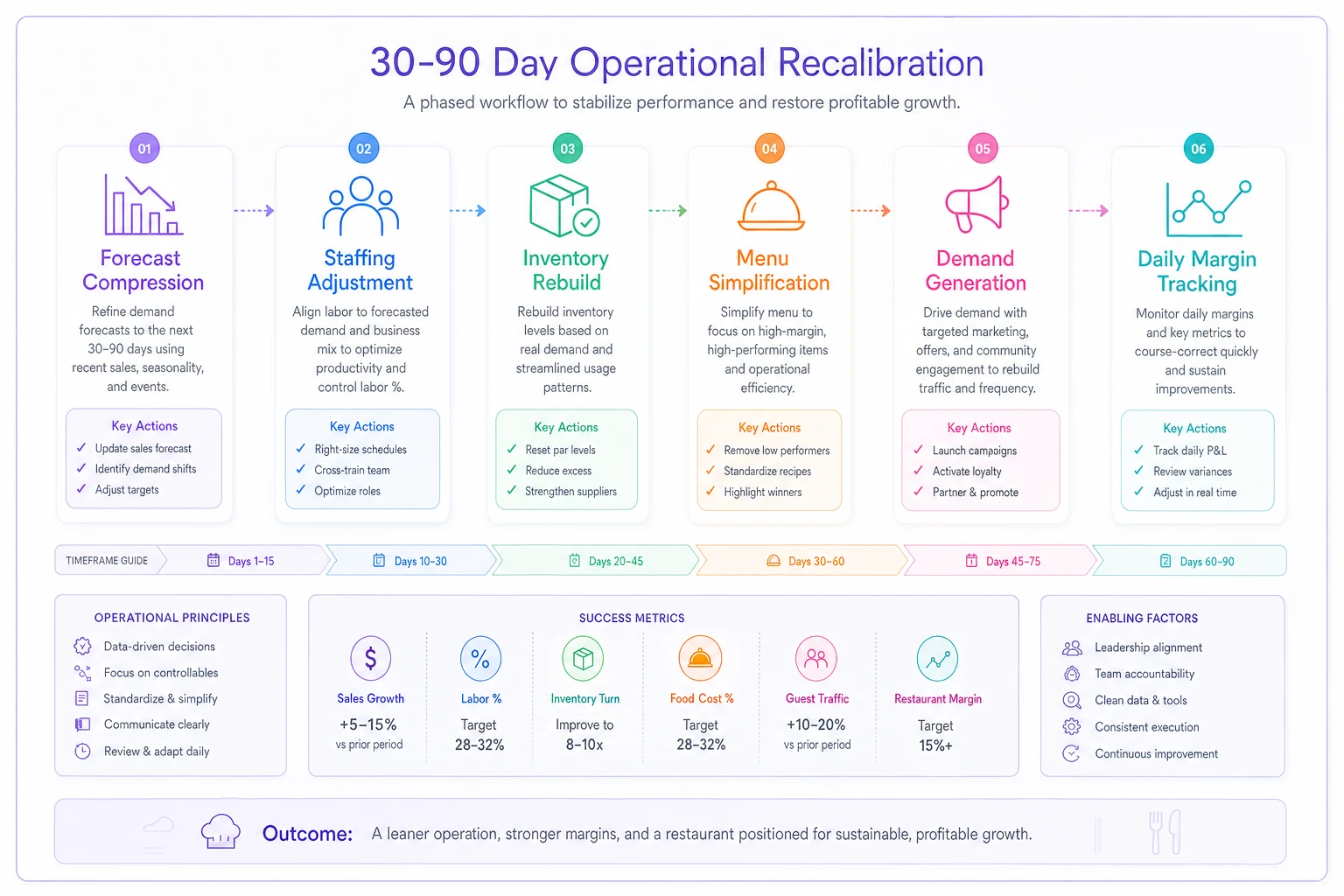
Use this flow as a checklist during implementation.
Technology and Automation Multipliers
The adjustments above require constant monitoring and fast decisions. Restaurants running on spreadsheets and paper checklists tend to crack under that pressure—there's simply too much to track manually while also running service.
Operational platforms with AI-powered forecasting compress what used to take hours of analysis into daily automated recommendations. Instead of managers spending two hours building next week's schedule, the system suggests optimal staffing based on the compressed forecast window. Instead of manually recalculating par levels, the platform adjusts them based on actual recent consumption.
The forecasting accuracy improvements alone justify the investment during volatile periods. We covered the full implementation roadmap for AI forecasting systems in a previous post—but the key point during a slowdown is the ability to retrain models quickly on recent data rather than leaning on historical patterns that no longer reflect what's happening.
One restaurant group had their AI-assisted platform flag a demand shift about 12 days before managers caught it in weekly reports. That early warning let them adjust labor scheduling and inventory orders before absorbing the full margin hit—saving roughly $18k over six weeks. That's not a technology pitch—that's just what happens when you have faster data feedback than your weekly P&L can provide.
The 90-Day Checkpoint
After three months of systematic adjustment, here's what you should expect to see:
-
Labor cost per cover stabilized at or below pre-slowdown levels
-
Inventory turns increased by 20-30%
-
Food waste reduced by at least 25%
-
Daily cashflow improved despite lower revenue
-
Guest satisfaction maintained or improved
That last one surprises operators, but it's genuinely achievable. Leaner, well-trained teams running a tighter menu often deliver more consistent experiences than bloated operations did during busier periods. Fewer items means better execution. Less scheduling chaos means better service.
Restaurants that struggle through consumer spending slowdowns usually aren't the ones with weak concepts. They're the ones that reacted too slowly, or too drastically when they finally did react. Graduated, systematic adjustment beats both paralysis and panic almost every time.
Moving Forward
Slowdowns are operational tests. The restaurants that come out stronger are usually the ones that used the pressure to eliminate inefficiencies they'd been tolerating during good times—compressed forecasting, cross-trained teams, a tighter menu. These changes often produce better operations even after demand recovers.
Start your 30-day forecast and staffing recalibration now. Don't wait for next month's P&L to confirm what daily covers are already telling you. The operators who move fast and systematically through these adjustments protect more than their margins—they protect their ability to capitalize when spending picks back up.
Speed and precision of operational response is what separates restaurants that barely survive slowdowns from the ones that come out on the other side in better shape than when they went in.
Speed and precision of operational response is what separates restaurants that barely survive slowdowns from the ones that come out on the other side in better shape than when they went in.
Ready to elevate your restaurant operations?
Join 2,000+ restaurants using Dineoly to enhance efficiency, increase table turnover, and delight diners.