

Most banquet disasters aren't cooking disasters. They're sequencing disasters. The proteins were fine. The plating was fine. But somewhere between the confirmed headcount and the moment plates needed to hit tables, the math on time and bodies quietly broke — and nobody caught it until the room was full and the salad course was 22 minutes late.
The frustrating part is that banquet work is more predictable than à la carte, not less. You know the headcount. You know the menu. You know the start time. And yet plenty of operations still treat prep and staffing as a gut call made by whoever's running the event that week. That's the gap this piece is about: turning a known event into a backward-scheduled plan with a staffing number you can actually defend.
---
Schedule backward from plate-up, not forward from "when we get in"
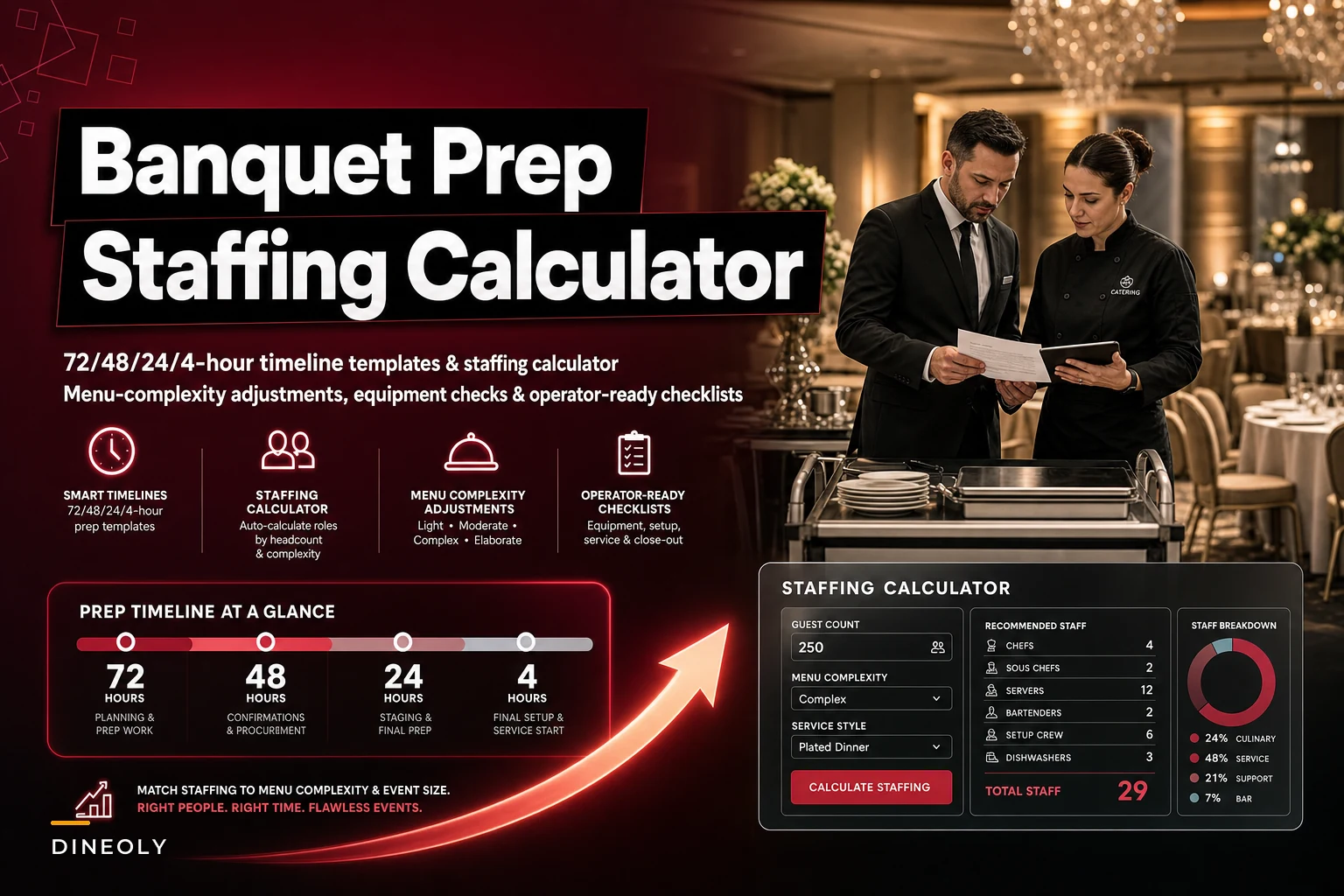
Forward scheduling is the default failure mode. The team arrives in the morning, starts on whatever feels most urgent, and hopes it all converges by service. Backward scheduling flips that. You anchor on the moment food hits the guest, then work in reverse through four checkpoints: 72 hours, 48 hours, 24 hours, and 4 hours out.
Each checkpoint has a different job. The 72 and 48 windows are about procurement and mise decisions you can't reverse later. The 24 and 4 windows are about execution and last-mile coordination. Mixing these up — trying to sort a supplier issue at 24 hours, or leaving mise en place for the 4-hour window — is where most timelines quietly fall apart.
Worth naming a pattern: the events that blow up are almost never the ones that were genuinely hard. They're the ones that looked easy, so the timeline got skipped. A 60-person plated dinner with a familiar menu feels low-risk, so nobody writes the schedule down — and then two cooks call out and there's no reference for who covers what.
The 72-hour template: lock the things that can't be rushed later
Seventy-two hours out is your last honest chance to change the plan without paying a penalty. After this, you're committed.
Eliminate operational bottlenecks effortlessly.
Dineoly helps you manage every reservation, order, and staff shift seamlessly.
- Unified reservation and order management
- Real-time staff scheduling
- Inventory and sales tracking
No credit card required
What has to be done at 72 hours:
-
Final confirmed headcount with a buffer decision made explicitly (are you prepping for 180 confirmed or 190 to cover walk-ups and dietary swaps?)
-
Full ingredient order placed, cross-checked against the plated menu, with substitution rules pre-agreed with the supplier
-
Dietary and allergen count locked — number of vegetarian, vegan, gluten-free, and specific allergy plates, each with a named prep owner
-
Equipment reservation confirmed
convection oven slots, hot-holding cabinets, banquet carts, chafers
-
Staffing draft posted (draft, not final — the final comes at 24)
The most common 72-hour mistake is confirming the headcount but not the dietary breakdown. You find out at 24 hours that 14 of the 180 are gluten-free, and now your entire pastry and sauce plan needs rework with no buffer left. Dietary counts belong at 72, full stop.
The 48-hour template: convert the order into a prep map
Forty-eight hours is where the abstract order becomes a physical plan. Ingredients are arriving or already in-house. Now you assign what gets prepped when so the 24-hour and day-of windows aren't overloaded.
This is also where you make the single most important call in banquet prep: what can be done ahead without quality loss, and what absolutely cannot. Braises, stocks, most sauces, marinades, blanched vegetables — they hold. Anything relying on temperature contrast or crispness at plate-up does not. Getting this wrong is what produces the classic banquet complaint — food that tastes like it was made three days ago, because it was.
48-hour checklist:
-
Receiving check against the 72-hour order; flag shortfalls now while there's still time to source
-
Prep map written
each component tagged as "make-ahead," "day-before," or "day-of only"
-
Portion standards set for the event — grams or count per plate, posted at the station (this ties directly into your portion-control and test-plate workflow, which is worth having settled before a big event rather than improvised during one)
-
Cold storage and labeling plan — a 180-cover event generates a surprising number of labeled containers, and the fridge needs to be planned like you plan the room
-
Staffing draft reviewed against the prep map; adjust if the map implies more labor than the draft covers
The insight most operators miss: the prep map is the labor forecast. If the map shows 40 hours of prep work and you've scheduled two cooks for a six-hour shift, the math doesn't close. You'll find out at hour five.
The 24-hour template: finalize bodies and stage everything
Twenty-four hours out, staffing goes from draft to locked. Everyone knows their station, their arrival time, and their plate-up responsibility. Make-ahead prep should be largely done by now, and day-before items in progress.
24-hour checklist:
-
Final staffing confirmed and communicated per person, with roles — not just "you're working the banquet," but "you're on protein plating, station 3"
-
Make-ahead prep complete and stored; day-before prep underway
-
Plate-up diagram distributed — a literal picture of the finished plate, posted at expo
-
Timeline for service posted
what time each course fires, plates, and clears
-
Equipment tested (hot-holding actually holding, ovens calibrated)
-
Runner and FOH coordination confirmed — this is where your reservations-to-service control loops matter, because banquet timing lives or dies on FOH and kitchen agreeing on when the room is ready to fire
A quiet failure pattern at this stage: staffing gets confirmed as a headcount ("we have six") without assigning roles. Six people with no stations isn't a plan — it's a crowd. Two of them will end up doing the same thing while nobody's on cold apps.
The 4-hour template: the last-mile window
Four hours out is pure execution. No decisions left to make — only setup, final cooking of day-of items, and staging for service.
4-hour checklist:
-
Day-of proteins and hot components cooking on the posted schedule
-
Plating stations staged
garnish prepped, sauce warm, plate-up diagram visible
-
Hot-holding loaded and temped
-
Pre-service line-up with the whole team
fire times, plate counts, dietary plate locations restated
-
Dietary and allergen plates physically separated and clearly marked
If 72/48/24 were done right, this window feels calm. If they weren't, this is where the panic lives — cooks doing prep that should've been finished yesterday while the service clock keeps moving.
The staffing and equipment calculator
Now the part everyone actually wants: how many bodies. A flat ratio — "one server per 20 guests" — is where most operations start and where most problems begin, because it ignores menu complexity and service style entirely. A four-course plated dinner and a stationed buffet at the same headcount are completely different labor problems.
Base staffing by service style (per 100 guests)
| Service style | BOH cooks | Plating/expo | Servers | Runners |
|---|---|---|---|---|
| Buffet / stations | 3–4 | 1 | 3–4 | 1 |
| Family-style | 4 | 1–2 | 4–5 | 1–2 |
| Plated (2 course) | 4–5 | 2 | 5–6 | 2 |
| Plated (3–4 course) | 6–7 | 3 | 7–8 | 3 |
These are starting points per 100 guests. Scale roughly linearly, but don't scale down below a minimum — a 40-person plated dinner still needs two people plating because plate-up is a burst, not a trickle.
Menu complexity multiplier
Rate the menu on three factors, each scored 1 (simple) to 3 (complex):
-
Component count per plate — a protein with two sides is a 1; a plate with a sauce, garnish, starch, protein, and vegetable staged separately is a 3.
-
À-la-minute finishing — fully make-ahead is a 1; anything requiring cook-to-order or last-second assembly is a 3.
-
Dietary variation — one menu for everyone is a 1; four or more parallel dietary versions is a 3.
-
3–4 ×1.0 (base staffing stands)
-
5–6 ×1.15
-
7–9 ×1.3
Worked example: A 180-cover plated 3-course dinner. Base BOH cooks per 100 = 6–7, so roughly 12 for 180. Menu scores: component count 2, à-la-minute finishing 2 (searing proteins toward the end), dietary variation 3 (vegan, GF, and a nut-allergy table). Total = 7, multiplier ×1.3. So 12 × 1.3 ≈ 16 BOH cooks, not 12. That four-cook gap is exactly what separates a clean plate-up from a room waiting 20 minutes on the entrée.
How the checkpoints connect
[72hr: Lock headcount + dietary counts + order] ↓ [48hr: Build prep map + assign components + review staffing draft] ↓ [24hr: Finalize staffing roles + complete make-ahead prep + confirm FOH timing] ↓ [4hr: Execute day-of cooking + stage stations + pre-service lineup] ↓ [Plate-up: Fire by course on posted schedule]
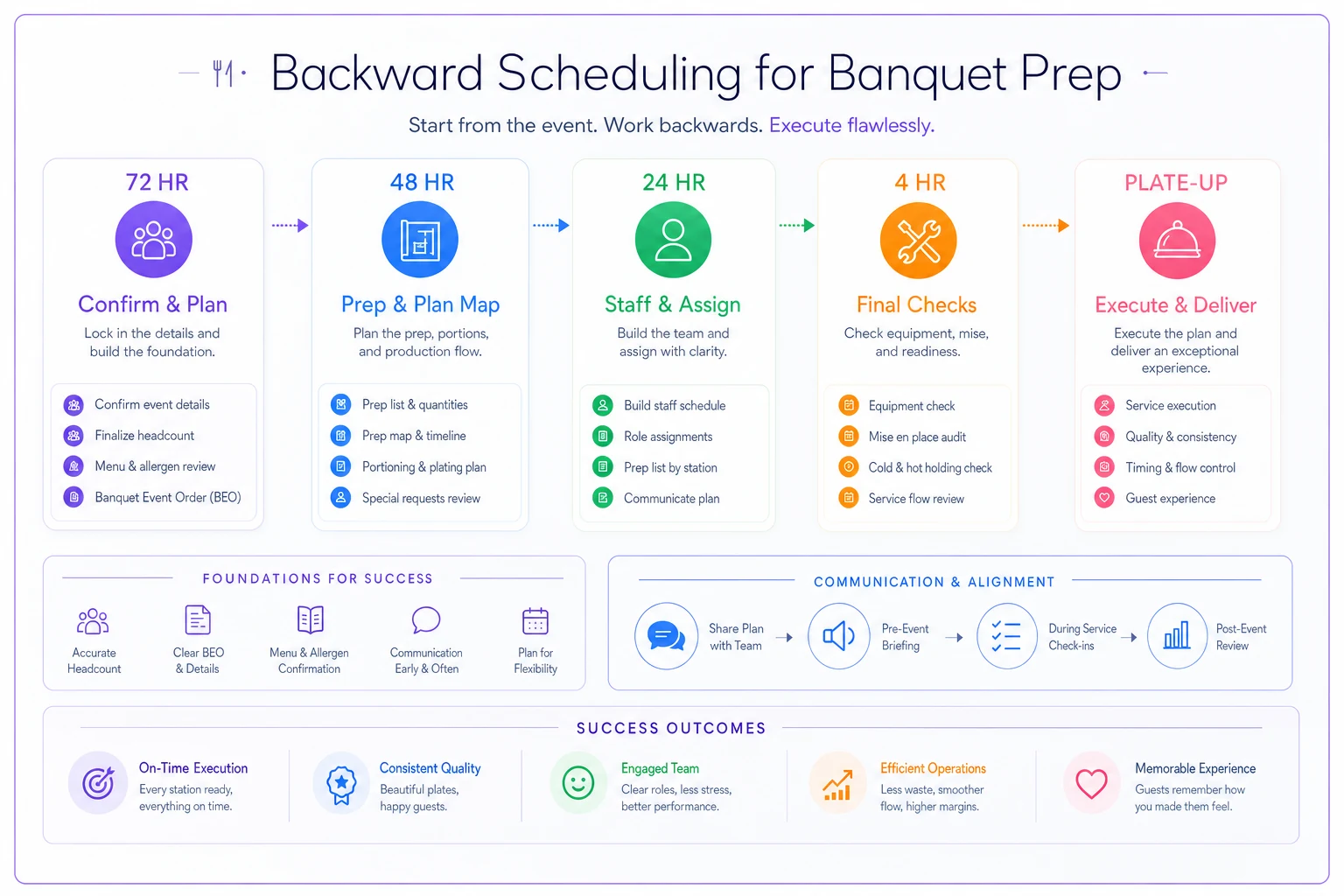
The point isn't that this is complicated — it's that each window has a defined job, and when one gets skipped or compressed, the next one absorbs the damage.
Equipment check formula
Equipment tends to get forgotten until it becomes the bottleneck. For hot-holding specifically: you need enough capacity to hold roughly 60–70% of the room's entrées simultaneously, because plated service fires in waves, not all at once. If your hot-holding tops out at 100 plates and you're serving 180, you're re-heating mid-service, and quality drops off fast.
-
Oven capacity vs. day-of cook volume — does everything that needs finishing fit in the firing window?
-
Hot-holding capacity vs. 60–70% of entrée count
-
Plating surface — enough linear station space for your plating crew to work without stacking up behind each other
-
Transport — carts and covers to move plates without a temperature crash between kitchen and room
Getting this tally done at 48 hours, not the morning of, is what gives you time to actually solve a gap before it becomes a service problem.
When this level of planning actually makes sense
For operations doing a handful of small private parties a year, full 72-hour templates are probably overkill. A single-page prep list works fine for a 30-person set menu you've run a dozen times.
The templates earn their keep when any of these are true: events over roughly 75 covers, plated multi-course service, three or more parallel dietary versions, or a venue running back-to-back events where equipment and staff overlap between functions. That last scenario is the sneaky one — two 100-cover events on the same Saturday can share a kitchen fine, or collide badly, entirely depending on whether the timelines were mapped against each other beforehand.
Who probably doesn't need the full calculator: operations doing pure drop-off catering with no on-site plating, and venues running a single fixed banquet menu they've executed hundreds of times. In those cases the labor is already muscle memory. The calculator matters most when the menu changes event to event, because that's when gut-feel staffing goes sideways.
Platforms built around AI-assisted workflow management can handle a lot of this scaffolding automatically — pulling dietary counts from the booking, flagging when a prep map implies more labor than what's been scheduled, or surfacing equipment conflicts across same-day events. It's not magic, but centralizing that information means fewer things fall through the cracks on a busy weekend.
A real scenario
A mid-size hotel banquet operation — the kind running weddings and corporate dinners most weekends — kept getting the same complaint on plated events over 150 guests: entrées arriving cold or badly delayed. Their staffing was set by a flat one-cook-per-25-covers rule regardless of menu, and prep was mostly scheduled the morning of.
They rebuilt around backward scheduling and the complexity multiplier. Dietary counts moved to the 72-hour lock. The 48-hour prep map revealed they'd been consistently understaffing plated three-course events by three or four cooks — the flat ratio never accounted for the plate-up burst.
The fix wasn't dramatic to look at. Roughly one extra cook and one extra runner on the larger plated events, plus prep pulled forward a full day. But late-entrée complaints on big plated dinners dropped to almost nothing over the following months. And — the part they didn't anticipate — food cost on those events tightened slightly, because a written prep map meant less panic over-ordering and less spoilage from prep done in the wrong window.
The takeaway that actually matters
The banquet staffing calculator isn't really about the multiplier math — it's about forcing the labor number to answer to the menu, not to a habit. A flat ratio treats a simple buffet and a component-heavy plated dinner as the same job. They aren't, and the guests waiting on a cold entrée can tell.
Two things carry most of the weight: lock dietary counts at 72 hours, and let the 48-hour prep map — not last year's gut feel — tell you how many bodies you need. Everything downstream gets easier, and the 4-hour window finally feels like setup instead of survival.
Ready to elevate your restaurant operations?
Join 2,000+ restaurants using Dineoly to enhance efficiency, increase table turnover, and delight diners.