

There's a moment that separates restaurants that survive a guest incident from the ones that spend six months bleeding reputation and legal fees. It's not the incident itself. A guest gets sick, a fight breaks out, a slip near the host stand, an allergic reaction, a data breach on the reservation system—these happen everywhere. The difference is what happens in the first 90 minutes, and whether anyone in the building actually knows the sequence.
Most restaurants don't have one. They have a manager improvising, texting the owner, and hoping the guest calms down. That improvisation is where the real damage gets created—not by the original event, but by the response. A restaurant incident communications legal playbook exists so the person on shift at 9:40 PM on a Saturday isn't inventing your legal strategy and your brand voice simultaneously, under pressure, with someone's phone pointed at them.
This is a systems piece. The goal isn't to hand you scripts you'll never customize. It's to show how communications, legal exposure, guest recovery, and your P&L are actually connected—and why treating them as separate problems is exactly how a $400 comp turns into a $40,000 problem.
Why incidents blow up: the response is the incident now
What breaks in almost every restaurant is timing and authority. When something goes wrong, three clocks start running at once, and they run at different speeds.
The guest clock is fast. An upset guest expects acknowledgment in minutes, not hours. The legal clock is slow but unforgiving—evidence needs to be preserved, statements need to be controlled, and one apologetic sentence from a server ("yeah, that chicken's been sitting out all night") can become the centerpiece of a claim. The regulatory clock depends entirely on severity: a suspected foodborne illness cluster may trigger a health department report within a defined window, while a minor slip doesn't.
The pattern shows up again and again: the manager tries to satisfy the guest clock and accidentally sabotages the legal clock. They admit fault to calm someone down. They let staff talk freely. They throw away the container, wipe down the area, or discard the plate—destroying the exact evidence that would have protected the restaurant. Good intentions, terrible outcome.
What breaks at scale is worse. A single location has one manager who at least knows what happened. A ten-location group has ten managers, each handling incidents differently, none of them documenting consistently, and a corporate office that finds out about a problem when it's already on social media or in a demand letter. Coordination collapses precisely when you need it most.
The severity ladder: match the response to the reality
The core of a working playbook is a severity classification that everyone in the building understands. Without it, you get two failures at once—overreacting to trivial issues (calling the owner about a lukewarm soup) and underreacting to serious ones (treating a possible allergic reaction like a normal complaint).
Eliminate operational bottlenecks effortlessly.
Dineoly helps you manage every reservation, order, and staff shift seamlessly.
- Unified reservation and order management
- Real-time staff scheduling
- Inventory and sales tracking
No credit card required
| Severity | Example Incidents | Who's Notified | Legal Hold? | External Statement | P&L Triage Range |
|---|---|---|---|---|---|
| 1 – Minor | Wrong order, slow service, cold food | Shift manager | No | None | Comp/discount, ~$15–$60 |
| 2 – Moderate | Minor slip (no injury reported), verbal altercation, wrong allergen on plate caught before eaten | GM same day | Preserve notes | None unless escalates | Comp + follow-up, ~$50–$300 |
| 3 – Serious | Guest reports illness, allergic reaction, injury requiring first aid, staff-guest physical conflict | GM + owner immediately | Yes | Holding statement only | ~$300–$5,000+ |
| 4 – Critical | Hospitalization, suspected foodborne cluster, data breach, media/lawyer contact | Owner + legal + insurer, same hour | Yes, formal | Legal-reviewed only | Highly variable, insurance-driven |
The insight most owners miss: severity isn't fixed at the moment of the event. A Level 2 slip becomes a Level 3 the instant the guest mentions a lawyer or shows up limping the next day. Your playbook needs upgrade triggers—specific phrases and facts that automatically bump an incident to the next tier and change who gets called. Train managers to listen for them.
Pre-approved communications templates, organized by severity
Improvised communication is where brand damage lives. The solution isn't scripts memorized word-for-word—guests can smell a canned response—but pre-approved frameworks that give staff the right posture for each severity level.
The principle across all of them: acknowledge and care without admitting fault. There's a real difference between "I'm so sorry this happened, let me take care of you right now" and "I'm sorry, that was our mistake and we messed up." The first shows humanity. The second ends up in a claim file.
-
Level 1–2, in-person guest recovery Warm, immediate, full authority to make it right on the spot. "That's not the experience we want you to have. I'm comping this and I'd love to get you something else—what can I bring you?"
-
Level 3, in-person holding statement Compassionate but controlled. "I'm truly sorry you're not feeling well. Your health matters most right now. We're going to document exactly what happened and I want to make sure you're taken care of—can I get your contact information so our management can follow up personally?"
-
Level 3–4, external written statement (public/press) Never released without legal review. Acknowledges awareness, expresses care, commits to cooperation, admits nothing. "We are aware of the situation and are taking it seriously. The wellbeing of our guests is our highest priority, and we are cooperating fully with the appropriate authorities while we gather the facts."
-
Staff-facing message Equally important and almost always forgotten. Tells the team what happened, what they can and cannot say, and who is the single point of contact for any questions—including from other guests who overheard something.
The mistake owners make is writing only the guest-facing templates and skipping the internal message entirely. In practice, the leak usually comes from a server venting to a regular, or a line cook posting on social media. If you don't control the internal narrative, you don't control anything.
Legal-hold and regulator reporting: the part nobody wants to think about
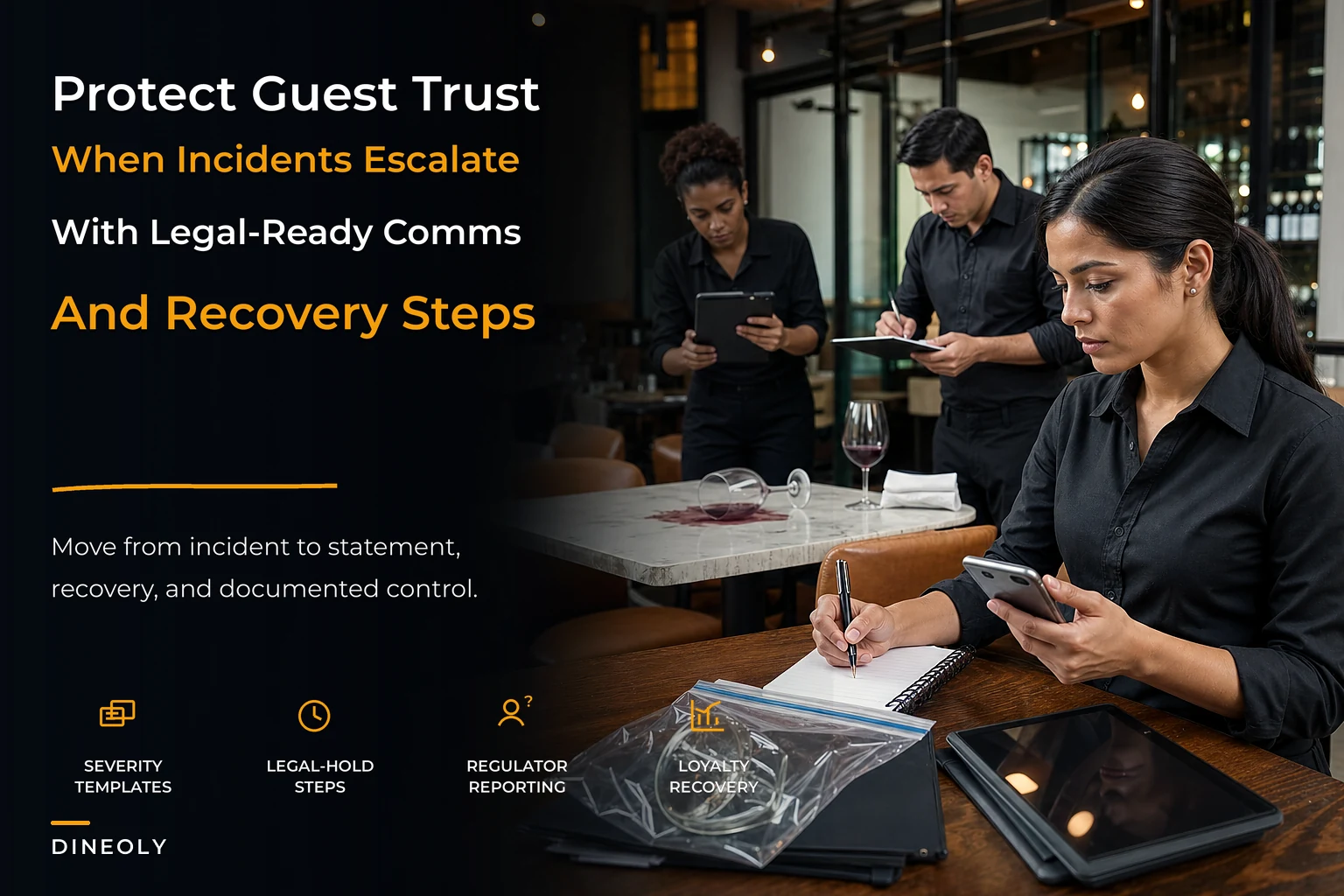
Once an incident hits Level 3, evidence preservation becomes a priority equal to guest care. It's boring, unglamorous, and it's what actually protects the business.
A legal-hold checklist for a serious incident looks something like this:
-
- [ ] Preserve, don't discard. Bag and label the food, container, or item involved. Do not clean the area yet if injury is involved.
-
- [ ] Pull and lock relevant footage before it auto-overwrites (most DVR systems loop in 7–30 days—know yours).
-
- [ ] Collect the POS record and ticket for the exact order, including timestamps and who handled it.
-
- [ ] Write down witness names—staff and, if willing, guests—while memory is fresh.
-
- [ ] Log the timeline with times
when the guest complained, when a manager arrived, what was said, what was done.
-
- [ ] Photograph the area, plate, or condition (with timestamps).
-
- [ ] Do not delete texts, tickets, or notes—the instinct to "clean up" is exactly wrong.
Label and timestamp preserved items immediately when you bag them.
Regulator reporting is severity- and jurisdiction-specific, and this is where you cannot rely on a generic template. A suspected foodborne illness may require notifying your local health department within a set window. A data breach involving guest payment information triggers an entirely different set of obligations and timelines. A workplace injury has its own reporting path. The playbook's job isn't to memorize every rule—it's to route each incident type to the right checklist and the right contact so nobody's Googling "do I have to report this" at 11 PM.
This connects directly to your broader operational resilience and incident management playbook—incident communications aren't a standalone system, they're the guest-facing and legal-facing layer sitting on top of your general incident response.
Severity → recovery ladders: winning the guest back without buying a lawsuit
Recovery and legal caution pull in opposite directions, and most restaurants pick one and ignore the other. The generous manager over-comps and over-apologizes, creating legal exposure. The cautious manager clams up, and the guest—feeling stonewalled—goes straight to a review site or an attorney.
-
Level 1 On-the-spot fix. Remake, comp, a small gesture. Handled and closed by the shift manager. No follow-up needed unless the guest is still upset.
-
Level 2 Comp plus a personal follow-up within 24–48 hours—a call or note from the GM. This is where most brand recovery actually happens; the follow-up matters more than the free entrée.
-
Level 3 Care-first, dollars-second. The priority is documented concern and a clear point of contact, not a gift card. Offering money here can look like an admission—coordinate any compensation with legal or your insurer first.
-
Level 4 No independent recovery gestures. Everything routes through legal and insurance. A well-meaning "here's a $200 gift card, so sorry" can undermine an insurance claim.
The pattern worth internalizing: for minor issues, generosity is your best defense. For serious ones, restraint is. Managers who apply the same "just comp it and apologize hard" reflex to every incident are the ones who turn goodwill into liability.
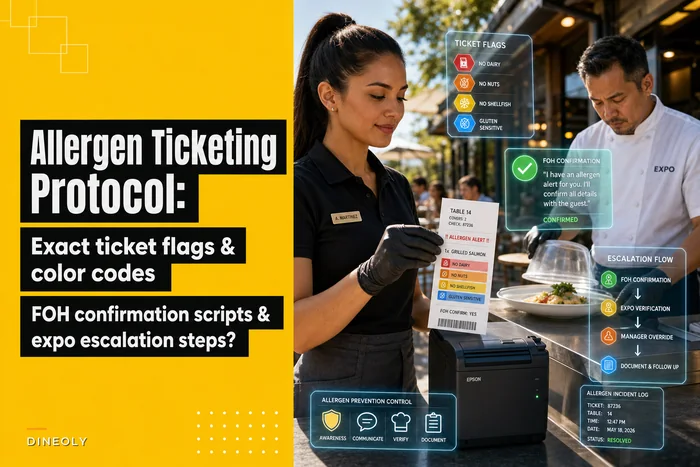
Your loyalty recovery workflow layers on top of this. For Level 1–2 guests, capturing them into a recovery segment and following up thoughtfully often turns a bad night into a more loyal customer. And if the incident is allergen-related, your response needs to connect directly to your allergen ticketing protocol—because how the ticket was flagged and confirmed becomes central evidence the moment someone reports a reaction.
A real scenario: the $340 comp that didn't become a lawsuit
A two-location casual dining spot had a guest report stomach illness the morning after dining, claiming the shrimp pasta. The guest was upset and mentioned "getting this looked at legally."
The old version of this restaurant would have had a manager who either got defensive ("lots of people ate that dish and they're fine") or over-admitted ("oh no, we've had trouble with that supplier"). Either response feeds a claim.
Instead, the on-duty manager followed the ladder. She classified it Level 3 the moment "legal" came up. She expressed genuine concern, took the guest's contact info, and promised a personal follow-up from the GM—no admissions, no arguments. Behind the scenes, the team pulled the POS ticket, identified the shrimp lot and supplier, preserved a sample from the same batch, and logged prep temps from the shift. The GM called the guest the next day, listened, and offered to cover any medical documentation costs—coordinated with their insurer first.
The batch tested clean. No other complaints surfaced. The guest, feeling heard and taken seriously, dropped the legal talk and later returned. Total direct cost: a comped meal and a follow-up, maybe $340 all-in. The uncontrolled version of that same night—an admission, destroyed evidence, a defensive manager—is the one that becomes a demand letter and months of legal fees.
The lesson isn't that they got lucky. It's that the sequence existed before the phone rang.
Where a management platform actually helps here
You can run all of this on paper, and small single-location spots often do. The strain shows up as you scale, because the whole system depends on the right information reaching the right person fast, consistently, across shifts and locations.
-
Consistent classification and routing. When a manager logs an incident, the system can flag the severity level, surface the matching template, and automatically notify the right people—so a Level 3 doesn't sit unescalated because someone forgot who to call.
-
Evidence and timeline capture in one place. Instead of scattered texts and fading memory, the incident log timestamps entries, prompts for legal-hold checklist items, and keeps everything centralized and audit-ready.
-
Cross-location visibility. Ownership sees a serious incident the moment it's logged, not when it surfaces online—which is the difference between managing a situation and reacting to one.
The point isn't automation for its own sake. The coordination breakdowns—wrong person notified, evidence lost, inconsistent responses between locations—are exactly the failures that a well-built operational platform prevents quietly, in the background. The judgment stays human. The routing, prompting, and record-keeping don't have to be.
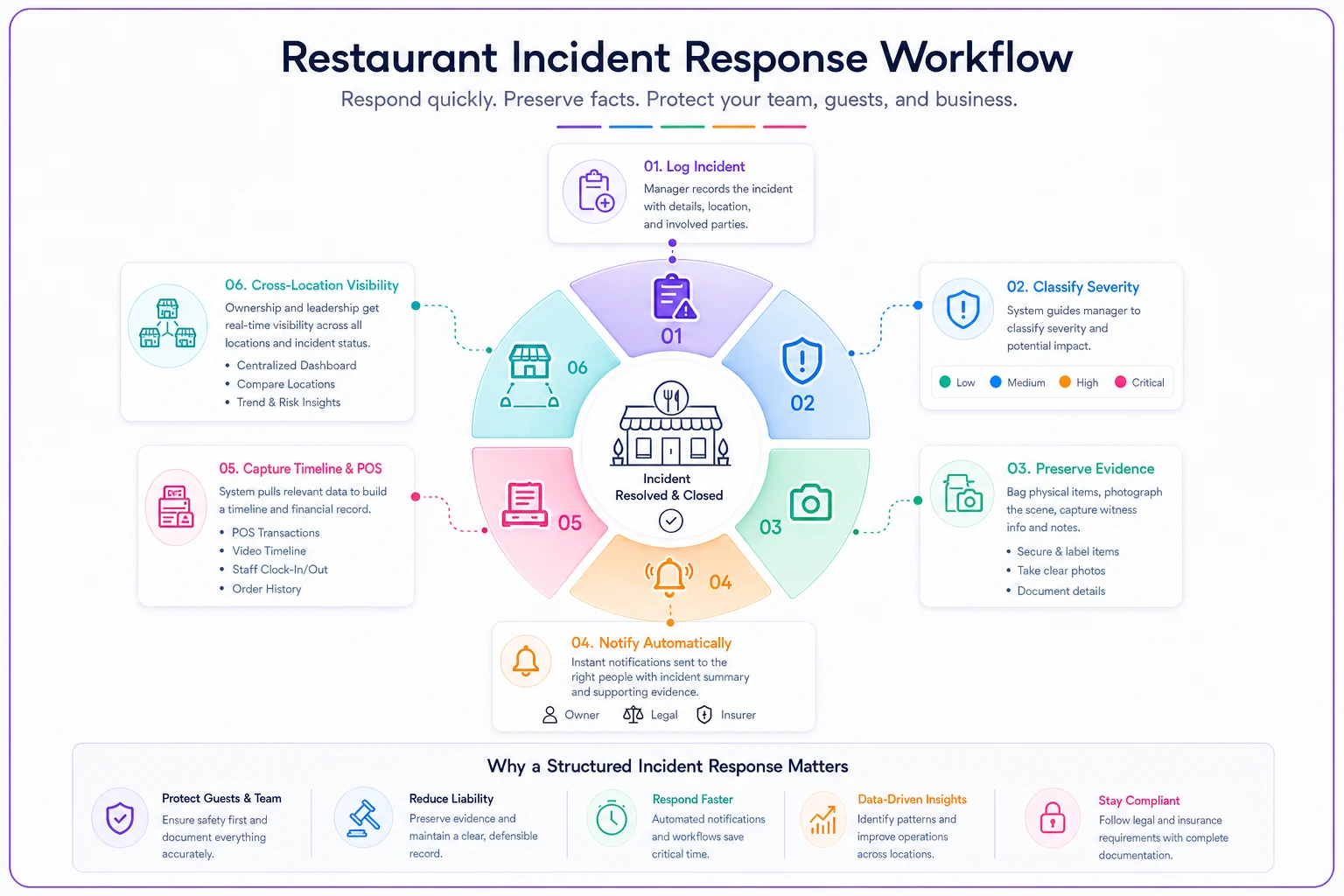
A quick diagram like this clarifies who does what during the first 90 minutes.
When a full playbook is overkill (and when it's non-negotiable)
When a lighter approach makes sense: A single small location with an owner-operator on the floor most nights can run a simpler version—a laminated severity card, a preserved-evidence rule, and one legal contact on speed dial. You still need the core sequence, but you don't need enterprise governance.
When it's non-negotiable: The moment you have multiple locations, managers running shifts you're not present for, or high guest volume, a formalized playbook stops being optional. Multi-unit groups are the ones that get burned by inconsistency—one location handles an incident well, another creates liability, and the brand carries both.
Who should never wing it: Anyone serving high-allergen menus, alcohol-heavy concepts where altercations are a real risk, or operations holding guest payment and reservation data. Those categories carry the exact incident types—reactions, injuries, breaches—where a bad first response is genuinely expensive.
Bringing it together
Guest incidents aren't rare events you can hope to avoid—they're a normal part of operating at volume. What's optional is whether your response is a system or a scramble. The restaurants that come through them intact aren't the ones with better luck; they're the ones where the severity ladder, the pre-approved language, the legal-hold discipline, and the recovery workflow were built and rehearsed before the bad night arrived.
Build the sequence now, while nobody's stressed and nothing's on fire. Write the templates, define the severity tiers and their upgrade triggers, drill the legal-hold checklist, and make sure the person closing on a Saturday knows exactly what to do in the first 90 minutes. That preparation is the actual product of a restaurant incident communications legal playbook—not the documents themselves, but the calm, correct response they make possible when it counts.
Build the sequence now, while nobody's stressed and nothing's on fire. Write the templates, define the severity tiers and their upgrade triggers, drill the legal-hold checklist, and make sure the person closing on a Saturday knows exactly what to do in the first 90 minutes. That preparation is the actual product of a restaurant incident communications legal playbook—not the documents themselves, but the calm, correct response they make possible when it counts.
Ready to elevate your restaurant operations?
Join 2,000+ restaurants using Dineoly to enhance efficiency, increase table turnover, and delight diners.