

The dangerous nights aren't the ones where a single thing goes wrong. A walk-in dies, sure, that's a bad night — but it's a knowable bad night. Somebody makes a call, you adapt, you survive. The nights that actually take a restaurant down are the ones where the POS goes offline during a Friday rush, and your closing cook called out, and a delivery of the wrong protein showed up at 4pm. Now three people are making three uncoordinated decisions at the same time, nobody knows who's actually in charge of what, and the guest-facing story falls apart.
Most restaurants don't have a system for that. They have instincts, a couple of experienced managers, and a lot of luck. That works until it doesn't — and it tends to stop working right when the business gets big enough that no single person can hold the whole operation in their head anymore.
A real restaurant incident management playbook isn't a binder that sits on a shelf. It's a set of pre-made decisions — who owns what, when you flip from "fix it" to "cancel it," what the fallback menu is, what you say to guests — so that when the pressure hits, people execute instead of improvise.
Why incidents cascade instead of staying contained
Single failures are rarely the problem. Cascades are.
A POS outage on its own is annoying. But the POS also drives your kitchen tickets, your timing, your comps tracking, and your close-out. So the moment it goes down at 7:40pm, you don't have one problem — you have a printer problem, a fire-timing problem, a payment problem, and a reconciliation problem, all landing on different people who each start solving their piece without talking to each other.
This usually happens because responsibilities during normal service are clear (host seats, server takes orders, expo runs the pass) but responsibilities during failure are undefined. Nobody rehearsed who calls the POS vendor versus who walks the floor versus who decides whether to keep seating. So everyone defaults to their normal role, which is exactly the wrong instinct, because those normal roles assume all the systems are working.
The operators who stay calm during multi-failure nights aren't necessarily smarter or more experienced — they've just pre-assigned the failure roles. The chaos gets absorbed by structure instead of by adrenaline.
The first fix: role-based runbooks, not a master manual
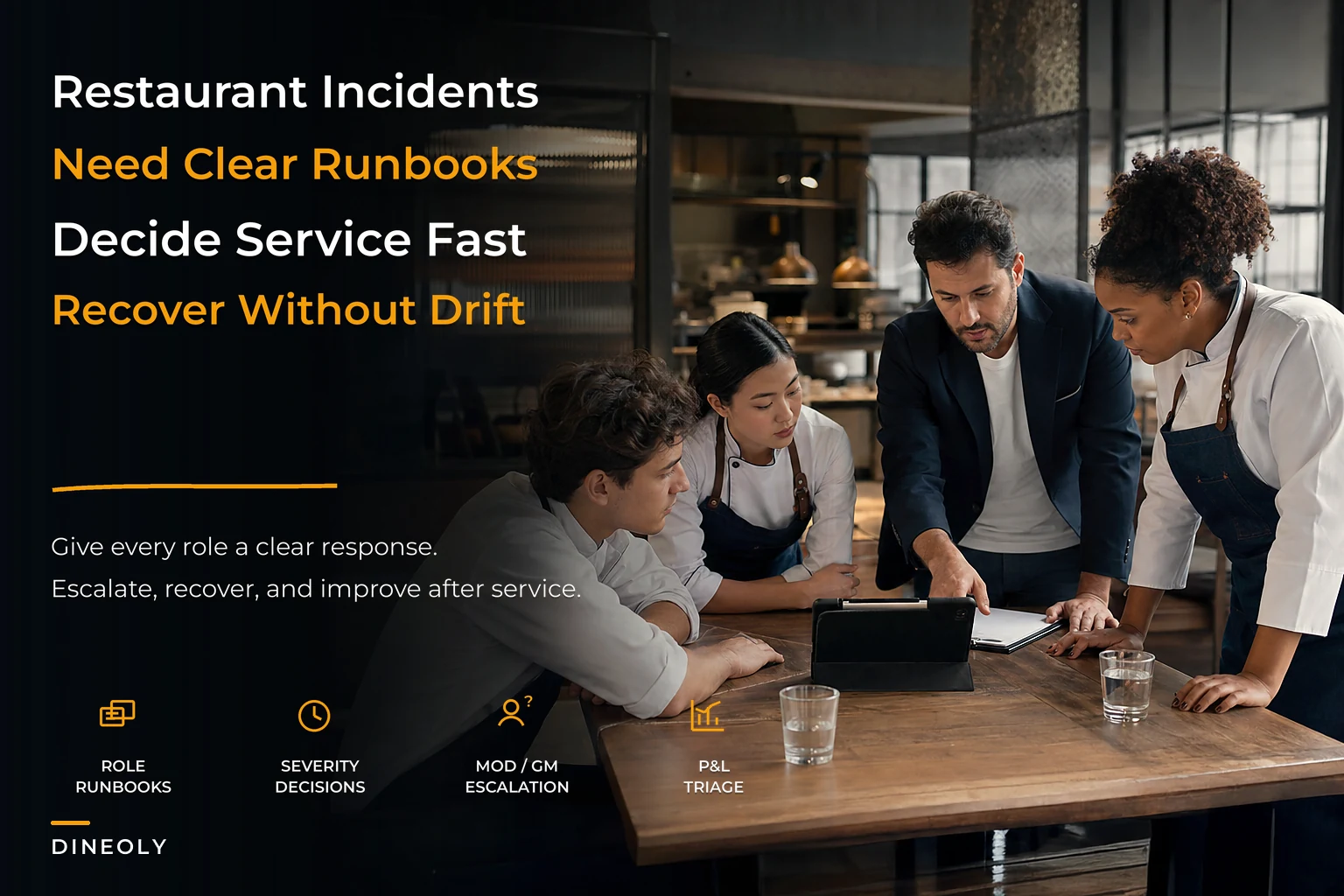
Forget the idea of one giant emergency document. Nobody reads it mid-rush. Short, role-specific runbooks work better — one for the manager on duty, one for the kitchen lead, one for the host/FOH lead — each answering one question: when this category of thing breaks, what is MY first move?
Eliminate operational bottlenecks effortlessly.
Dineoly helps you manage every reservation, order, and staff shift seamlessly.
- Unified reservation and order management
- Real-time staff scheduling
- Inventory and sales tracking
No credit card required
A role-based runbook has three parts and no more:
-
Trigger — the observable signal ("POS not printing tickets for 3+ minutes," "two or more line cooks down," "no hot water at handwash sinks").
-
My immediate action — the one thing this role does first, before checking with anyone.
-
My handoff — who I tell, and what decision I'm escalating.
So the kitchen lead's POS-outage runbook might read: Trigger — tickets stop printing. Immediate action — switch to verbal expo call-and-repeat, pull the manual ticket pad from the pass drawer. Handoff — tell MOD we're on manual, kitchen can hold ~15 tickets before we need to slow seating.
That last line matters more than people realize. The kitchen lead isn't deciding whether to stop seating — that's above their pay grade in the moment — but they're feeding the decision-maker the one number that makes the decision possible. Coordination by design instead of coordination by shouting.
The mistake most places make is writing runbooks that are 90% context and 10% action. Flip it. During an incident, nobody needs the philosophy. They need the next move.
Laminate each role's one-card runbook and keep it at the role's station or in their apron for quick access.
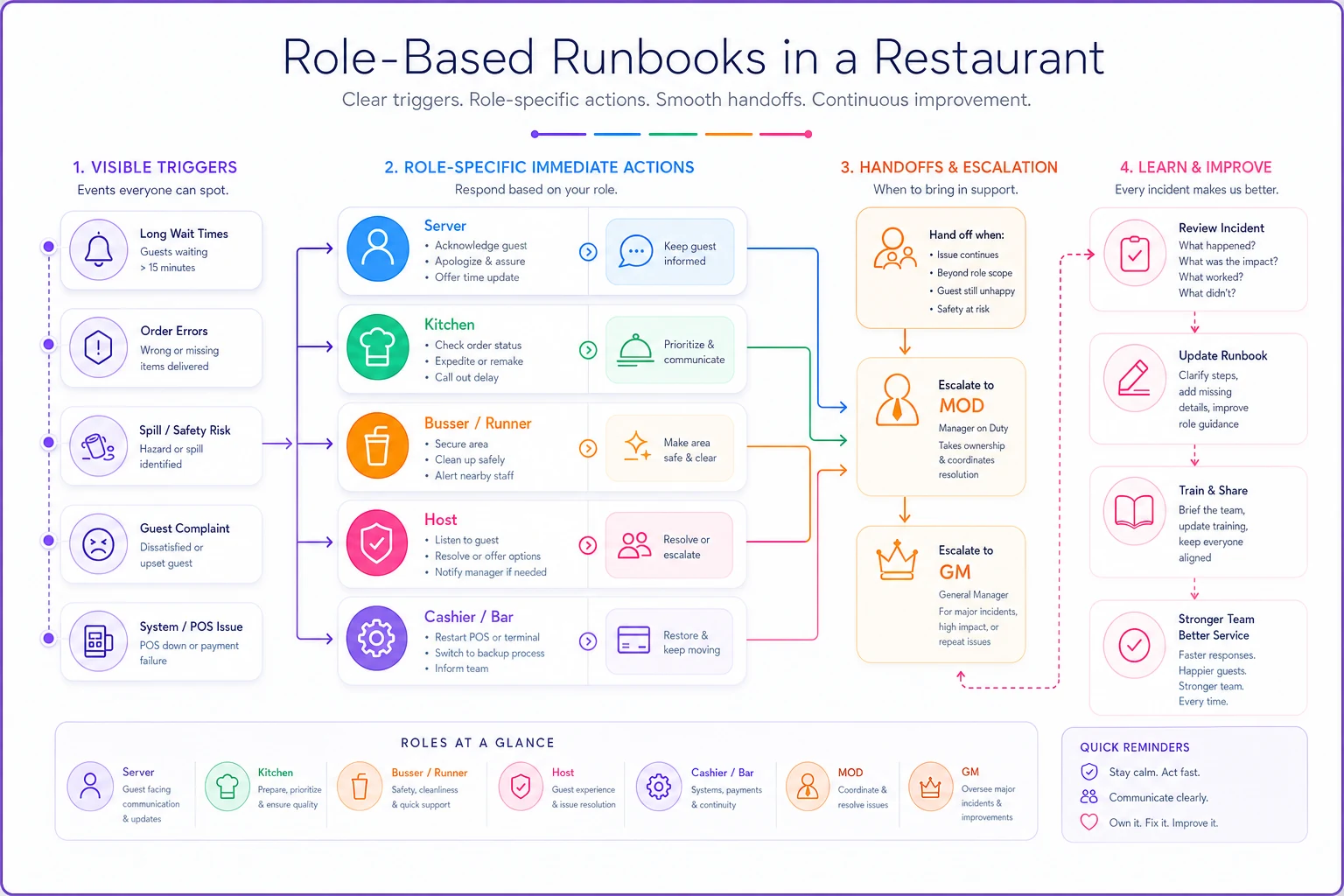
A clear visual makes it easier to train staff and to remember the flow under pressure.
Severity decision trees: the "service vs. cancel" line
The single hardest call in any incident is whether to keep serving or stop. Restaurants lose money and reputation on both sides of that line — they push through a night they should've paused, sending out cold, wrong, slow food to a room full of people who'll never come back. Or they cancel a night they could've saved, eating a fully-prepped inventory and demoralizing the crew.
The fix is making severity a decision tree, not a gut call. Define severity levels ahead of time, tied to observable conditions, and each level has a default action.
| Severity | Trigger conditions | Default action | Who decides |
|---|---|---|---|
| Level 1 — Degraded | One system down, workaround exists (POS on manual, one station short) | Keep full service, slow seating pace ~15% | Kitchen lead + MOD, quick verbal |
| Level 2 — Constrained | Two systems affected OR ticket times >25 min | Trim the menu to fallback list, stop taking walk-ins, honor reservations only | MOD |
| Level 3 — Compromised | Food safety risk, no payment ability >30 min, staffing below safe minimum | Stop new seating, serve current tables, close early | GM (or MOD if GM unreachable) |
| Level 4 — Halt | Fire, flood, gas, sewage backup, power loss | Evacuate/close immediately, guest safety only | Anyone can trigger, GM confirms |
The point of the table isn't the exact thresholds — you'll set those for your own operation. The point is that the threshold exists before the night it's needed. When ticket times cross 25 minutes, you're not debating anything. You're already at Level 2 and the fallback menu is coming out. That decision was made weeks ago in a calm office, which is the only place good decisions actually get made.
One thing worth flagging: notice that "anyone can trigger" Level 4. Safety failures should never wait for a chain of command. If a cook smells gas, they don't go find the GM — they act. Build that permission in explicitly, or people will hesitate at exactly the wrong moment.
For food-safety-related severity triggers, this ties directly into the same daily checks you're (hopefully) already running for health-inspection readiness drills — the temp logs and handwash-station checks that flag a Level 3 before it becomes a Level 4.
Fallback menus and temporary recipes: prep for the constrained night
Almost nobody builds a pre-designed fallback menu until after they've been burned by not having one.
When you hit Level 2 and need to trim the menu, the worst time to figure out which dishes to cut is right then. So you build the short list in advance — the version of your menu you can execute when you're down a station, down a protein, or down a piece of equipment.
The logic for choosing fallback dishes:
-
Fewest touchpoints. Dishes that need one station, not three. If the grill goes down, your fallback menu is everything that never touches the grill.
-
Longest hold tolerance. Items that don't die in the window. During chaos, timing gets sloppy — pick dishes that forgive it.
-
Shared mise. Dishes that draw from prep you already have in volume, so a surprise rush on the fallback menu doesn't 86 you in twenty minutes.
-
Margin-safe. Ideally the fallback skews toward your better-margin plates, so a bad night doesn't also become an expensive one.
A practical example: a mid-size Italian spot builds a "grill-down" fallback of six dishes — three pastas, a risotto, a braise, and a salad — all executable from the sauté and cold stations alone. When their grill line fails on a Saturday, the host hands guests a single-card "tonight's menu" instead of apologizing for a dozen 86'd items. Guests barely notice. The version of that night without a fallback menu is a server standing at the table listing what they can't make, which reads as "this place is falling apart."
Temporary recipe cards matter here too. If your fallback pasta normally gets a component from the grill, write the no-grill version of it — down to the plating — so cooks aren't inventing substitutions on the fly. Improvised substitutions are how allergens and inconsistency sneak in.
There's an inventory dimension here too: knowing what you can actually execute depends on knowing what's actually in the building. Loose inventory discipline turns small incidents into big ones. If your counts drift, you'll build a fallback around a protein you thought you had. Tight cycle-count cadences and variance thresholds are quietly part of your resilience story.
Communication scripts: control the story before it controls you
During an incident, the operational problem and the guest-perception problem are two different problems, and they need two different owners.
The kitchen fixes the operational problem. The floor manages the perception problem. And perception is managed with pre-written scripts, because under stress people either over-explain ("our whole POS system crashed and we're totally slammed and I'm so sorry") or under-explain — awkward silence, long waits, no acknowledgment. Both erode trust.
Good incident scripts are short, honest without oversharing, and always paired with an action:
-
Delayed kitchen (Level 1–2) "I want to be upfront — the kitchen's running about 15 minutes behind tonight, so I've asked them to prioritize your table. Can I bring you something to start on the house while you wait?"
-
Menu trimmed (Level 2) "We had an equipment issue tonight, so we're running a focused version of the menu — everything on this card is coming out great. Happy to make a recommendation."
-
Closing early (Level 3) "We've hit a problem we can't fix mid-service, so we're not able to take new tables tonight, but we're taking great care of everyone already seated. I'm so sorry for the disruption."
The pattern: name it briefly, don't dramatize it, offer the next step. What you're avoiding is the two failure modes — the panicked info-dump and the stonewall.
There's also an internal comms script, which people forget. When severity changes, how does the room find out? A shouted "we're 86ing the grill menu" during a rush gets half-heard. The better version is a defined signal — a specific phrase in the group chat, a whiteboard flag at the pass, whatever works for your team — so everyone flips to the new state at the same time. Uneven awareness is where the second wave of mistakes comes from.
The P&L triage calculator: deciding with money in front of you
Knowing, roughly, what each choice costs before the night is over is what separates a resilience system from a panic response.
When you're staring at a multi-failure situation, "should we close?" feels like a values question. It's actually a math question with a values overlay. A quick triage calc gives you the rough shape of the decision:
The push-through scenario:
-
Estimated remaining covers × average check = revenue at stake
-
Minus
comps/discounts you'll likely eat to smooth over slow service
-
Minus
the harder-to-see cost — guests who won't return after a bad experience
The close-early scenario:
-
Lost revenue (same remaining-covers number)
-
Minus
labor you save by cutting the shift
-
Minus
prepped inventory you'll waste if it won't hold
-
Plus
reputation you protect by not sending out a bad night
A back-of-envelope version: say you've got roughly 40 covers left at a ~$45 average, so about $1,800 of revenue on the table. But you're Level 2-going-on-3, ticket times are 35 minutes, and you're realistically comping 20–30% to keep people from walking angry. That $1,800 is closer to $1,200 in real terms — and you're spending it buying a room full of people a mediocre experience they'll remember. Against that, closing early saves maybe $400 in labor and wastes maybe $300 in prep. The gap narrows fast, and the reputation cost quietly tips it toward closing.
The number won't be precise, and it doesn't need to be. The value is that it converts a stomach-churning judgment call into a comparison you can reason about in ninety seconds. Most bad "we pushed through a night we shouldn't have" decisions come from never running the comparison at all — the revenue felt too real to walk away from, and the hidden costs stayed invisible.
When a full playbook makes sense — and when it's overkill
When this is worth building: you're running multiple shifts where the GM isn't always present, you've grown past the point where two people can hold the whole operation in their heads, or you've already had a cascade night that cost you real money and rattled the staff. More than one location makes this non-optional — inconsistent incident response across sites is its own liability.
When it's premature: a small owner-operated spot where the owner is on the floor every service may not need formal runbooks yet. The owner is the runbook. The trap there is assuming you'll always be there. The day you're out sick is the day the gap shows up. Even a one-page severity tree taped inside the office is worth having before that happens.
Who should not over-engineer this: if you're spending more time maintaining the playbook than running the restaurant, you've built a bureaucracy, not a resilience system. The whole thing should fit on a few laminated cards. If it needs a training seminar, it's too complex to survive a real rush.
A short real scenario
A three-unit regional group — casual American food, roughly 120 seats each — kept having "bad nights" that management couldn't quite explain. Digging in, the pattern was always the same: a single failure (an outage, a callout, an equipment issue) that spiraled because each site handled it differently and nobody escalated at the right moment.
They built the basics: a one-card severity tree per station, a grill-down and a fryer-down fallback menu, three guest scripts, and a rough P&L triage sheet in the manager's binder. Nothing fancy.
Over the following months, failures didn't stop — equipment still broke, people still called out. What changed was that failures stopped cascading. Nights that used to end in a demoralized crew and a stack of comps turned into Level 2 nights the team executed cleanly. Comps on incident nights dropped noticeably, and managers stopped dreading the shifts where something went sideways, because they finally knew what to do at each step instead of inventing it live.
Bringing it together
Resilience isn't heroics. The restaurants that handle chaos well aren't the ones with the most talented improvisers — they're the ones that did the boring work of pre-deciding. Who owns what when it breaks. Where the service-vs-cancel line sits. What the fallback menu is. What you say to the room. Roughly what each choice costs.
Build those five things and most "disaster" nights quietly become manageable nights. The failures still come — a walk-in still dies, a cook still calls out, a delivery still shows up wrong. But they stop stacking into a spiral, because the structure absorbs them one at a time. That's the entire point of a restaurant incident management playbook: not to prevent problems, but to keep a bad moment from becoming a bad night.
If you're thinking about where to start, this same pre-decided, contingency-first thinking shows up in high-stakes execution like private dining and catering run-books — the operations where everyone already agrees that improvising isn't an option. Steal that mindset for your regular service, and you've done most of the work.
Ready to elevate your restaurant operations?
Join 2,000+ restaurants using Dineoly to enhance efficiency, increase table turnover, and delight diners.