

Most restaurants lose chargebacks they should win. Not because the guest was right — because nobody captured the two or three pieces of evidence that would have settled it, and by the time the notice showed up in the inbox, half the response window was already gone.
The frustrating part is that restaurant disputes are genuinely more winnable than most industries. You almost always have signed receipts, timestamped POS data, camera footage, and a server who remembers the table. The problem is that evidence lives in five different places, nobody knows the deadline, and the person who could explain what happened at Table 14 quit three weeks ago.
This is a workflow, not a lecture. The goal is that any manager on any shift can capture the right evidence the moment a dispute-prone situation happens, respond inside the processor's window, and log the outcome so the same problem stops repeating.
The two dispute types you actually face
Before touching evidence, separate what you're fighting. Restaurants deal with basically two buckets, and they need different handling.
"I don't recognize this charge" (true fraud or friendly fraud). The cardholder claims they never made the purchase. Sometimes it's real card theft. More often it's friendly fraud — the guest recognizes the meal but disputes anyway, either forgetting they came in or gaming a refund out of the bank while keeping the meal.
"The service or product was wrong" (quality/service disputes). The guest admits they were there but claims the food was cold, the order was wrong, they were double-charged, or an added gratuity wasn't authorized. These are the ones where your handling at the table often decides the outcome before the bank ever gets involved.
A huge share of restaurant chargebacks are friendly fraud on the first bucket and preventable service failures on the second. The evidence you need differs by type, so your workflow has to sort them fast.
| Dispute reason | Evidence that actually wins | Common failure point |
|---|---|---|
| "Didn't authorize / don't recognize" | Signed receipt, EMV chip read data, AVS/CVV match, camera timestamp | No signature captured on mobile/QR payments |
| "Charged twice" | Batch report showing two distinct auths OR proof it was one | Voided-then-rerun tickets that look like duplicates |
| "Food/service unacceptable" | Order timestamps, kitchen ticket, manager comp notes, no prior complaint | No record the guest ever complained on-site |
| "Wrong tip amount" | Signed slip with written tip, or POS tip-adjust log | Tip added after signature with no trail |
| "Never received order" (delivery/takeout) | Pickup timestamp, ID check note, driver handoff record | No proof of handoff |
The evidence you need differs by type, so your workflow has to sort them fast.
The evidence you must capture at the POS — before you need it
The disputes you lose are almost always decided at the moment of sale, not the moment of dispute. If the data wasn't captured then, no amount of scrambling later fixes it.
Eliminate operational bottlenecks effortlessly.
Dineoly helps you manage every reservation, order, and staff shift seamlessly.
- Unified reservation and order management
- Real-time staff scheduling
- Inventory and sales tracking
No credit card required
Here's the specific POS evidence to lock down for every card transaction, and why each one matters when a processor reads your response:
-
Full itemized receipt tied to the transaction ID. Not just the total. The bank wants to see what was purchased. A $186 charge with no detail looks disputable; the same charge with two entrées, a bottle of wine, and four cocktails looks like a real dinner.
-
Entry method (chip, tap, swipe, or keyed). Chip and tap transactions are cardholder-present and carry liability protection. Keyed transactions almost always lose. Your POS records this — you just need to pull it.
-
AVS and CVV results. For any keyed or card-not-present charge — phone orders, catering deposits — matched address and CVV are your strongest proof the real card was present.
-
Signature capture, digital or paper. On QR-pay and pay-at-table mobile flows, signatures often get skipped. That's a gap. If your setup allows it, capture something — even a PIN entry log helps.
-
Timestamp down to the minute. This is what you cross-reference against camera footage and the reservation.
-
Server ID on the ticket. So you know who to ask when the notice arrives.
Make signature capture mandatory on tableside QR flows if your platform supports it.
The single most common gap: mobile and tableside payments that never capture a signature or a clear entry-method record. Restaurants adopt QR-pay for speed, then discover months later they can't defend a single "I wasn't there" dispute because there's no cardholder-present proof.
Guest-handling scripts that prevent disputes at the table
Most service-quality chargebacks are winnable for one reason: the guest never complained on-site. If they ate the whole plate, paid, tipped, left happy, and then disputed two weeks later, you have a strong case — if you have a record showing service went fine.
The move is to handle real complaints on-site so they never become disputes, and to document non-complaints so friendly fraud has nothing to stand on.
Server script when a guest raises a problem:
> "I'm really sorry about that — let me get the manager so we can fix it right now."
Then the server flags it in the POS as a guest issue on that check. That flag is your record.
Manager script for a table complaint:
> "Thanks for letting me know. I've taken the [item] off your bill and I'd like to bring you [replacement/comp]. Is there anything else that wasn't right tonight?"
The point isn't just service recovery. When a manager comps an item and notes it in the system, you now have a documented resolution. If that same guest later disputes the remaining charge claiming everything was terrible, your comp note directly contradicts them.
What to document every time:
-
Which item was disputed and why
-
What was comped or replaced
-
That the guest accepted the resolution
-
Manager name and time
The mistake here is verbal-only recovery. A server tells the manager, the manager waves a burger, everyone moves on, nothing gets written. Six weeks later a $240 dispute lands and there's zero paper trail. The recovery happened — it's just invisible to the bank.
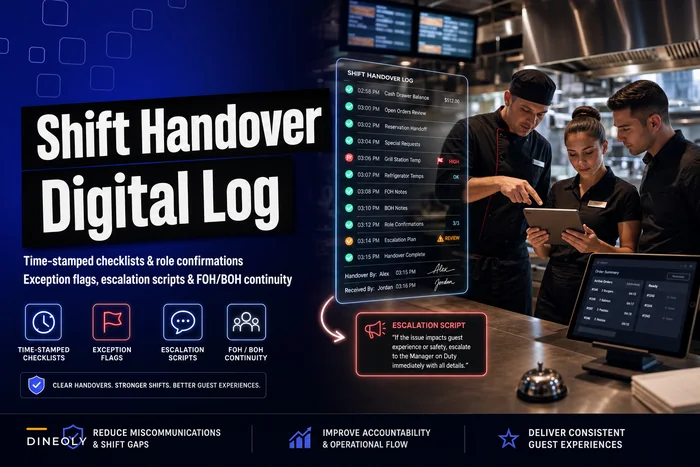
This ties directly into your shift handover digital log — comps, complaints, and unusual table situations should carry over so the next manager isn't blind when a dispute references a shift they didn't work.
The processor timeline — where most losses actually happen
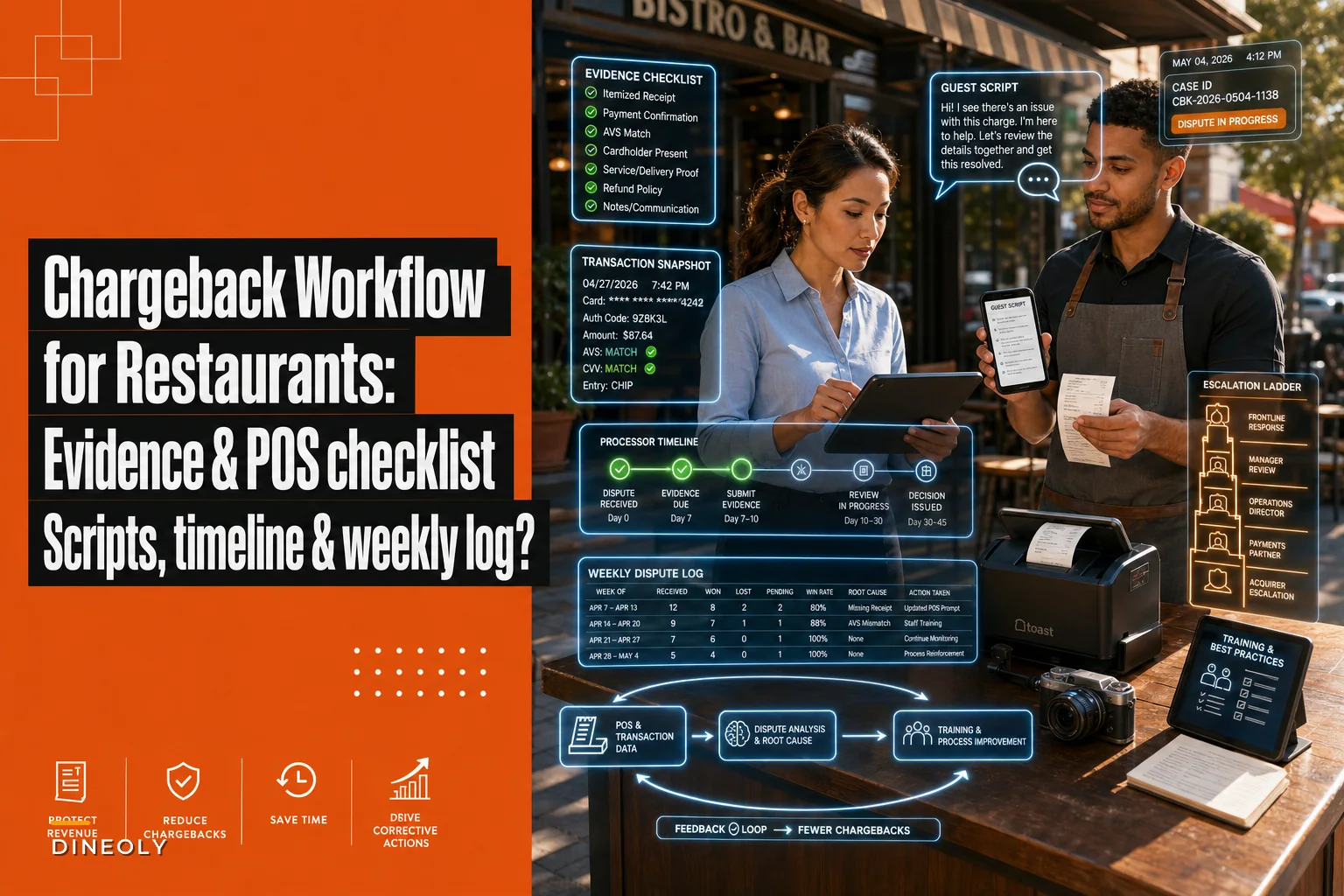
You can have perfect evidence and still lose by missing the clock. Card networks give you a fixed, short window to respond, and it starts the day the notice posts — not the day you notice it.
-
Day 0 — Chargeback notice posts. The funds are usually already pulled from your account. Your processor notifies you through their portal or email. This is the day the clock starts.
-
Days 0–2 — Triage. Identify the transaction, the reason code, the date of service, and which bucket it falls in. Pull the server and shift.
-
Days 2–7 — Evidence assembly. Gather receipt, entry method, signature, camera footage, comp notes, and any guest communication.
-
Response deadline — commonly 7 to 20 days depending on network and processor. Many processors give less time than the card network technically allows, so treat your processor's stated deadline as real, not the network's.
-
Post-submission — issuer review, then possible second presentment / arbitration. Most cases end here. A small number escalate.
The failure pattern is brutal in its simplicity: the notice sits unread in a general inbox for nine days because nobody owns it. By the time someone opens it, there are four days left and the server who worked that table is off for the week. The case is lost on logistics, not merit.
Fix the ownership problem first. One named person checks the dispute portal on a fixed cadence — daily is ideal, every other day is the floor. Missing the window is the most expensive and most avoidable loss in this entire process.
The escalation ladder
Not every dispute deserves the same effort, and not everyone should be making the call on whether to fight.
-
Tier 1 — Shift manager. Pulls initial evidence, confirms the transaction, checks for comp notes or on-site complaints. Handles low-dollar, clear-cut cases directly.
-
Tier 2 — GM or operations lead. Reviews anything above a dollar threshold you set (many restaurants use something in the $150–$250 range), makes the fight-or-concede call, and owns the formal response.
-
Tier 3 — Owner / finance. Steps in for high-dollar disputes, catering and large-party charges, or any pattern that suggests a systemic problem — a specific delivery channel, a repeat card, a particular server.
The fight-or-concede decision matters more than people admit. Fighting a $22 dispute you'll probably lose costs staff time worth more than the charge. But conceding a $260 catering dispute with a signed contract and delivery confirmation is throwing money away. Set a rough threshold, but weigh evidence strength against dollar amount rather than blindly fighting everything.
When to just concede: keyed transaction, no signature, no camera coverage, low dollar amount. You'll lose, and the effort isn't worth it. Concede fast and put your energy into the winnable ones.
The weekly dispute log that actually fixes things
This is the part almost everyone skips, and it's where the real money is. Winning individual disputes is defense. The weekly log is how you stop disputes from happening at all.
Keep a simple running log with these fields for every dispute:
-
Date of transaction and date of dispute
-
Amount
-
Reason code / dispute type
-
Payment channel (dine-in, tableside QR, phone, delivery, catering)
-
Server or order-taker
-
Won / lost / conceded
-
Root cause note (one line)
Here's a simple workflow visualization.
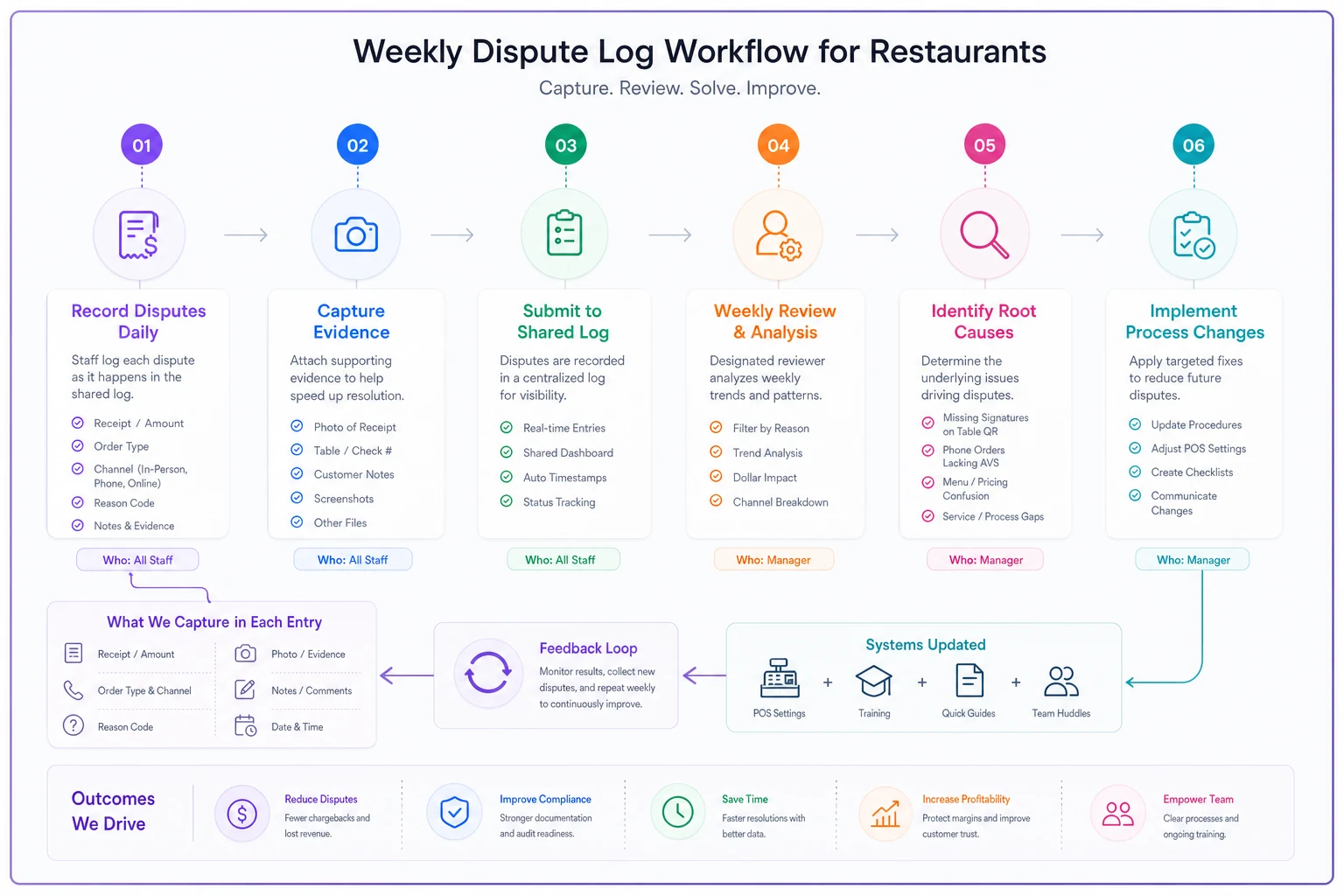
Then, once a week, someone reads the whole log looking for patterns — not individual cases.
A typical example: a casual-dining spot was losing a cluster of "didn't authorize" disputes, maybe eight to ten a month, roughly $1,400–$1,800 in lost charges plus fees. Fighting them one by one was a losing game because most were keyed phone orders with no signature. The weekly log made the source obvious — nearly all of them came through the same to-go phone-order flow that never captured AVS. They changed the process to require billing ZIP on every card, and the "didn't authorize" bucket dropped by more than half within two months. The wins didn't come from better dispute responses. They came from reading the log.
Individual chargebacks are symptoms. The log turns them into a diagnosis. If tableside QR pay generates most of your "wasn't there" losses, you fix the signature capture. If one delivery channel drives "never received," you fix the handoff proof. The disputes you prevent are where the margin lives — and this connects directly to the broader margin control work covered in operational FinOps, where small recurring leaks quietly reshape your P&L.
When fighting disputes is a bad use of time
Fight when: the charge is meaningful, entry was chip or tap, you have a signature or strong cardholder-present proof, and there's no record the guest complained on-site. High-win, worth-the-effort cases.
Don't bother when: it's a small keyed transaction with no signature, no camera coverage, and a plausible-sounding reason. You'll spend an hour to lose a $19 case. Concede and move on.
Who shouldn't be running this at all: a rotating cast of whoever happens to see the email. Dispute handling with no single owner and no deadline discipline loses cases it should win, every single time. If you can only fix one thing, fix ownership before you fix evidence.
Bringing it together
The restaurant chargeback dispute workflow isn't really about writing clever rebuttal letters. It comes down to three unglamorous habits: capturing cardholder-present proof at the moment of sale, documenting service recovery so friendly fraud has nothing to stand on, and never missing the processor's clock because one named person owns the portal.
Do those three things and most of your winnable disputes get won. The restaurants that get this right aren't fighting more disputes — they're getting fewer of them. They read what the disputes were telling them, closed the process gap, and stopped absorbing losses that were preventable from the start. The weekly log is what makes that shift happen, and it costs nothing but a few minutes of honest attention each week.
The restaurant chargeback dispute workflow isn't really about writing clever rebuttal letters. It comes down to three unglamorous habits: capturing cardholder-present proof at the moment of sale, documenting service recovery so friendly fraud has nothing to stand on, and never missing the processor's clock because one named person owns the portal.
Do those three things and most of your winnable disputes get won. The restaurants that get this right aren't fighting more disputes — they're getting fewer of them. They read what the disputes were telling them, closed the process gap, and stopped absorbing losses that were preventable from the start. The weekly log is what makes that shift happen, and it costs nothing but a few minutes of honest attention each week.
Ready to elevate your restaurant operations?
Join 2,000+ restaurants using Dineoly to enhance efficiency, increase table turnover, and delight diners.