

Your dinner shift manager just walked into chaos. The lunch manager left three hours ago, nobody knows about the walk-in cooler running warm, table 12's reservation notes got missed, and the new server scheduled for tonight called out sick this morning but somehow that information disappeared into the void.
Sound familiar? Shift handovers in restaurants fail because critical information lives in people's heads, sticky notes, and random text messages. When your lunch manager walks out at 4pm, they take half the operational context with them. Your dinner manager walks in blind.
The fix is simpler than most people think: you need a structured digital handover system that forces accountability, captures exceptions, and creates an unbroken chain of operational awareness between shifts.
Why paper logs and verbal handoffs create operational black holes
Traditional shift handovers rely on two broken methods. Either managers do a quick verbal download ("hey, we're low on ribeye and the dishwasher's acting up") or they scribble notes in a paper logbook that nobody reads. Both approaches guarantee critical information gets lost.
The verbal handoff problem hits hardest during busy transitions. Your lunch manager tries to brief the dinner manager while handling final lunch tables, counting the drawer, and checking labor costs. They mention five things quickly. The dinner manager, who's simultaneously reviewing reservations and checking staff attendance, catches maybe two. Three critical issues vanish.
Paper logs create different problems. Managers write entries but skip timestamps. They note problems but not who's responsible for fixing them. They record events but miss the context that matters. "Cooler temp high" tells you nothing about whether maintenance was called, what temp it reached, or what product might be compromised.
Neither method creates accountability. When something falls through the cracks, both managers point fingers. The lunch manager swears they mentioned the VIP reservation's dietary restrictions. The dinner manager insists they never heard it. The guest gets regular pasta instead of gluten-free. Your reputation takes the hit.
The real cost of handover failures (it's not just about miscommunication)
Poor handovers don't just cause individual service failures. They compound into systemic operational decay. Each dropped ball erodes trust between shifts, creates more firefighting work, and ultimately drives your best managers toward burnout.
Eliminate operational bottlenecks effortlessly.
Dineoly helps you manage every reservation, order, and staff shift seamlessly.
- Unified reservation and order management
- Real-time staff scheduling
- Inventory and sales tracking
No credit card required
Consider what happens when maintenance issues get lost in handoff. Your lunch manager notices the walk-in cooler running at 44°F instead of 38°F. They mention it verbally but don't log it properly. The dinner manager misses it. Overnight, the temp climbs to 50°F. Next morning, you're tossing $2,400 worth of proteins and calling every reservation to apologize for the limited menu.
Staff scheduling miscommunications create similar cascades. A server calls out sick during lunch service. The lunch manager forgets to mention it during handoff. The dinner manager doesn't realize they're short-staffed until the rush hits. Service speed drops, tables turn slower, wait times balloon, and you lose walk-in business on what should've been a profitable Friday night.
These failures also destroy manager accountability. Without clear documentation showing who knew what and when, you can't identify patterns or coach improvement. Every shift starts from scratch, making the same mistakes, never building institutional knowledge.
Building a restaurant shift handover checklist digital log that captures everything
A functional digital handover system needs five core components: time-stamped entries, exception flagging, required confirmations, escalation triggers, and searchable history. Miss any of these and you're back to dropping balls.
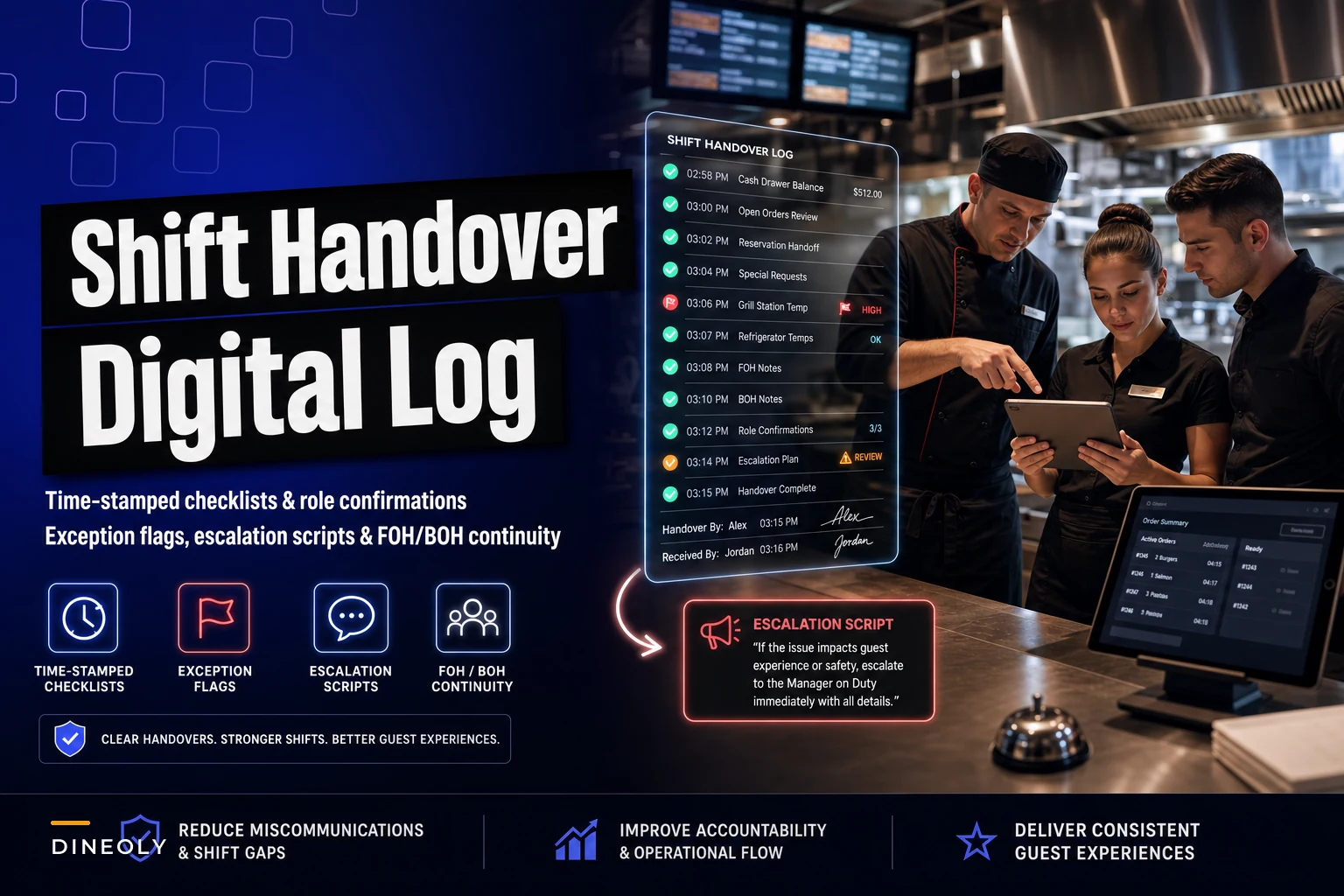
Time-stamping matters because sequence tells the story. When your log shows the freezer alarm triggered at 2:47pm, maintenance was called at 2:52pm, and they confirmed arrival at 3:35pm, you have a complete picture. No confusion about whether action was taken or how quickly.
Exception flagging prevents critical issues from getting buried in routine notes. Your system should force managers to categorize issues by severity. A VIP reservation with allergies gets a red flag. Low napkin inventory gets yellow. This visual hierarchy ensures the incoming manager addresses critical items first.
Required confirmations create accountability loops. The outgoing manager can't complete their shift until they've logged specific items. The incoming manager can't start without acknowledging what they've inherited. Both parties have skin in the game.
A proper digital handover structure looks like this:
-
Staffing changes (call-outs, early releases, overtime risks)
-
Maintenance issues (equipment problems, vendor visits scheduled)
-
Guest situations (complaints, VIPs, special requests)
-
Inventory exceptions (86'd items, low stock warnings)
-
Financial irregularities (voids, comps, cash discrepancies)
-
Safety incidents (spills, injuries, near-misses)
Each category needs specific fields. For staffing changes, you log: who called out, when they notified, who's covering, whether tomorrow's schedule is affected. For maintenance issues: equipment affected, problem description, action taken, follow-up required.
The digital log should also enforce structure without being rigid. Managers need to quickly log issues during service, but the system should prompt for missing details during slower periods. "You logged a cooler temp issue at 2:47pm but didn't specify which cooler or the actual temperature. Please complete this entry."
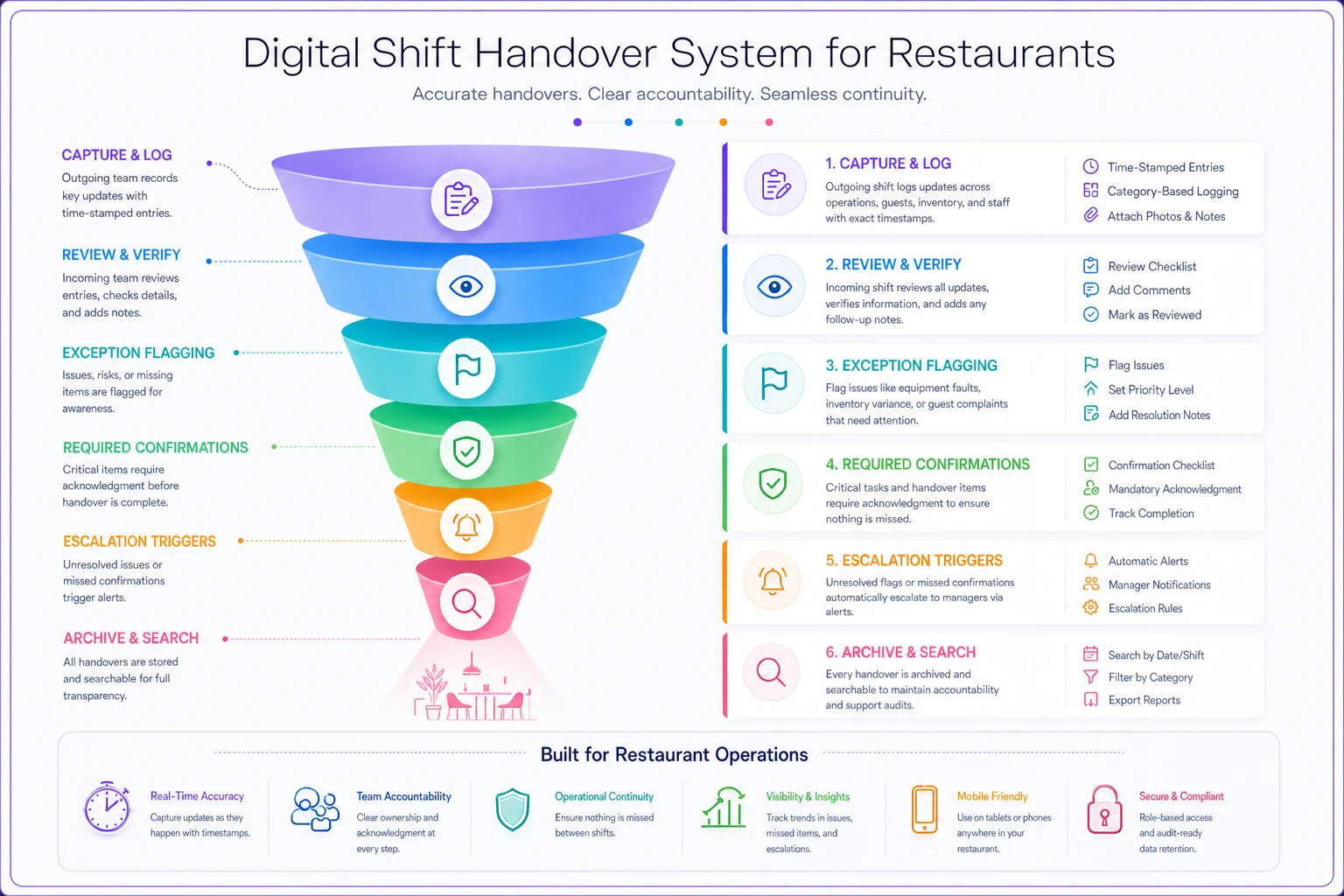
Here's a quick sketch of how those pieces flow together in practice.
The system should guide managers: capture core facts fast, flag exceptions, require acknowledgment, and escalate when thresholds are hit.
Time stamps and exception flags: the mechanical details that matter
The timestamp mechanism needs to work automatically, not rely on managers remembering to note the time. Every entry gets stamped when created, when edited, and when acknowledged. This creates an audit trail that eliminates the "I told you" arguments.
Exception flags need three levels minimum. Critical flags require immediate acknowledgment and trigger notifications to ownership if not addressed within 30 minutes. Warning flags need acknowledgment before service starts. Info flags can be reviewed when convenient.
Your flag triggers should be specific:
-
Critical Equipment failures affecting service, food safety issues, staffing below minimum, security incidents
-
Warning Running low on key items, minor equipment issues, difficult guest situations, scheduling conflicts for tomorrow
-
Info Routine maintenance completed, vendor delivery notes, minor operational observations
The system needs to balance urgency with practicality. A critical flag for "walk-in cooler down" deserves immediate attention. A warning flag for "low on french fries" can wait until prep time. An info flag for "delivery came early" just provides context for the next shift.
Build follow-up requirements into critical flags. When someone logs an equipment failure, the system should require updates every hour until resolved. When maintenance is called, require estimated arrival time. This prevents critical issues from getting flagged once then forgotten.
Manager escalation scripts that prevent balls from dropping
Escalation protocols need to be baked into your handover system, not left to manager discretion. When specific conditions trigger, the system should automatically notify the right people with the right information.
Clear escalation rules work best:
-
Auto-escalate to GM/Owner - Any critical flag unacknowledged for 30+ minutes - Food safety issues (cooler/freezer temps, pest sightings) - Staffing below 80% for upcoming shift - Cash variance over $50 - Any injury requiring more than basic first aid
-
Auto-escalate to department heads - Kitchen equipment failures to Chef - POS or tech issues to operations manager - Vendor delivery problems to purchasing manager
The escalation message needs context, not just alerts. Instead of "Temperature issue in kitchen," send "Walk-in cooler running at 44°F since 2:47pm. Maintenance called at 2:52pm, ETA 3:35pm. Proteins moved to backup cooler. Requires confirmation that temp is restored below 40°F."
Build follow-up requirements into escalations. When the GM gets notified about a staffing shortage, the system should require confirmation that they've either found coverage or approved running short. This closes the loop and prevents assumptions.
Most restaurants discover they need escalation rules they never considered. What happens when the dinner manager doesn't show up and nobody can reach them? What if the POS system goes down during a busy lunch? Build these edge cases into your escalation protocols before they happen.
Short FOH/BOH handover scripts for common scenarios
Different handoff scenarios need different conversation frameworks. Not everything requires detailed documentation, but critical handoffs need consistent structure to ensure nothing gets missed.
-
FOH to FOH manager handoff script "I'm confirming [number] total reservations for your shift, with [number] special requests flagged in the system. Table [numbers] have timing restrictions noted. We're running low on [items] from the bar, already communicated to purchasing. Had [number] walk-ins during lunch, might see similar for dinner. Check the digital log for three yellow flags about tomorrow's private event setup requirements."
-
BOH to BOH handoff for prep issues "Prep list is complete except [items], which are marked in the system with reasons. We're 86ing [items] until delivery tomorrow morning. The [equipment] is running but needs attention—work order #[number] is already submitted. Food safety temps logged at [time], all in range except [item] which has been addressed. Check the digital log for portion size adjustment on [dish] due to inventory levels."
-
Cross-shift coordination for special events "Tomorrow's buyout for 75 people has these confirmed details in the system: arrival time, menu selections, dietary restrictions for [number] guests, room setup preferences. I've flagged two concerns: they requested [special item] we don't normally stock, and they want speeches between courses two and three. Bar pars have been adjusted up 40% and submitted to purchasing. See digital log for contact's cell number and payment details."
These scripts work because they reference the digital log as the source of truth while highlighting what needs immediate attention. The verbal handoff becomes a pointer to documented details, not the primary information transfer.
Continuity between lunch and dinner shifts (the 3-7pm danger zone)
The afternoon transition period between lunch and dinner creates unique vulnerabilities. Most restaurants operate with skeleton crews from 3-7pm, right when critical information needs to transfer. This is when handover failures hurt most.
During this window, you're simultaneously breaking down lunch service, setting up dinner service, receiving deliveries, and handling prep. Information flows become chaotic. The lunch manager leaves at 4pm, the dinner manager arrives at 5pm, and that hour gap becomes an operational black hole.
Your digital log needs special handling during transition periods. Any entry made between 3-7pm should automatically flag for dinner manager review. The system should also require explicit handoff even when managers' shifts don't overlap.
-
Confirm dinner reservations against kitchen capacity
-
Verify special dietary requirements are communicated to kitchen
-
Check that all lunch service issues are closed or assigned
-
Ensure bar restocking is complete for dinner volume
-
Validate staffing matches expected covers
The digital log should prompt for these confirmations, not rely on manager memory. At 4:30pm, it asks: "Have dinner proteins been pulled from the walk-in for tempering?" At 5:30pm: "Has the dinner manager acknowledged all flagged items from lunch service?"
This structured approach to the danger zone prevents the classic scenario where dinner service starts strong, then collapses when hidden problems surface during the rush.
Accountability chains: who owns what, and when
Clear ownership assignment prevents the diffusion of responsibility that kills restaurant operations. Your handover system needs to explicitly assign every issue to a specific person with a specific deadline.
When the lunch manager logs that the ice machine is making weird noises, the entry must include: who's responsible for calling service (name, not "someone"), when they'll call (specific time, not "tomorrow"), and what happens if it fails completely (backup ice source identified).
Build ownership rules into your operational structure:
| Issue Type | Primary Owner | Escalation | Deadline |
|---|---|---|---|
| Equipment failures | MOD on duty | GM after 2 hours | End of shift |
| Guest complaints | Receiving manager | GM if unresolved | 24 hours |
| Inventory shortages | Kitchen manager | Chef if critical | Next delivery |
| Staff scheduling | Assigned manager | GM for coverage | 4 hours notice |
The digital system should track handoff of ownership too. When the lunch manager assigns the ice machine issue to maintenance, the maintenance manager must acknowledge receipt. If they don't acknowledge within two hours, it escalates automatically.
This creates accountability chains that survive shift changes. The dinner manager can see that the lunch manager assigned ice machine repair to maintenance at 3pm, maintenance acknowledged at 3:45pm, and scheduled service for tomorrow at 10am. No confusion, no assumptions, no dropped balls.
How AI automation strengthens handover protocols
Modern operational backbone systems can analyze patterns in your handover logs to identify recurring problems before they become critical. When the same issue appears across multiple shifts, AI automation flags it for systematic resolution rather than repeated band-aids.
AI-powered analysis of handover data reveals hidden patterns. Maybe equipment failures spike on Mondays because weekend skeleton crews defer maintenance. Maybe communication breaks down specifically between your Tuesday lunch and dinner managers. These insights let you fix structural problems, not just individual incidents.
The automation layer also enhances real-time coordination between FOH and kitchen during shift transitions. When your digital log notes special dietary requirements for dinner reservations, the system automatically creates prep tasks for the kitchen, updates the server notes, and confirms allergen protocols are followed.
AI monitoring can predict handover risks based on historical patterns. When it sees familiar problem combinations (new server + high reservation count + equipment issue), it preemptively suggests contingency plans and increases escalation sensitivity.
The technology also helps with manager development. By analyzing successful handover patterns, the system can coach less experienced managers toward better communication habits. It might suggest: "Based on similar situations, consider flagging this as warning-level rather than info-level."
Testing your handover system: simulation exercises that expose gaps
Your handover system needs stress testing before real service exposes its weaknesses. Run deliberate simulations that mirror actual operational chaos, not ideal scenarios.
Create a "handover fire drill" during a slow afternoon. The lunch manager logs six issues of varying severity: a critical freezer temperature alarm, two staff scheduling conflicts, a VIP reservation with complex dietary needs, low inventory on two key items, and a pending health inspection tomorrow. Give them ten minutes to log everything properly. Then have the dinner manager review and create action plans based solely on the digital log—no verbal communication allowed.
Watch for failure points:
-
Does critical information get proper priority flags?
-
Can the incoming manager understand context without clarification?
-
Are responsibilities clearly assigned with deadlines?
-
Do escalation triggers fire appropriately?
-
Is the historical record searchable and useful?
Run these drills weekly with different scenarios. Test edge cases like both managers calling out sick, requiring the GM to interpret logs from two days prior. Test technology failures where the digital system goes down during transition.
Run drills during actual service windows to simulate real pressure.
Track drill performance metrics: time to log standard handoff, percentage of critical items properly flagged, escalation response times. When metrics plateau, increase drill complexity.
The key is making drills realistic. Don't test your system when it's quiet and everyone's focused. Test it during lunch rush when the manager is juggling twelve things and the server just spilled wine on a regular customer.
Beyond basic handoffs: building institutional memory
Your digital handover log becomes more valuable over time as it builds a searchable operational history. Three months of proper logging reveals patterns invisible in daily operations.
Smart restaurateurs mine their handover data for insights. When was the last time the ice machine actually worked a full week without issues? How often do Monday lunch shifts run into the same inventory shortage? Which manager combinations produce the smoothest transitions?
This institutional memory helps with strategic decisions. Reviewing six months of handover logs might reveal that your Friday lunch-to-dinner transitions consistently struggle, suggesting you need overlapping manager coverage those days. Or you discover that specific seasonal patterns require proactive adjustments.
The digital log also becomes a training tool. New managers can review historical handovers to understand operational patterns before they're thrown into the fire. They see how experienced managers handle complex situations, what issues recur, and which solutions actually work.
Your handover system should support this evolution from daily communication tool to strategic asset. Build in monthly analysis requirements where managers review patterns and propose systematic improvements. The handover log stops being just about today's problems and starts preventing tomorrow's.
Making the transition from chaos to structure
Moving from verbal/paper handoffs to a structured digital system requires careful change management. Don't flip the switch overnight and expect immediate adoption. Phase the transition to build buy-in and competency.
Start with a two-week parallel period where managers maintain existing handoff methods while also logging in the digital system. This reduces anxiety about missing something during the learning curve. After two weeks, switch to digital-primary with paper backup. After a month, go fully digital.
Focus initial training on the "why" not just the "how." Show managers specific examples of problems the new system prevents. Pull real examples from your restaurant: the time a miscommunication led to running out of a featured special, the health code violation from a missed cooler temperature log, the VIP who left a terrible review because their reservation notes got lost.
Assign a "handover champion" from your management team—someone who believes in the system and can troubleshoot issues. They become the go-to resource when managers struggle with the new process. Their success stories become proof points for hesitant adopters.
Set clear expectations and consequences. Incomplete handovers should trigger the same response as missing a shift. When managers understand that proper handoffs are non-negotiable, they prioritize learning the system.
The transition period will feel messy initially. Some managers will over-document, logging every minor detail. Others will under-document, missing critical flags. Guide them toward the right balance through weekly reviews of their logs, highlighting good examples and coaching improvements.
The payoff:
Ready to elevate your restaurant operations?
Join 2,000+ restaurants using Dineoly to enhance efficiency, increase table turnover, and delight diners.