

Most cross-training in restaurants dies quietly. Somebody makes a spreadsheet in February, colors a few boxes green, and by June it's forgotten because nobody scheduled around it and nobody signed off on anything. Then a Friday night hits, your best server calls out, and you're right back to the same problem: three people who technically know how to run food, but only one who can actually do it under pressure.
The gap isn't skill. It's structure. A restaurant cross-training matrix only works when it's tied to fast, minimal competency checks and scheduling rules that reward flexibility. This piece is about building that in two-week chunks so you actually have coverage before your next peak season — not next year.
Why most cross-training programs fail before the first shift
The usual approach is too ambitious. Someone decides everyone should learn everything, builds a 12-station training plan, and then reality intervenes. Nobody has time to shadow for 20 hours. The trainer gets pulled to cover a shift. The trainee never gets signed off, so managers still won't put them on that station during a rush.
There's also a quieter reason it fails: no incentive. If a bartender learns to expo but gets scheduled and paid exactly the same, why would they volunteer to jump into the weeds on the hot line? Cross-training without a scheduling or pay hook is just extra unpaid effort, and staff figure that out fast.
The last failure mode is measurement. Managers can't answer a simple question — "Who can I move to host if my host walks?" — because the "matrix" is a stale spreadsheet nobody trusts. Green boxes from eight months ago mean nothing when the person hasn't touched the POS at that station since.
The compact matrix: keep it to what peaks actually demand
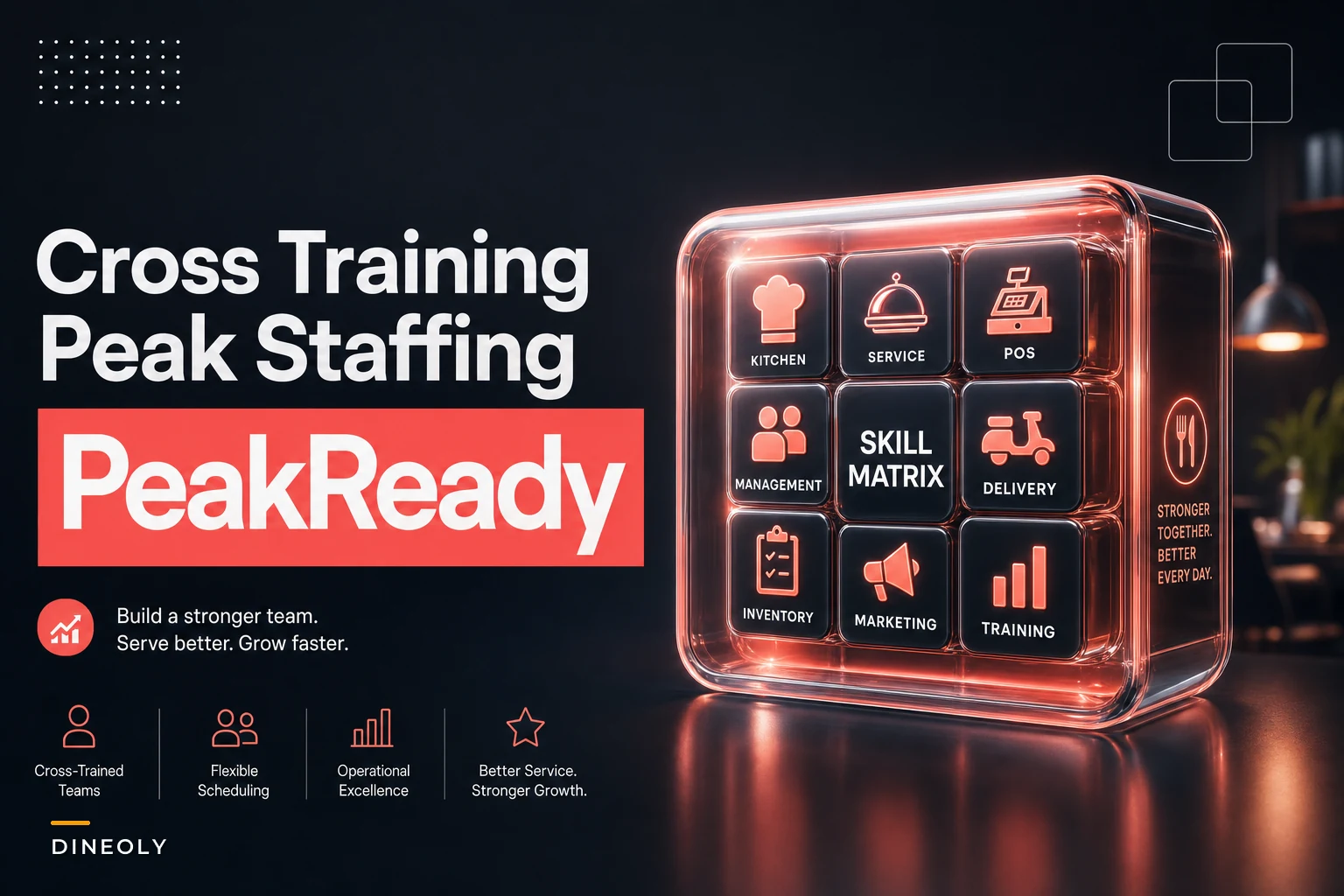
Forget the everything-to-everyone version. A useful matrix maps a small set of peak-critical stations against your staff, with three honest competency levels.
Eliminate operational bottlenecks effortlessly.
Dineoly helps you manage every reservation, order, and staff shift seamlessly.
- Unified reservation and order management
- Real-time staff scheduling
- Inventory and sales tracking
No credit card required
Here's the format that holds up in real operations:
| Staff member | Host/Seating | Food runner | Expo | Service bar | Line: cold/salad |
|---|---|---|---|---|---|
| Maria (server) | Sign-off ✅ | Sign-off ✅ | In sprint 🔵 | — | — |
| Dev (server) | Sign-off ✅ | Sign-off ✅ | Sign-off ✅ | In sprint 🔵 | — |
| Tasha (bartender) | — | Sign-off ✅ | Sign-off ✅ | Sign-off ✅ | — |
| Leo (line) | — | Sign-off ✅ | In sprint 🔵 | — | Sign-off ✅ |
| Priya (host) | Sign-off ✅ | In sprint 🔵 | — | — | — |
Three states only:
-
Sign-off ✅ — verified, can work it solo during a rush
-
In sprint 🔵 — currently upskilling, not yet peak-ready
-
— (blank) — not started
A common mistake is adding a "familiar" or "trained but rusty" tier. Don't. During a Saturday push you need a binary answer: can this person hold this station alone, yes or no? Anything mushier and managers won't trust the matrix, which defeats the whole point.
Keep the station list to the 4–6 spots that actually break during peaks. In most full-service places that's expo, food running, host/seating, and service bar — the choke points where one missing body cascades into slow tickets and blown tables. Deep kitchen stations like grill or sauté usually don't belong here. Those take real time and shouldn't be rushed.
Two-week upskilling sprints instead of open-ended training
The reason "learn expo when you have time" never happens is that it has no edges. A sprint gives it edges: one person, one new station, two weeks, then a sign-off decision.
Here's the structure that works:
-
Day 1 — pick one target per trainee. Not two. One station, chosen because it fills an actual coverage gap on the matrix. Priya learning food running matters more than Priya learning bar if you never lose bartenders on a Friday.
-
Days 2–4 — paired shadow shifts. The trainee works the station alongside someone signed off, on real service — not a slow Tuesday lunch nobody learns from. Live tickets or it doesn't count.
-
Days 5–9 — supervised solo reps. Trainee runs the station; the signed-off person is nearby but hands-off unless things break. This is where you find out if they can actually hold it.
-
Days 10–12 — the sign-off check. A short, specific competency review (below). Pass, and the box goes green. Fail, and you either extend one week or park it — no half-credit.
Two weeks is deliberate. Long enough to get real reps across a couple of weekends, short enough that people stay focused and you see results before a peak season, not after. Running these back-to-back, you can take a station from one person signed off to three in about a month.
One thing worth flagging: don't run sprints for more than two or three people at once. Every sprint consumes a signed-off trainer's attention during live service, and if you overload that, you degrade service quality for everyone. Stagger them.
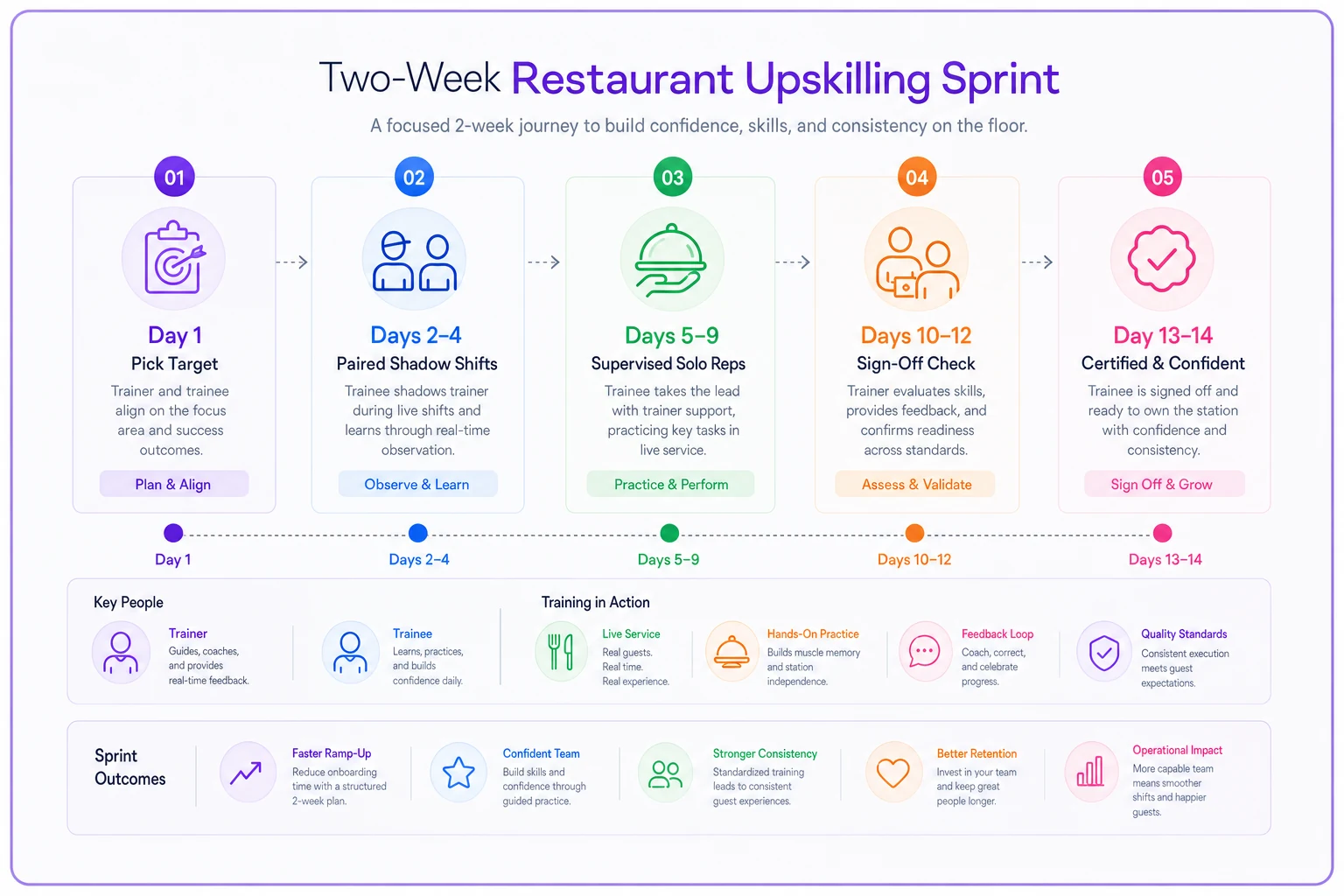
Here's a quick visual of the two-week sprint workflow.
Minimal competency sign-off checklists
This is where programs either get real or stay theater. A sign-off can't be "yeah, they seem fine." It also can't be a 40-point rubric nobody fills out. The sweet spot is 6–9 concrete, observable checks per station.
Example — Expo sign-off checklist:
-
- [ ] Reads the full ticket rail and correctly identifies the next 3 tables to fire
-
- [ ] Calls out an allergen/modifier ticket and confirms it verbally before it plates
-
- [ ] Wipes and inspects at least 8 consecutive plates without sending a wrong or cold plate
-
- [ ] Coordinates a split-table so all seats hit the pass within ~90 seconds of each other
-
- [ ] Handles one "we're slammed" moment
re-prioritizes tickets without stopping the flow
-
- [ ] Communicates a delay to the floor before it becomes a guest complaint
-
- [ ] Knows the escalation call when the kitchen is falling behind
The point of writing it this way is that a manager can watch one busy 30-minute stretch and check every box honestly. No box relies on interpretation. Either the split table hit together or it didn't.
The most common sign-off mistake is testing knowledge instead of performance. Asking "what would you do if…" tells you nothing. Watching them do it during a real rush tells you everything. Every checklist item should be something you observe, not something they recite.
For stations that touch coordination — expo especially — the sign-off should map directly to how your floor and kitchen already communicate. If you've built structured handoffs and peak-mode fast-track rules, your competency check for expo should mirror those exact protocols, so a newly signed-off person plugs straight into the system you already run.
Scheduling rules that make multi-skill worth it
You can have a perfect matrix and it still won't help if nobody wants to be flexible. Incentives fix that. A few rules that actually change behavior:
-
Flex-shift priority. Staff signed off on 2+ peak stations get first pick of the high-tip weekend shifts. This costs you nothing, and multi-skilled people will fight for it.
-
A small multi-skill premium. Even $0.75–$1.50/hour for anyone who worked a shift covering a station outside their primary role. Cheap relative to the cost of a blown Friday, and it makes flexibility a payday rather than a favor.
-
Cross-utilization on the schedule itself. Schedule multi-skilled people into "swing" slots deliberately — not locked to one station, but positioned to shift where the peak breaks that night.
-
Callout coverage tiers. When someone calls out, the schedule already shows who's signed off to backfill, ranked. No frantic group-text scramble.
Put sign-offs on the live schedule so staff see direct shift benefits and it becomes a visible reward.
Once staff see that green boxes translate into better shifts and a little extra pay, sign-offs stop being something you push and start being something they ask for. That flips the whole dynamic — you go from chasing people to complete training to managing a waitlist for sprint slots.
Where this connects to the rest of your operation is scheduling logic. If your labor and coverage decisions already run through structured control loops that link forecasts, reservations, and staffing, the cross-training matrix becomes a live input — the system knows who can cover what, so peak schedules build around real flexibility instead of guesswork.
A real scenario
A 70-seat neighborhood Italian spot, strong Friday/Saturday dinner, kept getting wrecked by single-point failures. One host. One expo who "owned" the pass. When either called out — which happened maybe two or three times a month — Fridays fell apart: ticket times crept past 20 minutes, a few tables walked before ordering, and the manager ended up expediting instead of running the floor.
They ran three two-week sprints over about six weeks. Sprint one: two servers signed off on food running and one on expo. Sprint two: the strongest bartender signed off on expo and one server on host/seating. Sprint three cleaned up the remaining gaps. They added a $1/hour multi-skill bump and gave flex-signed staff first pick of weekend shifts.
After roughly two months: expo coverage went from one signed-off person to three, host coverage from one to three. The next time the regular expo called out on a Saturday, a signed-off bartender slid over and ticket times barely moved — maybe a minute or two slower versus the usual meltdown. Weekend walk-outs from slow seating dropped to nearly none. The manager stopped being the emergency backup for two stations, which was arguably the biggest win and doesn't show up in any number.
When this makes sense — and when it doesn't
This works well when:
-
You have clear, repeatable peaks — weekend dinner, event nights — where single-station failures cost you real money.
-
Your core stations are learnable in two weeks
front-of-house roles, expo, food running, service bar.
-
You have at least a couple of strong signed-off people who can act as trainers without wrecking service while they do it.
This is a bad idea when:
-
You're trying to cross-train deep kitchen stations fast. Grill and sauté under volume take real time; rushing them creates food-cost and quality problems worse than the coverage gap you're trying to fix.
-
Turnover is so high that people leave before the sprint pays off. Fix retention first, or you're effectively training for your competitors.
-
You have no slack at all in your labor budget for shadow shifts. Sprints need a little paired-shift investment up front — if every shift is already skeleton-crewed, you can't run them properly.
Who should probably skip it: tiny operations where everyone already does everything, and highly specialized fine-dining kitchens where stations aren't interchangeable by design. For those, the matrix adds overhead without solving a real problem.
The thing to actually remember
Cross-training fails because most programs have no edges, no honest measurement, and no reward — not because staff can't learn. A compact matrix with three states, two-week sprints with a hard sign-off decision, and scheduling rules that pay off flexibility fixes all three at once. You stop hoping people will get around to learning and start building coverage on a schedule you control.
Start with your two worst single-point failures. Run one sprint. Get one person genuinely signed off — not "kind of trained." That single green box, backed by a real sign-off, is worth more than a spreadsheet full of optimistic colors nobody trusts.
Start with your two worst single-point failures. Run one sprint. Get one person genuinely signed off — not "kind of trained." That single green box, backed by a real sign-off, is worth more than a spreadsheet full of optimistic colors nobody trusts.
Ready to elevate your restaurant operations?
Join 2,000+ restaurants using Dineoly to enhance efficiency, increase table turnover, and delight diners.