
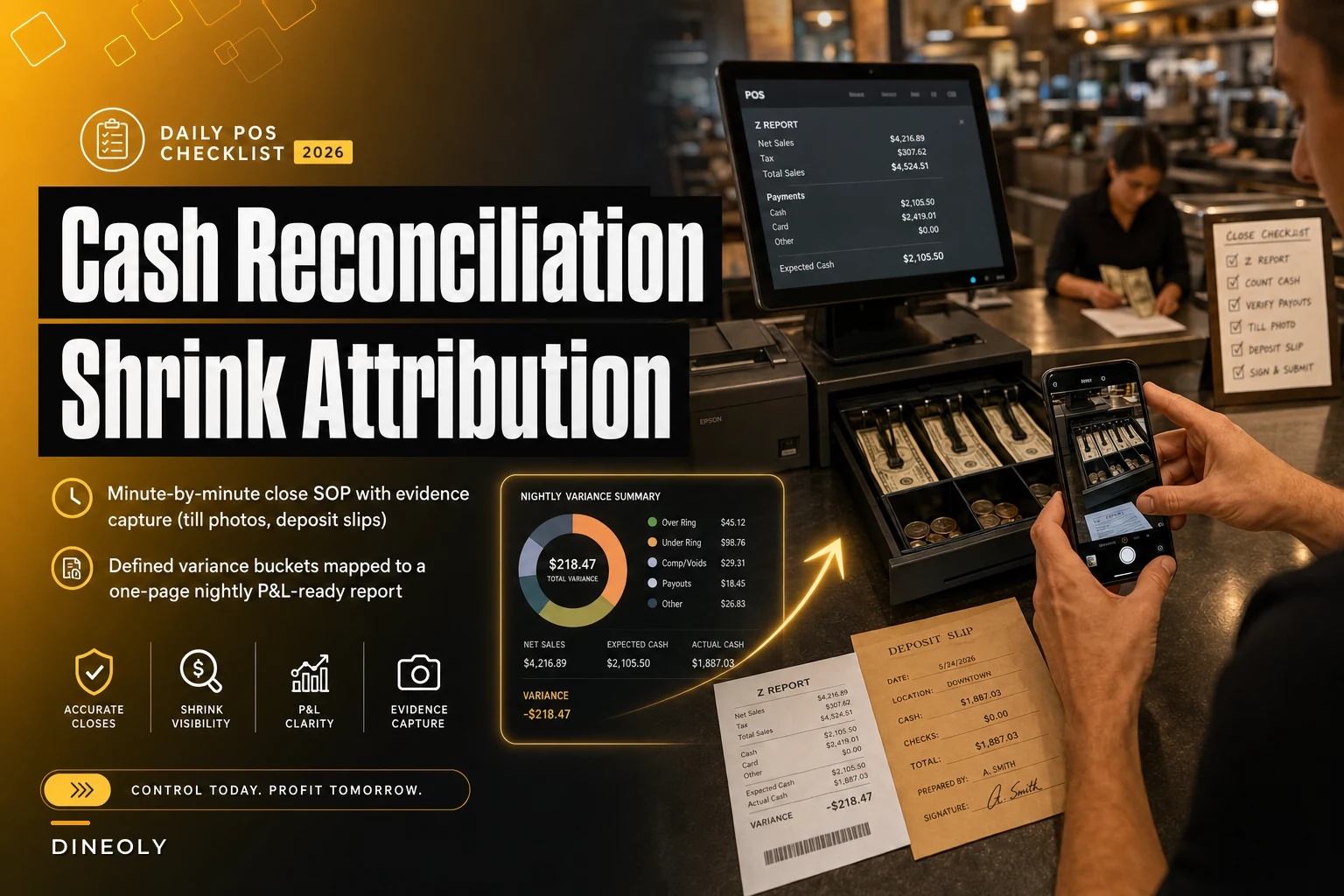

Most cash reconciliation problems don't show up as one big theft. They show up as a $12 short here, an $18 short there, a $7 over on Tuesday that nobody can explain. By the time the bookkeeper flags it three weeks later, the trail is cold. The server who ran that drawer is gone, the till photos don't exist, and the manager on duty "thinks" the tip-out was handled normally.
That gap — between the moment cash goes wrong and the moment anyone investigates — is where restaurants quietly bleed money. And it's almost always a process gap, not a people gap. If your close routine doesn't force evidence capture at the moment of counting, you're not reconciling. You're guessing after the fact.
Why "count it in the morning" quietly loses money
The pattern comes up constantly: closing manager counts the drawer, sees it's off by $23, shrugs because it's "within tolerance," drops the deposit, and goes home. No photo. No note on which POS transactions looked odd. No timestamp.
The problem is a single $23 short means nothing on its own. It's the sequence that tells you something — three shorts in a row on the same terminal, or shorts that only happen on split-shift Fridays, or overs that show up whenever a specific comp button gets used. You can't see sequences if you never captured the data points cleanly.
-
The variance gets rounded off mentally ("close enough")
-
Nobody records why they think it happened
-
The POS report and the physical count live in two different places
-
By month-end, you have a number in QuickBooks and zero context
The deeper issue isn't that drawers go short — they always will. Miskeyed orders, wrong change, a comp entered as a discount. The issue is that without evidence captured at close, every variance becomes an unsolvable cold case. Restaurant POS cash reconciliation only works if the evidence is frozen in time the moment the count happens.
Restaurant POS cash reconciliation only works if the evidence is frozen in time the moment the count happens.
The evidence you have to capture before anyone leaves
Evidence capture is the whole game. If you take one thing from this, it's that the close has to stop until the evidence exists. Not "we'll pull it up tomorrow." Now.
Eliminate operational bottlenecks effortlessly.
Dineoly helps you manage every reservation, order, and staff shift seamlessly.
- Unified reservation and order management
- Real-time staff scheduling
- Inventory and sales tracking
No credit card required
Here's what needs to be captured, and why each piece matters:
Till photo (before touching the count). A timestamped photo of the open drawer before counting. This does two things — it stops the "I counted it twice and got two numbers" argument, and it captures the physical state (bills folded weird, checks stuffed in a slot, a random gift card) that gets lost the second someone starts stacking coins.
Counted total with denomination breakdown. Not just "$412." The breakdown. A drawer that's exactly right on total but has zero fives and eleven twenties is telling you something about how change was made all night.
POS drawer/session report. Pulled and attached, not just glanced at. Expected cash, total sales, comps, voids, refunds, and payout activity for that specific session.
Deposit slip photo. The physical deposit tied to the count. This is the piece most places skip, and it's exactly where "the deposit was $40 light and nobody noticed for a month" comes from.
Named accountability. Who counted, who verified, which terminal, which shift. One count, two initials.
A one-line reason field for any variance over threshold. Even a bad guess is useful. "Think we gave change from the $100 that turned out fake" is a lead. Silence is not.
The rule that makes this stick: no deposit until evidence is complete. If the photo isn't taken and the reason field is blank on an over-threshold variance, the close isn't done.
Sorting variances into buckets that actually mean something
A raw variance number tells you nothing about what to do. "$31 short" — is that a training problem, a theft problem, or a POS-config problem? You can't tell until you attribute it to a bucket.
Most restaurants have exactly one bucket: "over/short." That's like a doctor writing "sick" on every chart. The whole point of attribution is to route the variance to the right investigation.
| Variance bucket | What it usually signals | Where you investigate first |
|---|---|---|
| Change-making error | Denomination breakdown is off even when total is close; overs and shorts both appear randomly | Retrain, check for a broken/slow terminal causing rushed change |
| Miskey / wrong tender | POS shows cash sale but card was actually run (or vice versa) | Pull transaction log, match to receipts, check the specific server |
| Comp/void leakage | Cash is short and comp/void counts are unusually high on that session | Review who authorized comps; tie to your discount governance rules |
| Payout/petty cash undocumented | Drawer short with no slip for a cash-out (vendor COD, tip payout) | Require a photo of every payout receipt going forward |
| Deposit discrepancy | Count matched but deposit came back light | Compare deposit slip photo to count photo, same session |
| Suspected internal theft | Repeat shorts, same person, same terminal, always just under threshold | Escalate — pattern across sessions, not a single event |
| Unexplained (genuine) | Evidence complete, everything reconciles, still off | Log it, watch for repetition, don't waste an hour hunting |
The key insight: the same $30 short goes into completely different buckets depending on the surrounding evidence. A $30 short with a clean denomination count and one giant comp is a comp-leakage problem. A $30 short with a mangled denomination breakdown is a change-making problem. Same dollar figure, totally different fix. That's why evidence capture has to come before attribution — the evidence is what determines the bucket.
If comps and voids are a recurring source of variances, the attribution here connects directly to how you're governing those approvals in the first place — this same tagging logic shows up in comps, voids and discount governance.
The minute-by-minute close sequence
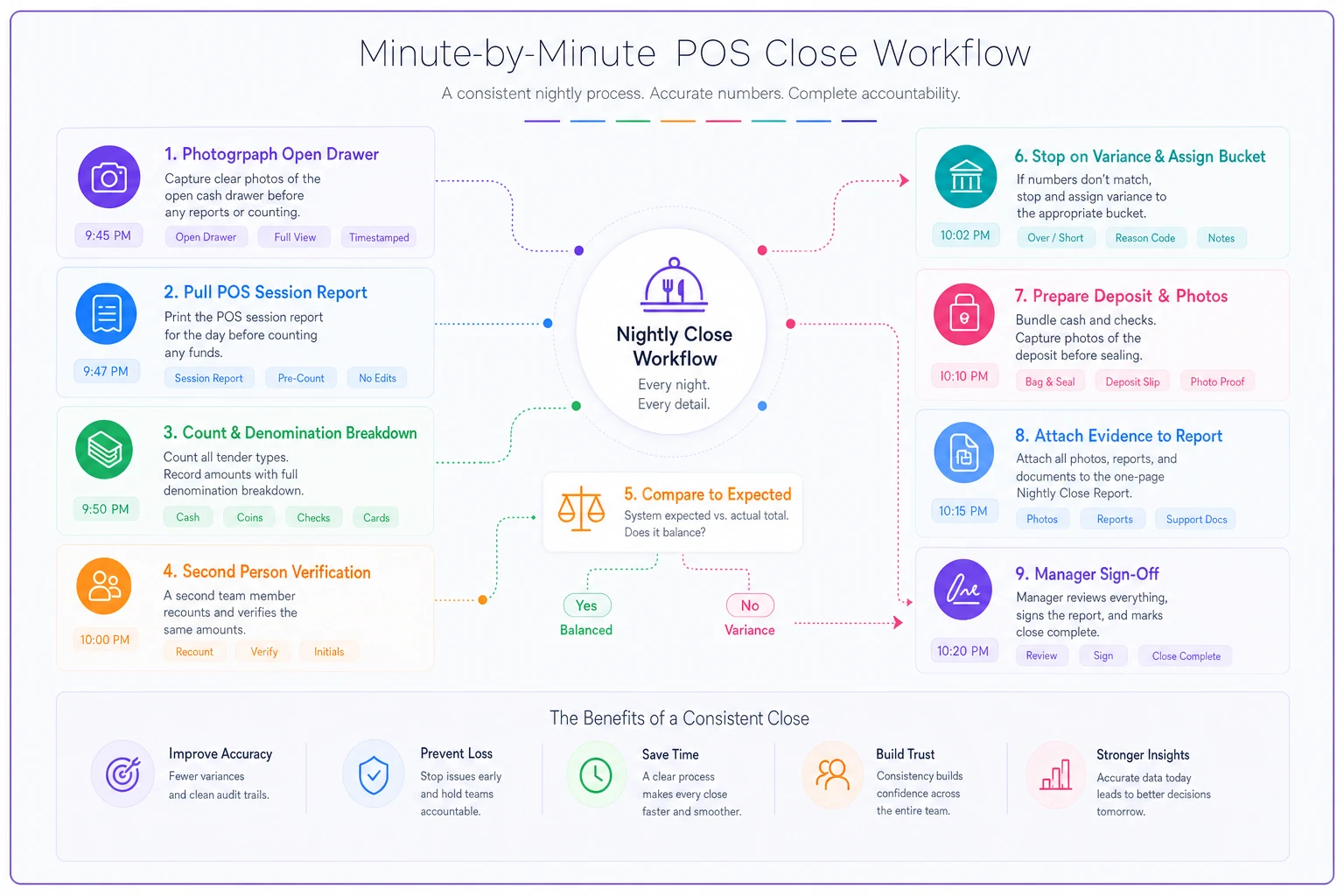
Order matters here. The most common mistake is dropping the deposit before pulling the POS report, which means the physical cash is already gone when you realize you needed to recount. Lock the sequence:
-
Photograph the open drawer — timestamped, before touching anything.
-
Pull the POS session report for that terminal and print or screenshot it. Do this before counting so expected cash is fixed and can't be adjusted to match.
-
Count with denomination breakdown, single counter, recorded on the sheet.
-
Second person verifies the total and initials. Two sets of eyes, always, on any drawer over a set amount.
-
Compare count to expected and calculate the variance.
-
If variance exceeds threshold, stop and fill the reason field and assign a bucket before continuing. Under threshold, log it and move on.
-
Prepare the deposit, photograph the deposit slip and the cash, and tie both to the session.
-
Attach everything to the nightly report — till photo, POS report, deposit photo, variance, bucket, reason.
-
Manager sign-off confirming evidence is complete. No sign-off, no closed session.
Pull the POS session report before counting to prevent the expected number from being adjusted to fit the cash.
The single highest-leverage step in that list is #2 — pulling the expected number before counting. When people count first and pull the report second, there's a natural temptation to make the count "work." Freezing the expected figure first removes that entirely.
The single highest-leverage step in that list is #2 — pulling the expected number before counting. When people count first and pull the report second, there's a natural temptation to make the count "work." Freezing the expected figure first removes that entirely.
The one-page nightly report
By the time the manager signs off, they should have a single page that a bookkeeper or owner can read in ninety seconds and act on. Not a spreadsheet dump. One page.
What it needs:
-
Date, shift, terminal, counter, verifier
-
Total sales, expected cash, counted cash, variance ($ and %)
-
Variance bucket and one-line reason
-
Comp/void/refund totals for the session
-
Links or thumbnails to the three photos (till, deposit slip, deposit cash)
-
A rolling flag
is this the 2nd or 3rd variance this week in the same bucket?
That last line is what turns a pile of nightly reports into an early-warning system. A single unexplained short is noise. The same bucket hitting three nights in a row is a signal — and the report should surface it without anyone manually flipping back through the week.
This report is also the clean handoff into your P&L. Cash variances mapped into shrink categories flow straight into the daily control loop instead of getting buried as a mystery line item — the same principle behind mapping daily control loops to your P&L.
A real scenario
A two-location casual spot — around 180 covers a night per location — was running a persistent cash short of roughly $200–$300 a week across both stores. Nobody could pin it. The owner assumed skimming and was ready to install cameras over every register.
They switched the close routine: till photo first, POS report pulled before counting, mandatory bucket and reason on anything over $10. Within about two weeks the pattern was obvious. It wasn't theft. One location had a comp button configured to log as a cash discount instead of a comp, so every comped meal made the drawer look short. The other location had two servers making change from a shared drawer during the dinner rush — a straight change-making and accountability problem.
Fixing the POS button config and splitting the drawer during peak cut the weekly shortage to under $40, most of it genuine rounding noise. No cameras needed. The variance was never a people problem — it was two miscategorized issues hiding behind one number, and the buckets separated them in days.
When this level of rigor makes sense (and when it's overkill)
Do this fully if: you run mostly cash or mixed tender, you have multiple people touching a drawer per shift, you're running more than one location, or you've already noticed variances you can't explain. The evidence-first routine pays for itself the first time it separates a config bug from suspected theft.
Scale it down if: you're a small, nearly cashless operation with one owner-operator closing every night. If 95% of your revenue is card and one person handles the drawer, the full photo-and-verify sequence is more ceremony than value. Keep the POS-report-before-count discipline and the bucket field; skip the double verification.
Don't bother building this at all if you have no cash drawer — pure card or mobile. Your reconciliation problem lives in tips, refunds, and chargebacks instead, which is a different workflow entirely.
The checklist is only as good as the "stop the close until evidence exists" rule. Every operation that skips the photos ends up back at square one, staring at a month-old short they can't explain. The evidence isn't bureaucracy — it's the only thing that turns a variance into a lead you can actually chase down while the trail is still warm.
Ready to elevate your restaurant operations?
Join 2,000+ restaurants using Dineoly to enhance efficiency, increase table turnover, and delight diners.