


Most restaurants that try demand-based pricing do it backwards. They read a headline about airlines or Uber, decide peak-hour surcharges are free money, then quietly bump Friday-night prices by 15% and wait for the extra margin to show up. What usually shows up instead is a one-star review mentioning "hidden price gouging," a confused host trying to explain why the same pasta costs different amounts, and a manager who can't tell whether the pricing change actually helped or just annoyed people.
The problem isn't the concept. Demand-based pricing works in plenty of hospitality settings. The problem is that restaurants treat it as a single lever instead of a system with a bunch of moving parts — service style, seat-time economics, guest perception, and a measurement setup that tells you whether the yield you gained cost you loyalty you can't easily replace.
This is a blueprint for running it as an actual pilot. Segmented by how you serve people. With pricing rules and hold rules written down before you start. With a couple of non-monetary scarcity experiments so you're not only pulling the price lever. And with a measurement matrix that ties yield per seat-hour back to guest satisfaction, plus recovery scripts for when it goes sideways — because it will, at least in a few cases.
Why "just raise peak prices" breaks in real operations
The core mistake is thinking demand-based pricing is about the price. It's about the seat. A restaurant doesn't sell food, it sells time-boxed access to a limited number of seats, and the whole game is revenue per available seat-hour (RevPASH). That framing changes everything, because it means a $19 entrée that turns a table in 45 minutes can out-earn a $34 entrée that holds the table for two hours.
This is where it falls apart for most operations. When you raise prices at peak without understanding your seat-time by service style, you often make the wrong tables more profitable to occupy slowly. A guest who paid a premium feels entitled to linger. Your turn rate drops. The yield gain from the higher price gets eaten by fewer covers. And nobody's watching that interaction, because the P&L only shows a revenue line — not revenue-per-seat-hour by daypart.
The second failure is perception drift. Diners tolerate price variation when it feels like there's a reason — a prix fixe on a holiday, a lower midweek menu, a happy-hour window. They revolt when it feels like they're being individually targeted at the exact moment they want to eat. What comes up again and again across small operations is that the mechanism of the price change matters more to reviews than the size of the change. A 12% swing framed as an "off-peak discount" barely registers. The same 12% framed as a "peak surcharge" generates complaints. Same money, opposite reaction.
So before touching a single price, you segment.
Segment the pilot by service style first
You cannot run one pricing pilot across a restaurant that does quick lunch counter service, à la carte dinner, and Saturday tasting menus. Each has a different seat-time profile, a different guest expectation, and a different tolerance for price movement. Lumping them together produces a muddy result you can't act on.
Eliminate operational bottlenecks effortlessly.
Dineoly helps you manage every reservation, order, and staff shift seamlessly.
- Unified reservation and order management
- Real-time staff scheduling
- Inventory and sales tracking
No credit card required
Break the pilot into segments that share seat-time economics and guest psychology:
| Service style | Typical seat-time | Price-sensitivity | Best pricing mechanism | Watch-out |
|---|---|---|---|---|
| Counter / fast-casual lunch | 20–35 min | High | Off-peak discount windows | Line perception, fairness |
| À la carte dinner (walk-in heavy) | 60–90 min | Medium | Menu-tier shifts by daypart | Turn rate drop at premium times |
| Reservation-driven dinner | 75–110 min | Medium-low | Time-slot pricing / deposit tiers | No-shows, seat-time overrun |
| Weekend brunch | 45–70 min | Medium-high | Scarcity + limited premium items | Wait-time backlash |
| Tasting / prix fixe | 120–180 min | Low | Fixed premium, date-based | Very low volume, high review weight |
Segmenting isn't just about cleaner data. Each segment gets a different pricing tool. Counter lunch responds well to discounting the dead 2–4pm window — you're pulling demand into empty seats, which nobody really complains about. Reservation dinner responds to time-slot pricing, where the 6:00 and 9:15 slots cost less than the 7:30 prime slot. That's the same logic as concert seats, and guests already accept it.
Applying the reservation-dinner playbook to your walk-in crowd, or adding scarcity mechanics to a counter that runs on volume, is where things go wrong fast. Match the mechanism to how people actually experience that service.
Concrete pricing rules and hold rules (write these before you launch)
A pilot without pre-written rules isn't a pilot, it's a vibe. You need two rule sets: how prices move, and when they stop moving. The hold rules are the ones everyone forgets, and they're the ones that protect you.
Pricing rules define the boundaries of movement:
-
Maximum swing per item
cap it. Something like ±10–12% off the base price for the pilot. Wider than that and you're testing outrage, not demand.
-
Direction bias
lead with off-peak discounts, not peak surcharges, wherever the segment allows. Discounts pull demand into empty seats; surcharges tax demand you already had.
-
Change frequency
prices adjust by daypart or slot, never mid-service and never per-guest. If two people at adjacent tables see different prices for the same dish, you've already lost.
-
Menu visibility
the varied price must be printed or displayed at the moment of decision, not surfaced at the check.
Hold rules define when you freeze pricing and revert to baseline, no matter what the yield model says:
-
If satisfaction score for a segment drops more than a set threshold (say 0.3 on a 5-point scale) versus the pre-pilot baseline, freeze that segment.
-
If the same complaint theme ("prices," "fairness," "confusing") appears in more than a handful of reviews in a rolling two-week window, freeze.
-
If turn rate at premium slots falls enough to wipe out the price gain, freeze — this is the trap where higher prices produce lower RevPASH.
-
If a regular flags it directly to a manager, that's not a data point to average away. Log it and check the segment.
The reason hold rules go in writing before launch is that once revenue looks good, everyone gets attached to it. A written hold rule lets a manager pull the plug on a segment without relitigating the whole decision at 8pm on a Saturday.
Non-monetary scarcity experiments (the underused lever)
Most restaurants skip this part entirely: you don't have to move price to shift demand. Scarcity and framing move behavior on their own, and they carry almost none of the "gouging" perception risk that price surcharges do.
Run these alongside the pricing tests, in separate segments so you can read them cleanly:
-
Limited-availability signature items. A specific dish available only in limited quantity per service, or only during certain slots. It drives demand toward the times you want filled without any surcharge, and protects perceived value.
-
Time-slot framing. Present less-popular slots as "chef's table window" or "early access" rather than "off-peak." Same seats, better story, and guests self-select into the times you need filled.
-
Reservation deposit tiers instead of price tiers. For prime slots, require a modest per-head deposit that applies to the bill. It reduces no-shows on your most valuable seats and gently nudges casual bookers to off-peak, without changing menu prices at all. This connects directly to how you architect the whole booking experience — worth reading alongside a guest experience architecture that turns reservations into recovery, segmentation and loyalty workflows so the deposit isn't a bolt-on but part of a coherent flow.
-
Bundling at the margin. Instead of raising the entrée, pair it with a first course or drink at a fixed combined price during peak. Guests read it as value, and your average check rises without a visible price bump.
Scarcity and framing experiments often deliver somewhere around 60–70% of the yield benefit of straight peak pricing with a fraction of the reputational downside. If you only run one type of experiment, run these first. They tell you how much of your demand problem is actually a price problem versus a timing and framing problem — and for most restaurants, it's more timing than price.
If you only run one type of experiment, run these first.
They tell you how much of your demand problem is actually a price problem versus a timing and framing problem — and for most restaurants, it's more timing than price.
The measurement matrix: linking yield to satisfaction
Without this, you're guessing. The single most common reason pricing pilots produce ambiguous results is that restaurants measure revenue and stop there. Revenue can go up while your business gets worse — more money from fewer, unhappier guests who won't come back.
Measure two axes together, always paired:
Yield axis:
-
RevPASH by segment and daypart (revenue per available seat-hour — the real number)
-
Average check by segment
-
Turn rate / actual seat-time versus target
-
Slot fill rate (are the discounted/off-peak slots actually filling?)
Satisfaction axis:
-
Post-visit satisfaction score by segment (survey or review-derived)
-
Review sentiment specifically around value and fairness
-
Repeat-visit rate for pilot segments versus baseline
-
Complaint themes, tagged and counted
The rule that keeps you honest: a yield gain only counts if satisfaction holds flat or improves. If RevPASH rises 8% in a segment but repeat-visit rate slips and value-complaints climb, you didn't win. You borrowed money from next quarter's regulars.
A simple way to read the results is a two-by-two. High yield + stable satisfaction = keep and expand. High yield + falling satisfaction = you're eroding the base, revert or reframe. Low yield + stable satisfaction = the mechanism didn't move behavior, drop it. Low yield + falling satisfaction = kill it. Most segments won't land cleanly in one box, which is exactly why you segment — a blended number hides all four outcomes happening simultaneously.
All of this only works if the underlying data actually connects. Your reservation system, POS, and seat-time tracking have to feed the same place, or you'll be reconciling spreadsheets at midnight. That's less about fancy software and more about having tight control loops between the moving parts — which is the whole idea behind an operational backbone that links reservations, staffing, orders and inventory. Pricing pilots live or die on whether those systems talk to each other.
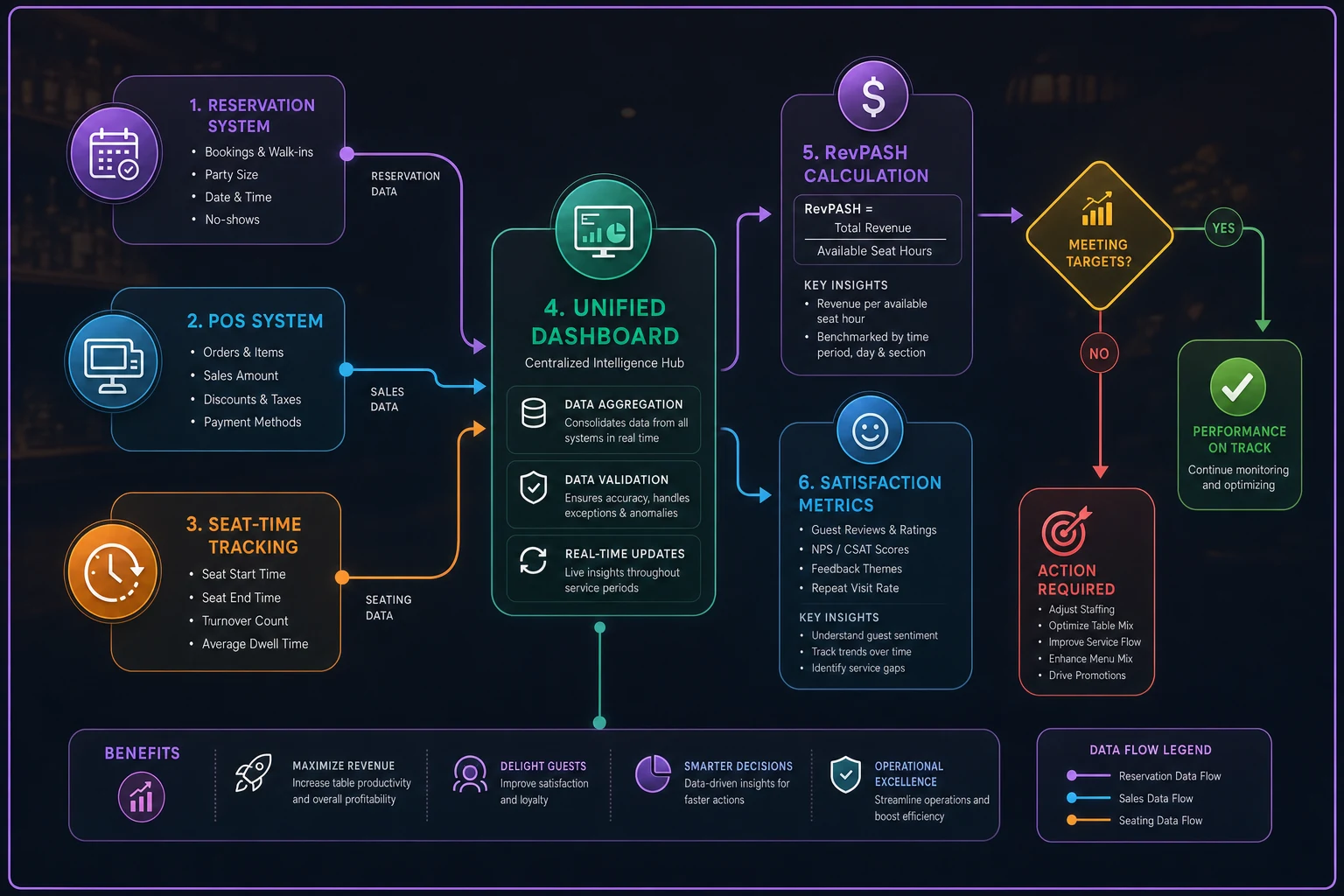
This shows how the reservation system, POS, and seat-time tracking feed into a dashboard that pairs yield and satisfaction.
Refund and recovery scripts for when it goes sideways
Some guests will feel wronged. Plan for it, because an unhandled pricing complaint becomes a public review, and a well-handled one often becomes a returning customer. The goal of recovery isn't to defend the pricing — it's to protect the relationship.
A few scripts, adjusted to context:
At the table, guest questions the price: "Totally fair question — our dinner pricing shifts a little by time slot, kind of like how the earlier and later seatings are priced differently. It's all listed on the menu, but if it caught you off guard tonight, let me take care of the difference this visit." Then log it.
Online review mentioning "hidden" or "surprise" pricing: "Thanks for flagging this, and I'm sorry it felt unclear — that's on us, not on you. Our prices vary by seating time and it should be obvious on the menu, not a surprise at the end. I'd like to make the last visit right, please reach out directly." Public, brief, no defensiveness.
A regular who feels the premium slots pushed them out: This one you handle with a person, not a script. A regular flagging pricing is worth more information than fifty anonymous covers. Offer to hold a preferred slot at baseline, and treat it as a signal that the segment may need reframing.
The recovery principle: refund small, fast, and without argument during a pilot. The cost of comping a difference is trivial. The cost of a guest deciding your restaurant got greedy is not. Track every recovery event as a data point — a spike in recovery incidents in one segment is itself a hold-rule trigger.
When this makes sense — and when it doesn't
Demand-based pricing in restaurants makes sense when:
-
You have clear, repeatable demand peaks and troughs (packed 7
30, empty 5:00)
-
Your POS and reservation data are clean enough to measure RevPASH by segment
-
You have off-peak seats to fill — discounting into empty capacity is nearly risk-free
-
You serve a mix of price-sensitive and price-insensitive dayparts
It's a bad idea when:
-
Your demand is flat across the week — there's nothing to arbitrage
-
Your data is a mess and you can't reliably tie seat-time to revenue
-
You're a neighborhood spot whose entire value is trust and consistency, where any perceived pricing game costs more than it earns
-
You'd be doing it to cover margin problems that are really cost or portioning problems in disguise
That last one matters. If margins are thin because of food cost or over-portioning, dynamic pricing is a band-aid over the wrong wound. Fix the costing first, then optimize yield on top of a healthy plate margin.
A realistic scenario
A 70-seat neighborhood bistro doing à la carte dinner had a classic pattern: jammed from 7:00–8:30, dead before 6 and after 9. Instead of surcharging the prime window, they ran a segmented pilot — a 10% off-peak menu on the early and late slots, a small deposit on Friday and Saturday prime reservations, and one limited-quantity signature dish offered only in the early window to pull people in.
Over about six weeks, the early-slot fill rate climbed from somewhere around 40% to roughly 65%. RevPASH across the whole dinner service rose in the high single digits — not from charging more, but from filling seats that used to sit empty. No-shows on prime weekend slots dropped noticeably because of the deposit. Satisfaction scores stayed basically flat, and value-related complaints actually ticked down, because the off-peak discount made the place feel more accessible, not more expensive.
The interesting part was what they didn't do. They never touched prime-time prices. The entire yield gain came from off-peak discounting, scarcity framing, and deposits — while the surcharge lever they'd originally planned to pull stayed holstered. When they modeled a prime surcharge later, the projected review risk wasn't worth the marginal dollars.
The takeaway
Demand-based pricing in restaurants isn't a switch you flip — it's a controlled experiment you run in segments with the brakes already installed. The restaurants that get it right lead with off-peak discounts and scarcity framing before ever reaching for a surcharge, they measure yield and satisfaction as a single paired metric, and they write their hold rules and recovery scripts before opening night, not after the first bad review.
Do it in segments. Measure RevPASH against guest satisfaction together, never separately. Keep the price swings modest and the framing generous. And when deciding whether to expand a segment, ask the only question that matters: did the yield gain hold without borrowing from the loyalty that took years to build? If yes, expand it. If no, freeze it, reframe it, and try again.
Demand-based pricing in restaurants isn't a switch you flip — it's a controlled experiment you run in segments with the brakes already installed. The restaurants that get it right lead with off-peak discounts and scarcity framing before ever reaching for a surcharge, they measure yield and satisfaction as a single paired metric, and they write their hold rules and recovery scripts before opening night, not after the first bad review.
Ready to elevate your restaurant operations?
Join 2,000+ restaurants using Dineoly to enhance efficiency, increase table turnover, and delight diners.