

Most restaurants don't have a feedback problem. They have a sorting problem.
The complaints come in — a cold entrée flagged mid-service, a one-star Google review at 11pm, a text from a regular who felt rushed, a comment card that says "server seemed annoyed." All of it lands in the same undifferentiated pile. Some gets handled brilliantly. Some sits for four days. And the stuff that sits is almost always the stuff that mattered most.
The gap isn't caring. Managers care. The gap is that there's no shared rule for what gets handled right now versus what waits, and no script for the person who happens to be standing there when the guest is still in the building.
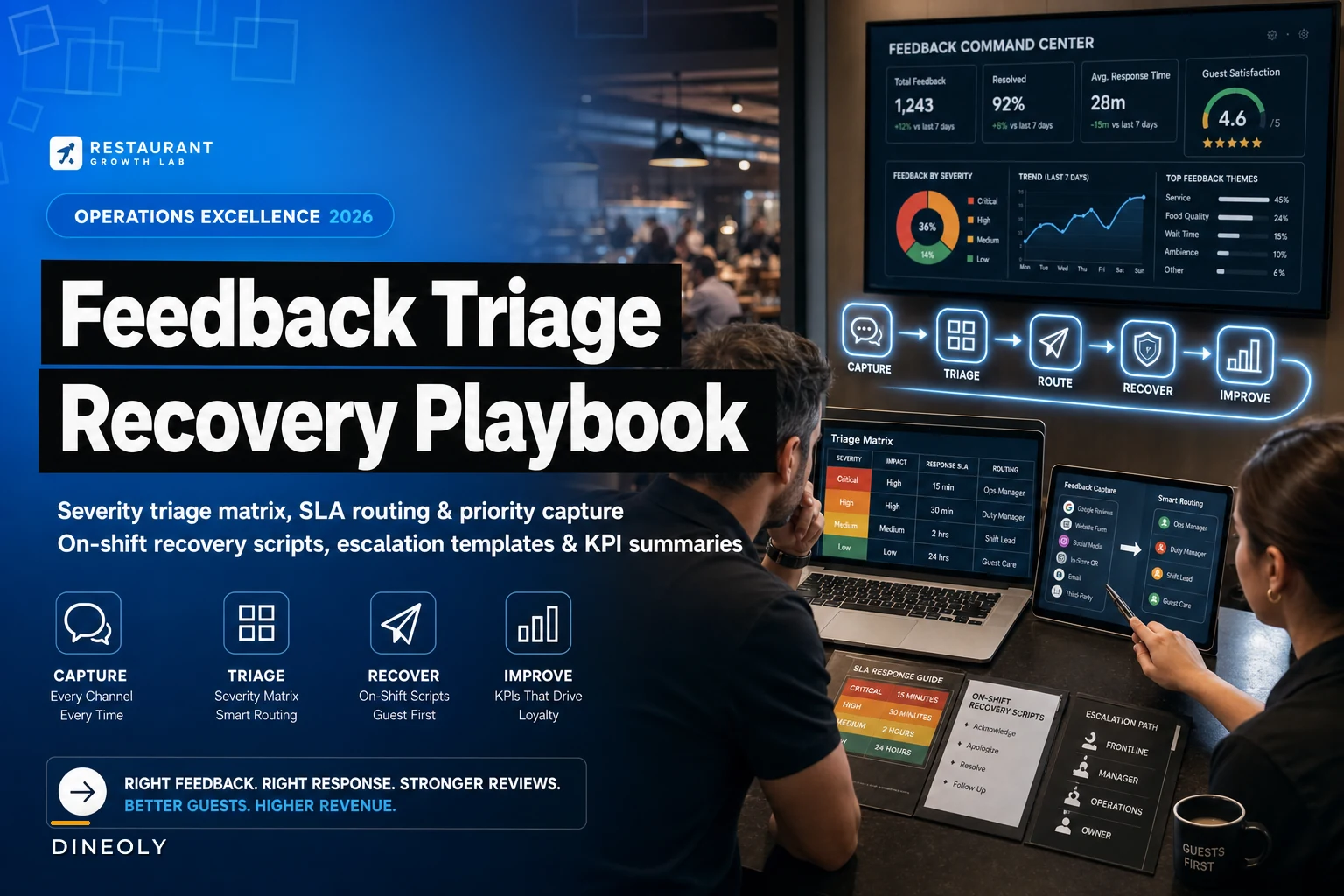
This playbook is about building that sorting logic — a triage matrix by severity, SLA-based routing, on-shift recovery scripts, one-touch escalation, and a weekly loop that ties outcomes back to your loyalty segments.
Severity and urgency are not the same thing
A guest telling your host "the AC is freezing over here" and a guest quietly deciding never to come back after a botched anniversary dinner are not the same event. But in most operations they get the same non-response, because nobody classified them differently at the moment of capture.
The pattern goes like this: front-of-house staff triage feedback emotionally instead of systematically. A loud, angry guest gets immediate attention. A calm, disappointed regular gets a polite "so sorry, I'll pass that along" — and then nothing passes along. The angry table might've been a one-time diner. The calm regular spent roughly $2,400 with you last year.
Severity (how bad the experience was) and urgency (how fast you must act) are two different axes. When you collapse them into one, you over-serve the loud and under-serve the loyal.
The triage matrix: severity × recoverability
Build a simple 2-axis matrix your team can hold in their head. Severity of the miss on one axis, whether the guest is still recoverable right now on the other.
Eliminate operational bottlenecks effortlessly.
Dineoly helps you manage every reservation, order, and staff shift seamlessly.
- Unified reservation and order management
- Real-time staff scheduling
- Inventory and sales tracking
No credit card required
| Category | What it looks like | SLA (response window) | Who owns it |
|---|---|---|---|
| P1 — In-house, high severity | Wrong order on an allergy table, spoiled food, guest visibly upset, still seated | Immediate (< 2 min) | Manager on shift, in person |
| P2 — In-house, moderate | Slow service, cold side, minor order error, guest still here | Same visit (< 10 min) | Section server + shift lead |
| P3 — Post-visit, high severity | 1–2 star review, angry email, "never coming back" text | Same day (< 4 hrs) | GM or designated responder |
| P4 — Post-visit, moderate | 3-star review, comment card gripe, "it was fine but…" | 48 hrs | Assigned closer, batch review |
| P5 — Signal, low severity | Passing comment, minor suggestion, one-off nitpick | Weekly rollup | Logged, no direct reply |
The single most useful line in that table is P3. Post-visit high-severity feedback is the category restaurants handle worst, because the guest is gone and the pressure is off. That's exactly why it deserves a hard 4-hour SLA. A response inside four hours to a bad review recovers a meaningful number of guests. A response three days later reads as damage control.
Worth sitting with: recoverability decays fast. A P1 handled at the table has maybe an 80% recovery rate. The same complaint, if it escalates to a review because nobody caught it in-house, drops to something closer to 30% even with a good response. The whole point of triage is catching things while they're still cheap to fix.
On-shift recovery scripts: what the person standing there actually says
Recovery fails in the moment not because of lack of authority — it's lack of words. A server knows they can comp something, but freezes on how to open the conversation without either over-apologizing or sounding scripted. So they under-react.
The P1/P2 in-house recovery shape:
-
Acknowledge specifically — name the actual miss, not a vague "sorry about that." → "The salmon came out overcooked and that's on us."
-
Take ownership, no excuses — don't blame the kitchen or the rush. → "I should've caught that before it left the pass."
-
Offer the fix, then the gesture — remake first, comp second. → "I'm firing a new one right now — that'll be about six minutes. And I'm taking it off the check."
-
Confirm the recovery landed — circle back after the fix. → "How's the second one? I want to make sure we got it right this time."
That step 4 is the one everyone skips. The remake goes out and the server never returns to confirm the guest is actually okay. Recovery isn't the gesture — it's the confirmation the guest felt taken care of. Without the loop-back, you spent the comp and never bought the loyalty.
Have servers mark 'confirmation completed' on the check to ensure step 4 isn't skipped.
For the awkward one — a calm, disappointed regular — the script changes. You don't over-comp. You acknowledge you know them:
> "You come in a lot and I know tonight wasn't our best. That matters to me more than most tables because you've given us so many good nights. Let me make the rest of this evening right." That costs nothing and lands harder than a free dessert.
One-touch escalation: kill the "let me go ask" delay
Recovery dies in the gap between "I should escalate this" and "I found a manager." During a Friday rush, a server flagging a P1 to a manager who's buried at the host stand can burn eight minutes. By then the guest has stewed.
One-touch escalation means the trigger to pull in a manager is a single action, not a hunt. In practice that's a fixed phrase over the headset, a flagged ticket, or a tap in whatever system you run — the mechanism matters less than the rule that P1 always escalates immediately and P2 escalates if the section is slammed.
Build a short escalation template so the handoff carries context, not just "table 12 is mad":
-
What happened (one line)
entrée returned twice, allergy table
-
Guest state
frustrated but calm, still seated
-
What's already been done
offered remake, guest declined
-
What I need
manager touch + decision on comp
The escalation should take fifteen seconds to communicate and give the manager everything they need to walk over ready to act. What kills recovery is the manager arriving cold, asking the guest to re-explain the whole thing — now the guest has told the story twice and feels processed rather than cared for.
Routing post-visit feedback so nothing rots in an inbox
In-house triage is half the game. The other half is what happens to reviews, emails, and texts that arrive after the guest leaves — the P3/P4 world.
The failure here is ownership ambiguity. A bad review lands and everyone assumes someone else is handling it. Then it's Tuesday and the Sunday review still has no reply. The fix is a named responder per shift or per day, with the SLA clock visible.
A workable routing flow:
-
Capture everything in one place. Reviews, comment cards, emails, DMs — a single intake. Feedback scattered across five channels can't be triaged because no one sees the full pile.
-
Auto-tag severity on arrival. Star rating and keywords ("allergy," "sick," "rude," "manager") should flag P3 the moment it lands.
-
Route to the owner with the clock attached. The responder sees "P3 — respond by 2:15pm," not just a new notification.
-
Require a closure note. No item closes without a one-line outcome: responded, offered return visit, guest accepted.
This is where operational software earns its keep quietly — not by writing responses for you, but by making sure a P3 can't sit unseen. Automated tagging and SLA timers turn a pile into a queue, and a queue is something a busy GM can actually clear. The judgment stays human; the sorting and the reminders don't need to be.
Restaurants that already run structured guest workflows have a head start here. If you've built out a guest experience architecture that turns reservations into recovery and loyalty segments, your triage system plugs straight into it — you already know who your high-value guests are before their feedback even arrives.
A simple routing workflow:
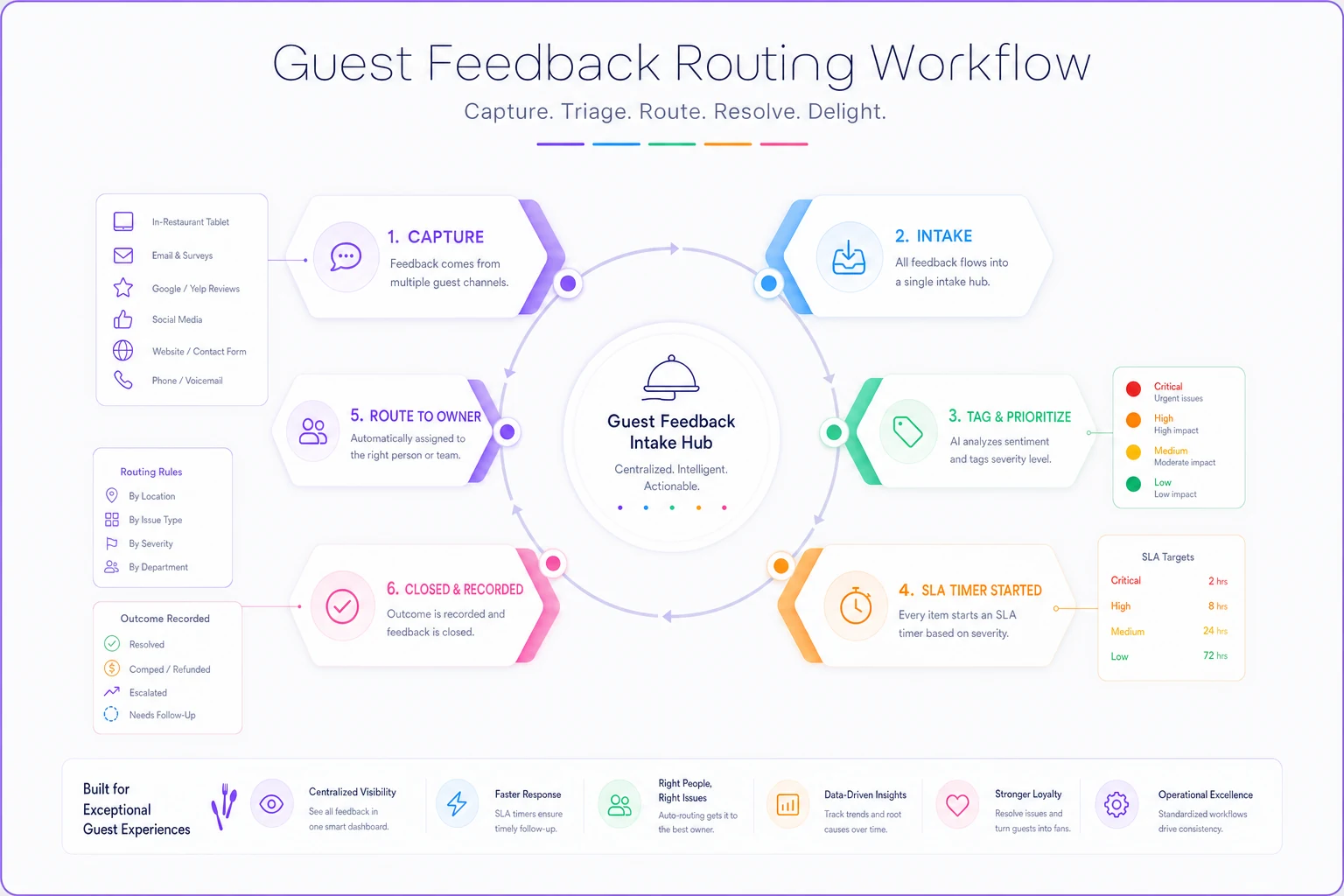
The judgment stays human; the sorting and the reminders don't need to be.
The weekly loop: turn feedback into fixes
Handling complaints one at a time is table stakes. The restaurants that pull ahead read the pattern every week and fix the source.
Every Monday, a 20-minute review of the prior week's feedback log should answer four questions:
-
What category spiked? Three "slow service" P2s on Friday isn't three complaints — it's a Friday staffing problem.
-
Which loyalty segment is hurting? If your regulars are generating the P3s, that's a retention fire. If it's first-timers, it's an onboarding or first-impression issue.
-
What was our SLA hit rate? Percentage of P1–P3 handled inside the window. If P3 SLA compliance is under 80%, your routing is broken, not your team.
-
What's the one operational fix this week? Tie at least one complaint cluster to a concrete change — reslot a server, re-fire a station, retrain a step.
The connection most reporting misses: link outcomes to loyalty segments. A comped dessert that saves a two-visit-a-week regular is worth wildly more than the same comp on a walk-in tourist. When your weekly summary shows which segment you recovered, comps stop being a cost line and become a retention investment you can actually measure.
Real scenario: a 90-seat neighborhood bistro
A family-run bistro, roughly 90 seats, was averaging a 3.6 Google rating and couldn't figure out why regulars were thinning out. Feedback existed everywhere — comment cards in a drawer, reviews nobody replied to, complaints the servers "mentioned to the manager" verbally.
-
Review response time dropped from never-to-three-days to under 3 hours on nearly every P3.
-
Rating moved from 3.6 to around 4.2 — mostly because responded-to reviewers edited their scores up.
-
The weekly loop surfaced that most P2 slow-service complaints clustered on two specific server sections during the Friday turn. One scheduling change fixed it.
-
Comps didn't rise. They actually dropped slightly, because in-house recovery caught problems before they became after-the-fact appeasement.
Nothing exotic. They just stopped treating every piece of feedback as the same undifferentiated thing.
When this makes sense — and when it's overkill
Build the full matrix when you're doing enough covers that feedback comes from multiple channels and a single person can't track it all in their head. Roughly 60+ seats, active online reviews, a repeat-guest base worth protecting.
Keep it lightweight when you're a small counter-service spot with mostly walk-ins and few reviews. A two-tier "handle now / log for later" split is plenty. Building a five-tier SLA system for 20 reviews a month is process for its own sake.
Who should NOT bolt this on first: if your in-house recovery is broken — servers who don't acknowledge misses, managers who never table-touch — fix that before building routing logic. A great triage queue feeding a team that can't recover at the table is just a very organized way to lose guests. And if no-shows and reservation gaps are your bigger leak, start with the no-show recovery and confirmation playbooks first — feedback triage matters more once your seats are reliably full.
Feedback doesn't hurt you when it's negative. It hurts you when it's unsorted — when the loud one-timer gets your energy and the quiet regular gets a shrug, when the bad review sits for three days, when the server who could've fixed it at the table didn't have the words. Severity and urgency are two different questions. Answer them separately, give your team scripts for the moment they're standing in, put a clock on the post-visit stuff, and read the pattern every Monday. Do that consistently and feedback stops being a pile you dread — it becomes the cheapest retention tool you own.
Ready to elevate your restaurant operations?
Join 2,000+ restaurants using Dineoly to enhance efficiency, increase table turnover, and delight diners.