


Most kitchens don't fail inspections because someone forgot how to run a restaurant. They fail because a walk-in gasket cracked three weeks ago and nobody logged it, or because the sanitizer bucket read 50 ppm at 2pm and nobody re-checked it before the dinner push. The failures are boring. That's exactly why they slip through.
The fix isn't a giant binder or a once-a-year panic clean. It's a set of short, drilled routines that run on a fixed cadence, produce a signature, and leave a trail you can actually pull up when the inspector is standing in your prep area at 10:45 on a Tuesday. This is what a real restaurant health inspection readiness checklist looks like when it's built into daily operations instead of taped to a wall.
The failure pattern nobody wants to admit
The most common violations are not surprises. Pull the inspection reports for any city and the same handful of items come up over and over — improper hot/cold holding temps, missing sanitizer concentration, handwashing sink blocked or out of soap, food stored uncovered, no date labels on prepped items.
Every one of those is preventable in under 30 seconds if someone checks it. The problem is nobody owns the check. In a typical mid-size kitchen, the prep cook assumes the closing manager handles temps, the closing manager assumes the opener wiped down and re-stocked, and the walk-in thermometer has been reading "close enough" for so long that nobody trusts it anymore.
Inspection failures cluster around ownership gaps, not knowledge gaps. The line cook knows food needs to be below 41°F. They just weren't the person responsible for confirming it at 3pm. That gap is where the violation lives.
Drill 1: The 10-minute daily check
The daily check is the smallest unit here and the one that does the most work. It should take one person about ten minutes, run twice a day — open and mid-afternoon before dinner — and produce a timestamp with a name attached.
Eliminate operational bottlenecks effortlessly.
Dineoly helps you manage every reservation, order, and staff shift seamlessly.
- Unified reservation and order management
- Real-time staff scheduling
- Inventory and sales tracking
No credit card required
Keep it short enough that people actually do it. If your daily check takes 40 minutes, it won't survive a busy Friday.
-
Cold holding — walk-in, reach-ins, and any prep rails read at or below 41°F (log the actual number, not a checkmark)
-
Hot holding — soups, sauces, held proteins at or above 135°F
-
Sanitizer — test strip reading on every bucket and the dish machine final rinse
-
Handwashing stations — soap, paper towels, hot water, nothing stacked in the sink
-
Date labels — spot-check the walk-in for anything unlabeled or past its discard date
-
Chemical storage — nothing stored above or near food, labels facing out
The rule that makes this work: log the number, not the checkmark. A checkbox that says "sanitizer OK" tells you nothing three weeks later. "Dish machine final rinse: 50 ppm at 10:12am, JR" tells you exactly what was true, when, and who confirmed it. If a reading is out of range, it triggers the corrective-action step instead of a shrug.
One pattern worth flagging: kitchens that let the same person run the daily check every single shift develop blind spots. That person stops seeing the thing they walk past every day. Rotating across two or three trained people catches more.
Rotate the daily-check assignment across opening, mid, and closing shifts to avoid blind spots.
Here's a simple visual of the daily check workflow.
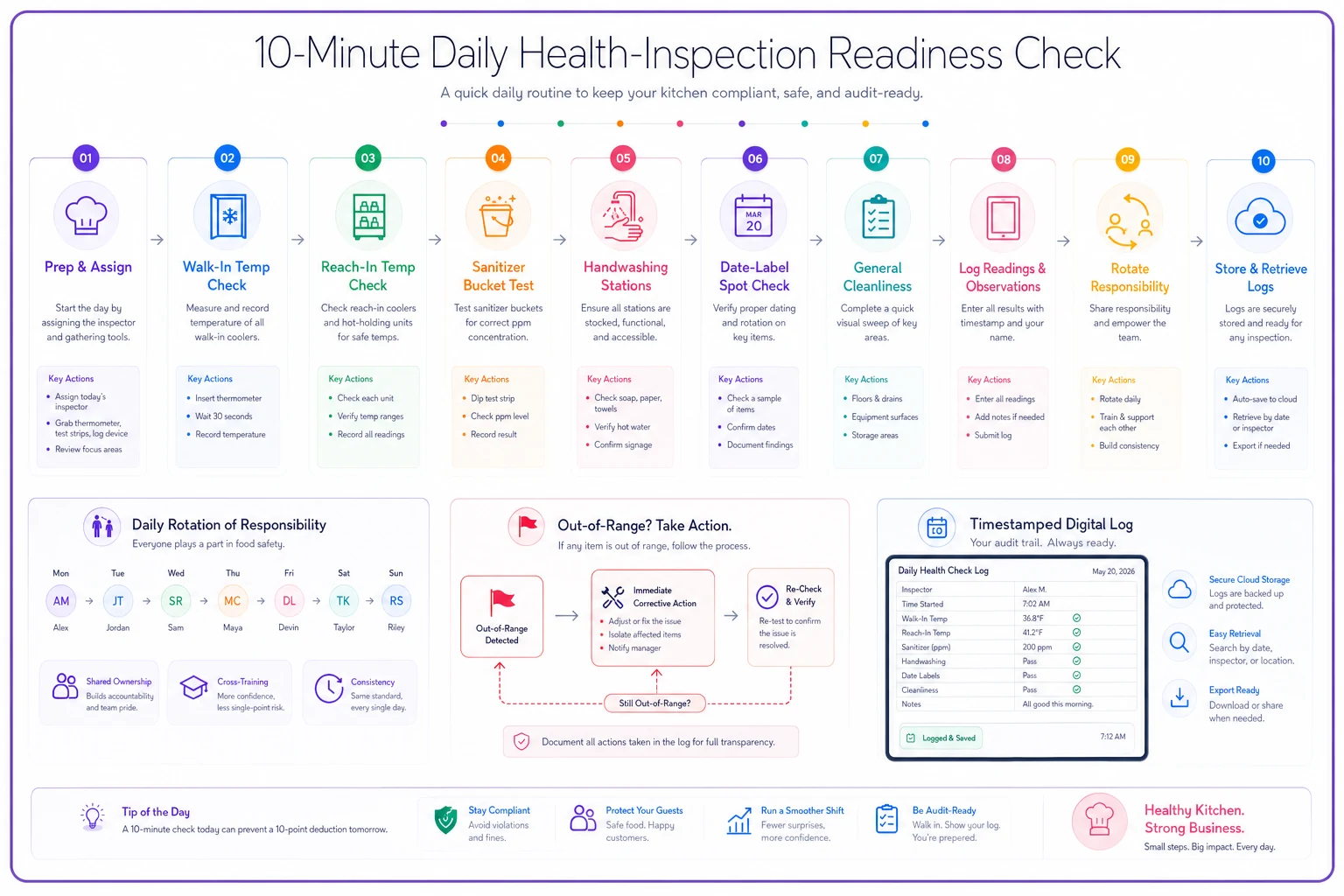
Rotating responsibility and logging exact readings makes the workflow auditable and hard to fake.
Drill 2: The 48-hour and 24-hour pre-inspection routines
You usually can't predict the exact day, but you can predict the window. Most jurisdictions inspect on a rough cycle, and if you got hit six months ago during a routine sweep, another one's coming. The 48/24-hour drills exist to turn "we should probably deep clean sometime" into two scheduled sessions.
The point of splitting into 48 and 24 hours is sequencing. The 48-hour drill handles the slow, structural stuff that needs lead time. The 24-hour drill is verification and the final surface-level pass.
48-hour drill focuses on items that need a day to correct:
-
Deep-clean of hood filters, walk-in floors and shelving, floor drains
-
Pull and check every held thermometer against a calibrated reference
-
Inventory sweep for expired product and unlabeled containers — anything questionable gets pulled now, not the morning of
-
Pest evidence check along walls, under equipment, storage corners
-
Verify every work order that's been sitting open (that cracked gasket, the drippy sink, the reach-in that runs warm)
24-hour drill is confirmation:
-
Re-run the full daily check twice, morning and evening
-
Confirm all corrective actions from the 48-hour pass are closed and signed off
-
Print or pull the last 30 days of temperature and sanitizer logs so they're ready to hand over
-
Walk the front-of-house the way an inspector would — restroom soap, floor around the soda fountain, ice scoop storage
A kitchen that finds a reach-in running at 46°F during the 48-hour pass still has time to call service, get it repaired, and re-verify before anyone shows up. Check that same unit 24 hours out and you're moving product and hoping for the best. The buffer is the whole point.
Corrective-action templates: the part most kitchens skip
Finding a problem is only half the drill. The other half is proving you fixed it. This is where audit-readiness actually lives, and it's the piece nearly everyone underbuilds.
A corrective action needs four things logged, every time:
-
What was found — "Walk-in reach-in reading 46°F at 3
14pm"
-
What was done — "Product moved to backup walk-in, service called, unit tagged out of use"
-
Who did it and when — name and timestamp
-
Verification signoff — a second person, usually a manager, confirming the fix held and re-checking the reading
That signoff line is the one people cut. It feels like bureaucracy until an inspector asks "what happened when this unit failed?" and you can show a closed loop with two names on it. That single record is the difference between a citation and a note that says the establishment self-identified and corrected the issue.
The same discipline applies beyond temperature. Allergen handling is another area where a documented, repeatable protocol keeps a small mistake from becoming a serious one — the same thinking behind a solid allergen ticketing protocol with confirmation scripts and expo escalation steps is what makes a corrective-action log defensible.
Building logs that survive an actual inspection
Paper logs on a clipboard have two failure modes: they get filled out at the end of the shift from memory (which inspectors can usually tell), or they go missing. Neither helps you.
An audit-ready log has a few non-negotiable traits:
| Trait | Why it matters |
|---|---|
| Timestamped at entry | A row all logged at 11pm in the same pen looks fabricated |
| Names attached | Ownership is traceable; "who checked this" has an answer |
| Actual readings recorded | Numbers, not checkmarks — shows real measurement |
| Out-of-range flags visible | Proves you catch problems, not just record wins |
| Corrective actions linked | Every flagged reading ties to a closed action |
| Retrievable on demand | You can pull 30 days in under two minutes |
The digital angle matters here mostly because of timestamps and retrieval. When temperature and sanitizer readings are entered on a tablet or phone at the point of the check, the timestamp is real and the log can't quietly disappear. Some kitchens run these checks through a workflow platform that flags an out-of-range reading the moment it's entered and won't let the entry close until a corrective action is logged. That's not about fancy software — it's about making the right behavior the path of least resistance. The person can't skip the signoff because the system won't let them move on without it.
The same principle shows up in inventory discipline. Kitchens that run structured cycle-count cadences with variance thresholds and investigation workflows already have the muscle memory for this — a scheduled check, a recorded number, a triggered follow-up when something's off. Inspection readiness is the same shape of habit pointed at food safety.
A real scenario
A two-location casual concept — roughly 90 seats each, moderate volume — kept scraping through inspections with 3 to 5 violations per cycle. Nothing catastrophic, but enough to land in the "needs improvement" bucket and generate a re-inspection at one location. The recurring hits were predictable: cold holding, sanitizer concentration, and a date-label problem in the walk-in.
The crew knew the rules. The issue was that checks happened whenever someone remembered, and there was no record proving anything got fixed. When the inspector asked about a warm reach-in, the manager had nothing to show.
They put in the three-drill structure: a 10-minute daily check twice a shift with logged numbers, the 48/24-hour pre-inspection routine tied to their known inspection window, and corrective-action logs with a required second signoff. The date-label problem got solved almost immediately just by making it a line item on the daily walk-in check.
Over the next two inspection cycles, violations dropped to 0–1 per visit. The location that used to catch re-inspections stopped needing them. The re-inspection alone had been costing time and a fee each round, plus the manager hours spent scrambling. The bigger win was quieter: the pre-shift stopped feeling like a gamble.
When this level of drilling makes sense — and when it doesn't
This works best for kitchens doing meaningful volume with more than a handful of staff, where ownership gaps are the real risk. Multiple shifts, a larger crew — that's where drills and signoffs keep checks from falling through the cracks between people.
When it's overkill: a tiny operation where two people do everything and are always physically in the space. The formal signoff loop adds friction without much payoff when the same two people already know the exact state of every reach-in. A lightweight daily check still helps, but the full 48/24 apparatus is more structure than a two-person kitchen needs.
Who should not treat this as optional: any multi-location operator, and anyone who's already caught a re-inspection this year. If you've failed once in a routine window, you're on a shorter leash, and "we usually keep it clean" is not a defense. The logs are.
Bringing it together
Inspection readiness isn't a state you achieve and then relax into. It's a rhythm — a short daily check that produces real numbers, a scheduled pre-inspection sweep that gives you time to fix what you find, and a corrective-action log with signatures that proves the loop closed. Run those three consistently and the inspection stops being an event you brace for. It becomes a normal day where someone happens to be watching.
The kitchens that sail through are almost never the ones that cleaned frantically the night before. They're the ones where the walk-in got checked at 3pm on an ordinary Wednesday, the reading got logged, and when it was off, someone fixed it and signed their name.
Inspection readiness isn't a state you achieve and then relax into. It's a rhythm — a short daily check that produces real numbers, a scheduled pre-inspection sweep that gives you time to fix what you find, and a corrective-action log with signatures that proves the loop closed. Run those three consistently and the inspection stops being an event you brace for. It becomes a normal day where someone happens to be watching.
The kitchens that sail through are almost never the ones that cleaned frantically the night before. They're the ones where the walk-in got checked at 3pm on an ordinary Wednesday, the reading got logged, and when it was off, someone fixed it and signed their name.
Ready to elevate your restaurant operations?
Join 2,000+ restaurants using Dineoly to enhance efficiency, increase table turnover, and delight diners.