


Most promotions don't fail because the discount was wrong. They fail because nobody set up the rules for deciding whether it worked, when to kill it, and who gets blamed when the kitchen gets crushed on a Friday night because somebody ran a half-price wings deal without telling the line.
That's the gap this article is about. Not "how to run a good promo" in the marketing sense — plenty of people can write a catchy offer. The problem is menu promotions lifecycle governance: the operational scaffolding that decides what gets launched, how you measure it, and how you retire it before it quietly bleeds you dry for six months.
The ugly pattern plays out constantly. A promo launches with excitement. It sells. Everyone calls it a win. Nobody checks whether it actually added margin dollars versus just shifting sales from full-price items. Nobody notices it added 14 minutes to average ticket time during peak. And nobody ever formally kills it — it just sits on the menu forever, cannibalizing your best sellers, until a new GM asks "why do we even run this?"
This is the system that prevents that.
The three ways promotions quietly destroy margin
Before the checklist, it's worth naming the specific failure modes, because each one needs a different control.
Cannibalization. You run a bundle at $24 that includes items guests were already buying à la carte for $31. The register shows strong bundle sales. The P&L shows flat revenue and lower margin. Nobody connects the two because the bundle "looks successful." This is the most common and most invisible failure — it hides inside a metric that's technically up.
Capacity overload. The offer drives volume the kitchen or FOH can't absorb at the promoted price point. Ticket times blow out, comps go up, reviews slip. The promo "worked" on paper and cost you repeat visits you'll never see on a report.
Zombie promos. The offer that never dies. It made sense in Q1 during a slow stretch. It's now June, you're slammed, and you're still honoring a 20% discount with no strategic purpose. These accumulate. A restaurant can easily carry four or five zombie promos at once, each shaving a point or two off a category.
Governance exists to catch all three before they compound. The rest of this is the machinery.
The launch gate: what has to be true before a promo goes live
Think of the launch gate as a checklist a promo must clear before it earns a spot on the menu. Not a suggestion — a gate. If it doesn't clear, it doesn't launch.
Eliminate operational bottlenecks effortlessly.
Dineoly helps you manage every reservation, order, and staff shift seamlessly.
- Unified reservation and order management
- Real-time staff scheduling
- Inventory and sales tracking
No credit card required
-
Hypothesis written down. One sentence
"This promo exists to do X." Fill traffic on slow Tuesdays. Move slow-aging inventory. Introduce a new category. If you can't finish the sentence, you don't have a promo — you have a discount.
-
Target metric and effect-size gate. What number has to move, and by how much, for this to be worth the operational cost? More on this below — it's the part most people skip.
-
Margin floor. The lowest acceptable contribution margin per unit, after accounting for the discount. If the promoted item drops below this, you don't run it.
-
Capacity check. Expected volume lift mapped against kitchen throughput and labor coverage during the hours the promo runs. A promo that works fine on Tuesday lunch might be a disaster on Saturday dinner.
-
Attribution plan. How will you tell the difference between "this promo caused sales" and "these sales would have happened anyway"? Decide this before launch, not after.
-
Retirement trigger. The pre-agreed condition that ends the promo. Date-based, performance-based, or both.
-
Owner. One name. The person accountable for pulling the plug.
Make the owner someone with authority to edit live menus in the POS so the kill switch is operable without coordination lag.
That last one matters more than it looks. Zombie promos survive because they're nobody's job to kill.
Minimum effect-size gates (the part everyone skips)
Most promos that "work" don't actually clear the bar once you account for the margin you gave away.
An effect-size gate is simple. Before launch, you decide the minimum real lift that justifies the discount. If a bundle drops your margin on those items by roughly 18%, you need volume to rise enough to more than offset that — not just rise at all.
> If you're discounting margin by X%, your incremental unit volume generally needs to rise by more than X% on the discounted items just to break even — and that's before counting cannibalized full-price sales.
So a 20% margin haircut that produces a 12% volume bump is a loss, even though sales went up. People see "sales went up" and declare victory. The gate forces you to set the real threshold in advance, which stops you from moving the goalposts after the fact to justify a promo you're emotionally attached to.
Set the gate at a number that actually protects you — usually meaningfully above break-even, because you're also paying in operational strain and menu complexity.
Attribution recipes: telling signal from noise
Attribution is where most restaurants wave their hands. "We ran the promo, sales went up, must've been the promo." Maybe. Or maybe it was payday weekend, decent weather, and a local event that happened to fall on the same nights.
You don't need a data science team. You need a few repeatable comparison recipes.
| Recipe | How it works | Best for | Main weakness |
|---|---|---|---|
| Day-over-day baseline | Compare promo days against the same weekday for the 4 weeks prior | Recurring weekday promos | Seasonality, events |
| Holdout location | Run the promo at some locations, not others; compare | Multi-location groups | Needs comparable sites |
| Pre/post with control item | Track a non-promoted item alongside to isolate overall traffic shifts | Single-location bundles | Cross-item effects |
| Category-share analysis | Watch whether promoted category grew as a share of total, not just in dollars | Spotting cannibalization | Needs clean category data |
The category-share recipe is the one that catches cannibalization, which is why it's worth building into your process even though it takes the most setup. If your promoted category's dollar sales rose but its share of total check held flat, you mostly just moved money around. That's not growth — that's a discount you handed to people who'd have bought anyway.
For multi-location operators, the holdout approach is genuinely powerful and underused. Run the deal in half your stores for two weeks, keep the other half as a control, and the difference is your real effect. It's the closest thing to a clean experiment you'll get in a real operation. This mindset carries directly from structured menu A/B testing and portion-control workflows — same discipline, applied to offers instead of plates.
The retirement decision tree
Retirement is where governance earns its keep. Launching is the fun part; killing things is where discipline lives or dies.
Run every active promo through this tree on a fixed cadence — weekly for short promos, monthly for standing ones:
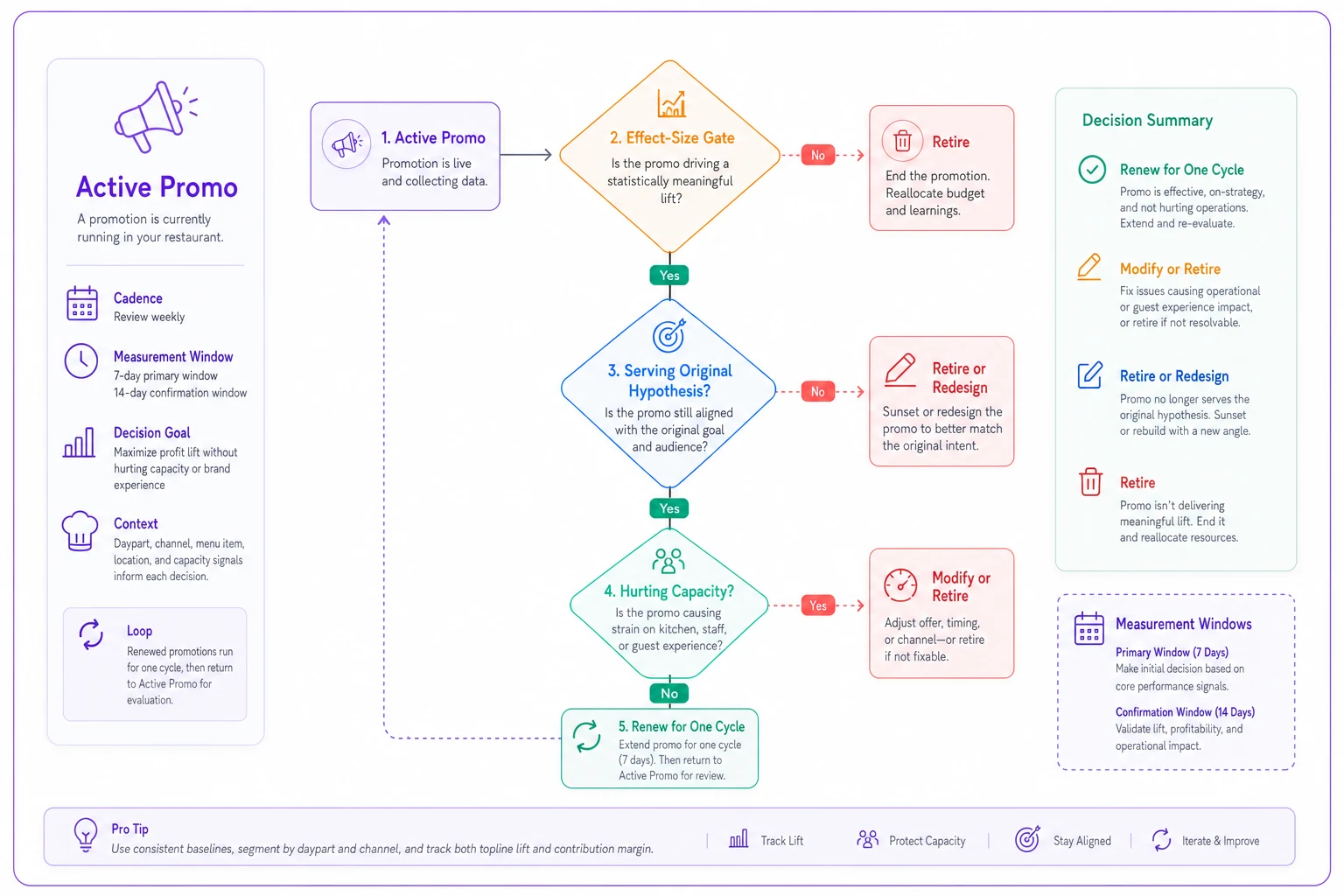
Run every active promo through this tree on a fixed cadence — weekly for short promos, monthly for standing ones:
-
Did it clear the effect-size gate over the measurement window?
-
- No → go to step 2. - Yes → go to step 3.
-
Is it within the first measurement window (too early to judge)?
-
- Yes → keep, re-evaluate next cycle, no extensions beyond one. - No → retire it. It failed its own bar.
-
Is it still serving its original hypothesis?
-
- No → retire or redesign. The thing that filled slow Tuesdays has no business running on packed Saturdays. - Yes → go to step 4.
-
Is it hurting capacity (ticket times, comps, labor strain) beyond the agreed threshold?
-
- Yes → modify (restrict hours/dayparts) or retire. - No → renew for one more cycle. Not forever. One cycle. Re-run the tree next time.
The key design choice here is that nothing renews indefinitely. Every promo has to re-earn its spot each cycle. This single rule does more to prevent zombie promos than any other control, because it flips the default from "stays unless killed" to "dies unless renewed."
A measurement template you can actually maintain
Fancy dashboards die of neglect. A simple template survives because it takes five minutes to fill out. Here's the minimum each promo should carry, from launch through retirement:
-
Promo name & owner
-
Hypothesis (one line)
-
Launch date / planned end date
-
Effect-size gate (the number that defines success)
-
Margin floor per unit
-
Baseline metric captured before launch
-
Weekly actuals vs baseline
-
Category share before vs during
-
Capacity flags (ticket time delta, comp rate, OT incidents)
-
Decision log (every renew/modify/retire call with date and reason)
The decision log is the quietly valuable piece. Six months later, when someone asks "why did we kill the brunch bundle?" you have the answer written down with the numbers. It also stops you from re-launching the same failed idea in a new wrapper — which happens more often than most operators want to admit.
Promotions don't live in isolation either. They sit on top of your underlying item economics. If your plate-level margins and seasonal guardrails aren't solid to begin with, a promo just discounts numbers you don't trust. Governance works best when the base menu costing is already clean.
A real scenario
A two-location casual Italian spot was running a "family bundle" — pasta for four plus a shared app and dessert — at $59. It had been live for about eight months. Management loved it; it showed up strong in the POS every weekend.
When they finally ran the category-share recipe, the picture changed. Bundle dollars were up, sure. But the pasta category's share of total check had barely moved, and à la carte dessert sales had quietly dropped. Guests buying the bundle were mostly people who'd have ordered roughly the same food anyway — now at a discount. Effective margin on those tables was running somewhere around 9–11 points lower versus comparable à la carte parties.
Worse, the bundle was concentrated on Friday and Saturday dinner — the exact windows where the kitchen was already pinned. Average ticket times on bundle-heavy nights were running several minutes longer than normal.
They didn't kill it outright. They restricted it to Sunday through Thursday, nudged the price to $64, and swapped the fixed dessert for a smaller token item. Weekend capacity relief was immediate, and the weeknight version started doing what a promo is actually supposed to do — pulling traffic into slow dayparts. Within a couple of months the category margin recovered most of the lost points, and the promo was finally earning its place instead of just occupying it.
The fix wasn't clever marketing. It was governance: measure properly, judge against a real bar, and modify instead of worshipping a number that looked good in isolation.
When this level of rigor makes sense — and when it doesn't
When it's worth it: You run promotions regularly, you operate more than one location, or you've noticed category margins slipping without a clear cause. The more promos you run, the faster a zombie problem compounds, and the more governance pays for itself.
When it's overkill: A single small spot running one seasonal special a year doesn't need a decision tree. Setting a margin floor and a hard end date is plenty. Don't build a measurement machine heavier than the thing it's measuring.
Who should hold off: If your baseline menu costing is shaky — if you genuinely don't know your contribution margin per item — fix that first. Governance built on bad cost data just produces confident wrong decisions. Get your plate economics clean, then layer promotions on top.
Where the right systems quietly help
None of this requires exotic software, but it does require your data to be connected. The hard part isn't the decision tree — it's pulling baseline numbers, category share, and capacity flags into one place consistently, cycle after cycle, without someone manually exporting spreadsheets every week.
That's where operational platforms with built-in automation earn their keep: tagging promo items in the POS, auto-pulling holdout and baseline comparisons, flagging when a promo breaches its margin floor or capacity threshold, and surfacing the retirement tree on schedule so nobody has to remember to run it. The governance logic stays yours. The tooling just removes the manual drudgery that causes these reviews to get skipped — and skipped reviews are exactly how zombie promos survive.
The same discipline applies anywhere you're testing a pricing lever. If you're also experimenting with segmented, demand-based pricing, the launch gates, effect-size thresholds, and retirement logic transfer almost directly — a promo and a pricing test are the same experiment wearing different clothes.
Bringing it together
A promotion is a controlled bet on your margin and your capacity. Write the hypothesis. Set the bar for success before you launch so you can't rationalize a loss later. Pick an attribution recipe that can actually catch cannibalization. Give every promo a death date it has to fight to survive.
Do that consistently, and promotions stop being a slow leak in your P&L and start being what they're supposed to be — a deliberate tool you aim at a specific problem, measure honestly, and retire without sentiment. The restaurants that run this way aren't running fewer promos. They're just running the ones that actually work, and killing the rest before anyone gets attached.
Do that consistently, and promotions stop being a slow leak in your P&L and start being what they're supposed to be — a deliberate tool you aim at a specific problem, measure honestly, and retire without sentiment. The restaurants that run this way aren't running fewer promos. They're just running the ones that actually work, and killing the rest before anyone gets attached.
Ready to elevate your restaurant operations?
Join 2,000+ restaurants using Dineoly to enhance efficiency, increase table turnover, and delight diners.