

The moment a restaurant group crosses from three locations to eight or ten, something quiet starts happening. The SOPs that felt airtight at the flagship begin to mutate in the field. One store's line cooks portion protein by eye because the new scale broke and nobody replaced it. Another location's opener runs a shortened prep list because the GM decided the "full" version wasted time. Neither store is wrong on purpose — they're just adapting to their own reality, and nobody upstream knows it's happening until a health inspection, a viral complaint, or a margin gap forces the question.
This is the real problem with multi-location restaurant SOP governance: it isn't that you lack standards. Most groups have binders, PDFs, and training decks packed with them. The problem is that standards written once, at HQ, don't survive contact with fifteen different kitchens, staffing levels, equipment sets, and local laws — and there's usually no structured way to tell which deviations are fine and which ones are quietly eroding the brand.
Why "one SOP for everyone" quietly fails
A central SOP assumes a level of uniformity that stops being true almost immediately as you grow. Your downtown location has a 900-square-foot kitchen and a walk-in the size of a closet. Your suburban store has double the prep space and a completely different guest mix. Handing both the same 40-page operations manual and expecting identical execution is where drift starts.
What tends to happen is that local managers do read the SOP — once. Then they hit a wall: equipment that doesn't match the manual, a prep step that doesn't fit their volume, a local ordinance the SOP never mentioned. They solve it their own way. That solution becomes the new local norm. Multiply that by 12 stores and 200 line-level tasks, and you no longer have one operation. You have twelve loosely related ones wearing the same logo.
The failure isn't the deviation itself. Smart local adaptation is often good. The failure is that nobody classified which parts of the SOP are non-negotiable and which parts are meant to flex. Without that distinction, every store improvises across the board — including on the things that should never move.
The core idea: separate "the brand" from "the method"
The single most useful shift in governance thinking is to stop treating every SOP line as equal. Some things define the brand and the safety of the operation. Other things are just one way to hit an outcome, and a store should be free to find its own path as long as the result matches.
Eliminate operational bottlenecks effortlessly.
Dineoly helps you manage every reservation, order, and staff shift seamlessly.
- Unified reservation and order management
- Real-time staff scheduling
- Inventory and sales tracking
No credit card required
-
Mandatory-exact — must be done this exact way, everywhere, no exceptions (allergen handling, cook temps, cash handling, food-safety holds).
-
Mandatory-outcome — the result is required, but the method can vary (station must be prepped and ready by open; how they sequence prep is up to them).
-
Recommended — HQ's preferred method, but a documented local alternative is allowed.
-
Local discretion — fully up to the store (break scheduling nuances, minor merchandising placement).
The part most groups miss: the classification has to be visible on the SOP itself, not buried in a governance policy nobody reads. When a line cook or shift lead is looking at the prep sheet, the mandatory-exact steps should be flagged right there so there's zero ambiguity about what can bend and what can't.
A simplified matrix example
| SOP element | Classification | Who can approve a deviation | Audit frequency |
|---|---|---|---|
| Allergen ticket flags & confirmation | Mandatory-exact | Nobody — zero deviation | Every audit |
| Chicken cook temp / hold time | Mandatory-exact | Nobody | Every audit |
| Opening prep completion by open | Mandatory-outcome | GM (method only) | Weekly self-check |
| Prep sequence / batch sizing | Recommended | GM with documented note | Monthly |
| FOH greeting script wording | Recommended | Regional manager | Quarterly |
| Break rotation timing | Local discretion | Store-level | N/A |
This table is the backbone. It turns a vague "follow the SOP" into a precise map of where standardization is enforced and where local judgment is welcome. It also gives you something real to audit against — you can't audit "are they following the manual," but you can absolutely audit "are the seven mandatory-exact items being executed correctly."
The translation workflow: central standard → local adaptation
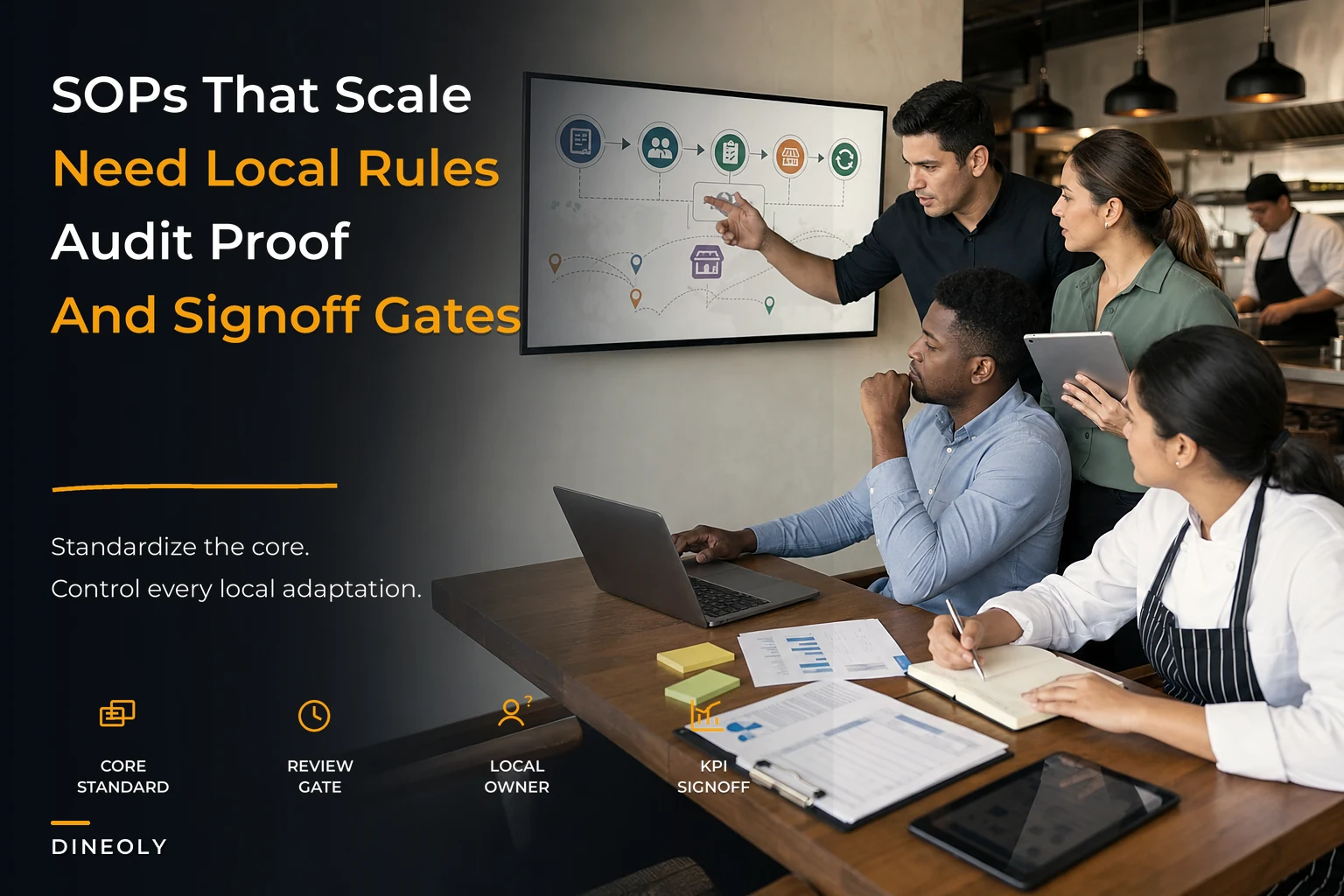
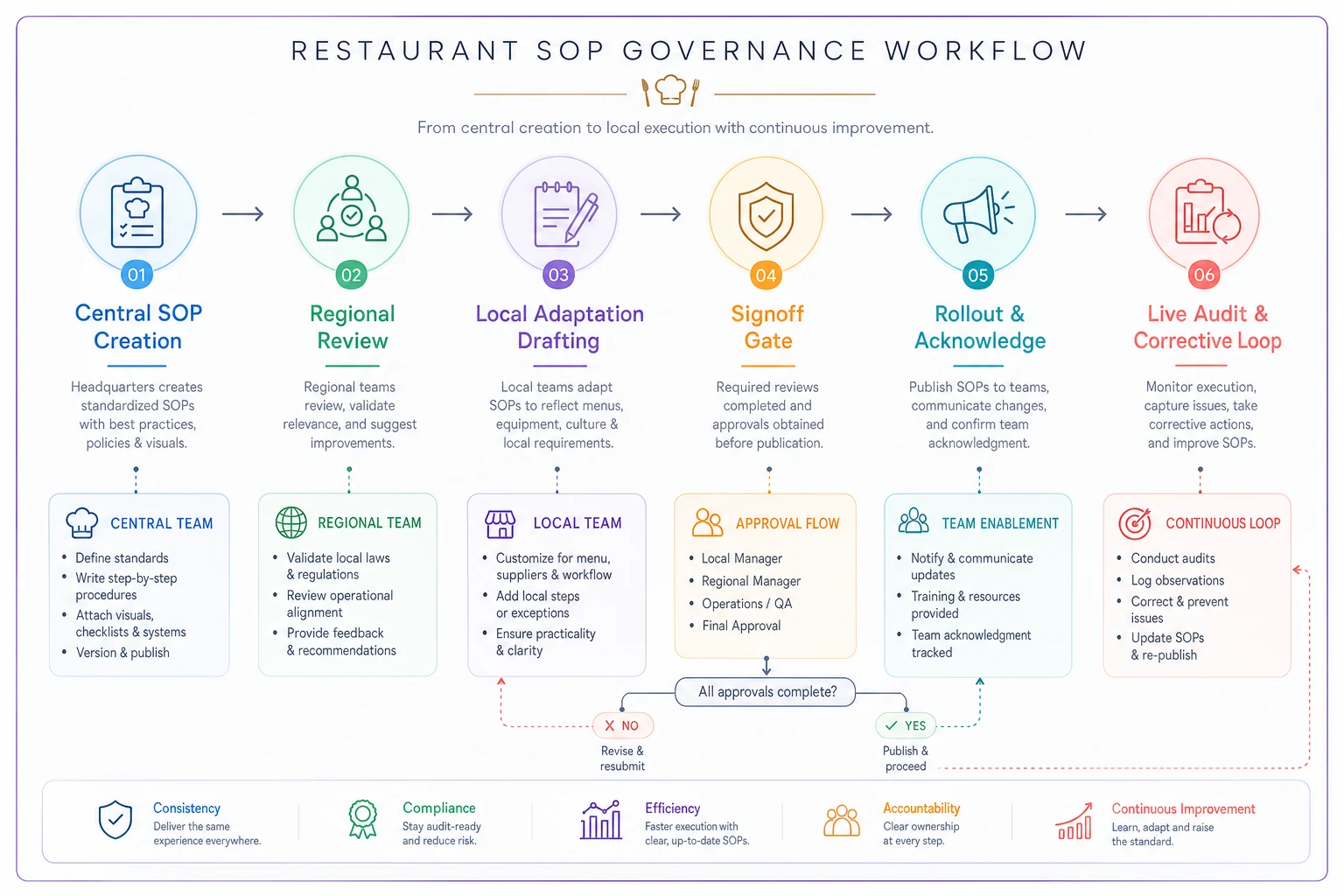
Publishing an SOP from HQ and adapting it locally shouldn't be a game of telephone. It should be a defined workflow with actual checkpoints. Here's the sequence that holds up as a group scales:
-
HQ drafts or updates the master SOP and assigns each element a matrix classification before it ships.
-
Regional review — a regional manager who actually knows the stores flags anything that won't survive locally (equipment gaps, staffing realities, local law conflicts).
-
Local adaptation drafting — the GM documents any deviations for mandatory-outcome, recommended, or discretion items. Mandatory-exact items are locked.
-
Signoff gate — the local version can't go live until it clears review (more on KPI gates below).
-
Rollout with acknowledgment — every affected staff member confirms they've seen the local version, timestamped.
-
Live audit + corrective loop — the store is audited against the local version, and deviations from mandatory items trigger corrective action.
The reason this matters at scale is coordination. With a handful of stores, an ops director can hold all the local variations in their head. Past ten or so, that memory breaks. You need local adaptations written down and linked to the master, so that when HQ updates the allergen protocol, you can see every store's version and push the change everywhere — without wondering who's still running the old one.
Here's a simple visual of that translation workflow.
This is the same principle behind linking your operational systems together rather than running them as islands — the operational backbone that connects reservations, staffing, orders and inventory applies just as much to SOPs. A standard that isn't connected to how you audit, staff, and correct is just a document.
KPI gates: the part that makes signoff mean something
A signoff that's just a manager's signature is theater. The signature says "I read it," not "we can actually execute it here." A KPI gate replaces the ceremonial signoff with a real one: the local version doesn't get approved until the store can demonstrate the underlying numbers support it.
-
Ticket-time median at or under the target across a trial week
-
Zero mandatory-exact allergen deviations during the trial
-
Food-safety log completion at 100% for the trial period
-
Staff acknowledgment rate at 100%
If the store can't clear those numbers, the SOP isn't approved — which forces a real conversation about why. Is it a staffing problem? Equipment? A training gap? The gate surfaces the blocker instead of papering over it with a signature. A lot of failed gates trace back to labor mismatches rather than bad SOPs — the kind of thing you plan for when you link labor forecasts to profitability and cross-training.
The mistake groups make is setting gates that are either impossible (so nothing ever gets approved and stores ignore the process) or meaningless (so everything passes regardless). Gates should be tuned to catch the failures that actually hurt you — safety, brand-defining moments, and the two or three metrics that predict guest experience.
The audit checklist that doesn't take three hours
Audits die when they're too long. A 120-item audit gets rushed, faked, or skipped. Auditing against the matrix naturally prioritizes what matters. Mandatory-exact items get checked every time and heavily weighted. Discretion items don't get audited at all — that's the whole point of classifying them.
-
Mandatory-exact (100% required, any miss = immediate corrective action) - Allergen protocol executed correctly on live tickets - Cook temps / hold times logged and in range - Cash handling steps followed - Cold-chain / walk-in temps in range with logs complete
-
Mandatory-outcome (result verified, method noted) - Prep complete and station-ready by open - Cleaning/sanitation outcomes met at close
-
Recommended (deviation check) - Any documented local alternative still producing the required outcome? - Are undocumented deviations creeping in?
-
Governance hygiene - Local SOP version matches current master (no orphaned old versions) - Staff acknowledgments current - Prior corrective actions actually closed
Weight mandatory-exact items heavily on the audit form and avoid turning discretion items into time-consuming checks.
That last bullet matters more than most groups realize. One of the biggest silent failures in multi-store operations is corrective actions that get opened and never closed. The audit has to check the previous audit's findings, or you end up with the same violation showing up quarter after quarter with no real accountability.
The corrective-action loop
Finding a deviation is easy. Closing it is where most governance systems fall apart. A corrective-action loop that actually works has four moving parts and a clock on each:
-
Log the finding — what deviated, from which classification, and the severity. A mandatory-exact miss is a different animal than a recommended deviation.
-
Root-cause it — and be honest. "Staff didn't follow SOP" is almost never the real cause. Usually it's broken equipment, a training gap, unrealistic timing given the shift's staffing, or an SOP that genuinely doesn't fit that store.
-
Assign an owner and a deadline — a mandatory-exact food-safety miss might need same-day resolution; a recommended-item drift might have a two-week window.
-
Verify closure at the next audit — not "we said we fixed it," but confirmed on the ground.
The groups who actually improve versus the ones who just keep re-auditing the same problems: the difference is usually whether findings feed back up to HQ. When a root cause turns out to be "the SOP doesn't fit this store," the fix isn't disciplining the store. It's reclassifying the item or adjusting the master. A corrective loop that only ever pushes down turns into a blame machine. A loop that also pushes up makes your standards smarter over time. The suburban store that couldn't hit the prep sequence might reveal that it should've been mandatory-outcome, not mandatory-exact, all along.
A real scenario
A regional group running about nine full-service locations kept getting inconsistent health-inspection results — some stores scoring in the mid-90s, a couple scraping by in the low 80s. Same brand, same "SOPs," wildly different execution. When they mapped it out, the lower-scoring stores had drifted on cold-chain logging and allergen confirmation, mostly because their SOP versions were 18 months out of date and nobody had a system to catch it.
They rebuilt around a matrix and gates. Mandatory-exact items got locked and flagged on every prep sheet. Each store's local version got tied back to the master so an HQ update pushed everywhere at once. Audits shrank from a bloated everything-checklist to a focused list weighted toward the items that actually drive inspections and guest safety. Corrective actions got owners, deadlines, and a next-audit verification step.
Over the following couple of quarters, the spread between their best and worst stores closed noticeably. The low-80s stores climbed into the low 90s, repeat findings dropped significantly because corrective actions were finally being closed instead of relogged, and the version-mismatch problem basically disappeared.
When this level of governance makes sense — and when it doesn't
When it's worth it: Once you're past roughly five or six locations, the informal "everyone knows how we do things" approach stops scaling. If you're seeing inconsistent audit or inspection results, if HQ updates aren't reliably reaching the field, or if you can't quickly answer "which version is this store running?" — you need this structure.
When it's overkill: For a single location or two closely managed stores under one hands-on owner, a full matrix-plus-gate system is bureaucracy you don't need yet. A solid SOP set and regular walkthroughs are enough.
Who should not do this: Groups that aren't willing to actually enforce the gates. If leadership overrides a failed KPI gate every time a store pushes back, the whole system loses credibility fast and staff learn the audit is theater. Half-committed governance is arguably worse than none — it burns effort and trust for zero consistency.
Where the tooling quietly helps
None of this requires software to think about — the logic is the logic. But keeping matrices, local versions, acknowledgments, and open corrective actions straight across a dozen stores by hand is exactly the kind of coordination work that eats a regional manager's week and still leaves gaps.
Workflow platforms with AI automation earn their place here in pretty specific ways: pushing a master SOP update to every local version and flagging which stores haven't acknowledged it, surfacing corrective actions past their deadline before the next audit instead of after, catching version mismatches automatically so nobody's running an 18-month-old allergen protocol without anyone noticing. The point isn't to replace the operator's judgment — it's to make sure the tracking doesn't depend on someone remembering. When routine reconciliation runs itself, managers can spend their attention on the deviations that actually need a human decision.
The bigger picture
Governance across locations isn't a binder problem or a discipline problem. It's a systems problem — how central standards translate into local reality, how you decide what's allowed to flex, how you verify execution, and how findings loop back to make the standard better.
Get the classification right, put real gates on signoff, keep audits focused on what matters, and actually close your corrective actions. Do that consistently, and adding your eleventh and twelfth locations feels like a repeatable process instead of a slow-motion loss of control.
Get the classification right, put real gates on signoff, keep audits focused on what matters, and actually close your corrective actions. Do that consistently, and adding your eleventh and twelfth locations feels like a repeatable process instead of a slow-motion loss of control.
Ready to elevate your restaurant operations?
Join 2,000+ restaurants using Dineoly to enhance efficiency, increase table turnover, and delight diners.