
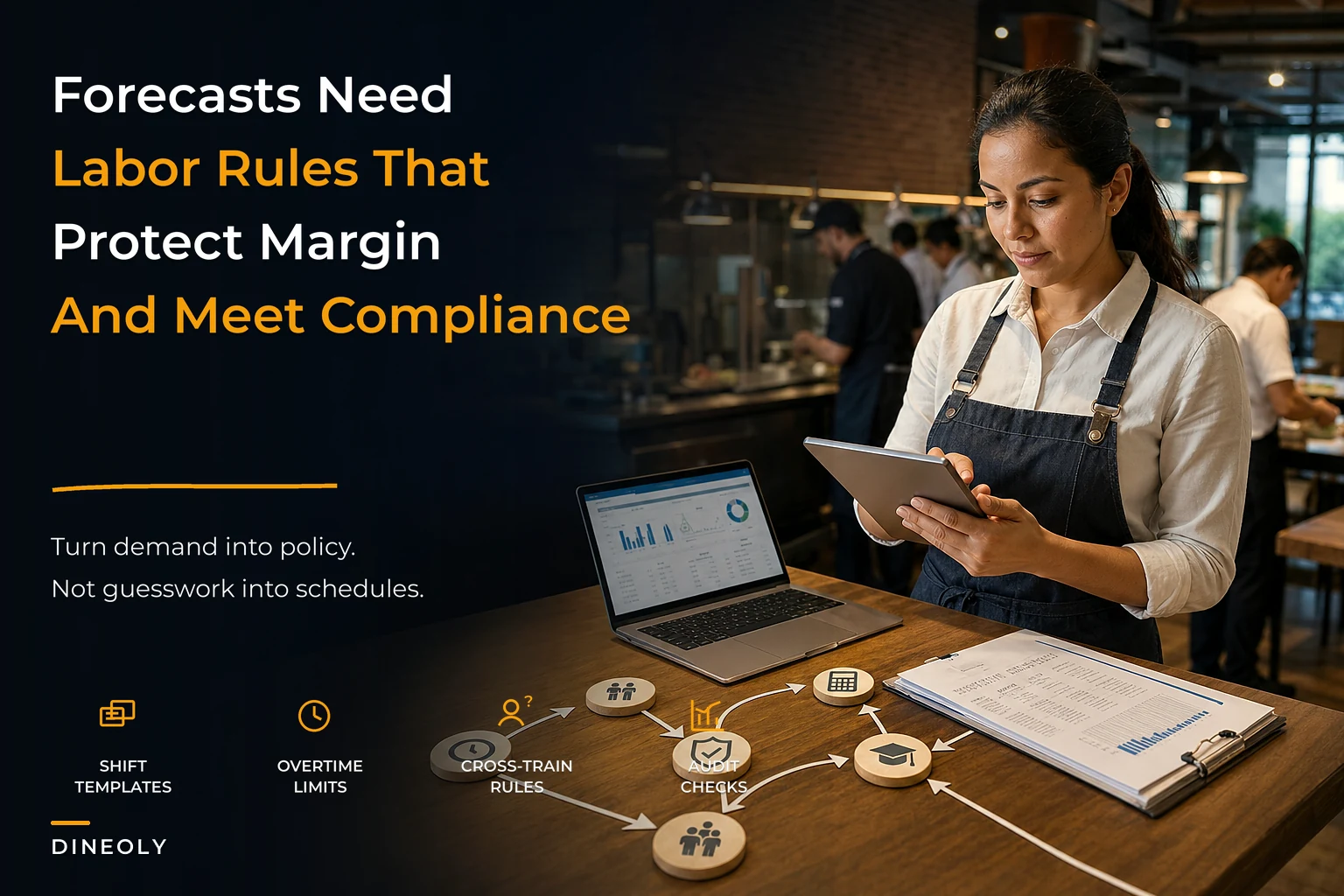

Most restaurant managers treat scheduling like a weekly puzzle—looking at next week's bookings, guessing who's available, then scrambling when someone calls out sick. But scheduling isn't really about filling shifts. It's about converting demand forecasts into enforceable policies that protect both profitability and compliance while systematically building team capabilities.
The restaurants that survive tight margins don't just schedule better. They build labor strategies that link predictive scheduling directly to profit controls, overtime guardrails, and cross-training matrices. They turn scheduling from a reactive scramble into a proactive system that actually scales.
Why Traditional Scheduling Breaks Your P&L
Restaurant labor typically runs 25-35% of revenue. A two-point swing either direction can mean the difference between profit and loss. Yet most operators manage this massive cost center with spreadsheets, text messages, and hope.
The problem compounds because labor isn't just about coverage—it's about capability matching, compliance tracking, and skill development. When your best grill cook calls out Saturday night, you don't just need "someone" to cover. You need someone qualified, available within overtime limits, and ideally someone who could use the cross-training opportunity.
Traditional scheduling fails because it treats each week as isolated. There's no connection between your demand forecasting system, your compliance requirements, and your team development goals. You end up with experienced servers working dead shifts while new hires get thrown into Saturday rushes. Labor costs spike from overtime nobody tracked until Thursday. And you have no systematic way to build bench strength.
The restaurants pulling 8-12% profit margins in this environment don't have better managers. They have better systems—ones that treat scheduling as policy enforcement rather than weekly guesswork.
Demand Patterns Drive Everything Else
Your scheduling system starts with understanding demand patterns, not employee availability. Most managers do this backwards—they look at who's available, then try to make it work. That's how you end up overstaffed on Tuesdays and understaffed on Fridays.
Eliminate operational bottlenecks effortlessly.
Dineoly helps you manage every reservation, order, and staff shift seamlessly.
- Unified reservation and order management
- Real-time staff scheduling
- Inventory and sales tracking
No credit card required
Real demand forecasting for labor goes beyond counting reservations. A 50-cover Tuesday lunch requires different staffing than a 50-cover Saturday dinner. Corporate lunches move fast with simple orders. Date nights linger with wine pairings and desserts. Same covers, completely different labor needs.
Start by mapping your actual service patterns. Track not just covers but table turns, average ticket, and service complexity. One steakhouse I worked with discovered their "slow" Monday nights actually required more experienced servers because those covers were mostly business dinners with expensive wine orders. They'd been scheduling junior staff on Mondays to save costs, then wondering why wine sales were tanking.
Build demand profiles for each service period that capture:
-
Cover count ranges (not just averages)
-
Table turn expectations
-
Menu complexity indicators
-
Bar attachment rates
-
Special service requirements
These profiles become the foundation for your shift templates. Instead of scheduling "dinner shifts," you're scheduling specific service profiles with defined capability requirements.
Shift Templates That Enforce Standards
Once you understand demand patterns, convert them into shift templates that enforce your operational standards. A shift template isn't just start and end times—it's a complete operational blueprint that defines capabilities, ratios, and handoff protocols.
Consider a typical Friday dinner service. Your template might specify:
-
One experienced server per 4-table section
-
One runner per 12 tables
-
Two line cooks plus one floater after 7pm
-
Dedicated expeditor when covers exceed 80
But here's what most operators miss: templates should also specify capability requirements and acceptable substitutions. That experienced server requirement might translate to "Level 3 certified or Level 2 with wine training." Line cook positions might require specific station certifications. This turns scheduling from "finding bodies" to "matching capabilities."
The template also needs to define escalation triggers. What happens when covers spike 20% above forecast? Who gets called in first? What positions can you combine in a pinch? Without these pre-defined decisions, every busy night becomes a crisis of manager judgment calls.
One California bistro was averaging 32% labor cost with constant overtime. After implementing demand-based templates with clear escalation rules, they dropped to 27% labor while actually improving service scores. The difference was simple—they stopped making reactive decisions and started following pre-planned responses.
Overtime Guardrails That Actually Work
Overtime kills restaurant margins faster than almost anything else. Not because overtime itself is evil—sometimes it's the right call. The problem is unplanned, reactive overtime that happens because nobody tracked accumulated hours until Thursday.
Effective overtime guardrails work on three levels:
Weekly caps by position type. Your prep cooks might cap at 40 hours while experienced servers can hit 45. These aren't suggestions—they're system-enforced limits that require manager override to exceed.
Rolling period tracking. Track both weekly and bi-weekly accumulated hours. Someone might be under 40 this week but trending toward 85 over two weeks. Your system needs to flag this before it becomes a problem.
Substitution hierarchies. When someone approaches overtime, who takes their shifts? Build explicit substitution chains: Sarah covers for Miguel, Tommy covers for Sarah, with clear capability requirements at each level.
Here's a real overtime control calculator that maps hours to costs:
| Hours Worked | Regular Rate | OT Premium | Weekly Cost | vs 2 Part-Timers |
|---|---|---|---|---|
| 40 hrs | $15/hr | $0 | $600 | $600 (same) |
| 45 hrs | $15/hr | $112.50 | $712.50 | $600 (-$112.50) |
| 50 hrs | $15/hr | $225 | $825 | $600 (-$225) |
| 55 hrs | $15/hr | $337.50 | $937.50 | $750 (-$187.50) |
The math is stark. One person working 50 hours costs the same as 1.4 people working regular time. Yet restaurants routinely let their best employees rack up 50-60 hour weeks because "they're reliable." Reliability doesn't offset math.
Cross-Training as Strategic Investment
Cross-training isn't about teaching servers to bus tables in emergencies. It's about systematically building organizational capability while creating advancement paths that reduce turnover.
Build your cross-training matrix around natural skill progressions. A host learning server basics. A prep cook training on garde manger. A server developing bar skills. Each progression should have clear checkpoints, required shifts, and certification criteria.
The matrix itself needs to track four dimensions:
-
Current certified capabilities
-
In-training progressions
-
Interest indicators (who wants to learn what)
-
Business need priorities (what skills you need most)
A Denver gastropub I analyzed built their entire retention strategy around aggressive cross-training. New hires started with a clear 18-month development path. Hosts could become servers in 6 months, servers could add bar certification in 9 months, everyone could train on management basics by month 12. Their turnover dropped from around 180% annually to roughly 95%—still high by normal standards but revolutionary for restaurants.
The key is making cross-training systematic, not opportunistic. Schedule dedicated training shifts. Build training requirements into your templates. Track progression metrics just like you track sales.
Compliance Checkpoints You Can't Skip
Labor compliance in restaurants is a minefield. Between predictive scheduling laws, minor restrictions, break requirements, and tip pooling regulations, there are dozens of ways to accidentally break the law. And penalties are getting serious—Seattle fines restaurants $500 per violated shift under their secure scheduling ordinance.
Build compliance checkpoints directly into your scheduling workflow:
Predictive scheduling compliance. Many cities now require 14-day advance notice for schedules, with penalties for late changes. Your system needs to track both initial posting dates and any subsequent modifications.
Minor hour restrictions. Underage employees often can't work past certain times or during school hours. These restrictions change by state, sometimes by city. Manual tracking is basically impossible at scale.
Break requirement tracking. California requires a 30-minute meal break before the fifth hour of work. Miss it and you owe an hour of penalty pay. Your scheduling system needs to build breaks into the template, not hope managers remember.
Tip pooling validation. The rules around who can participate in tip pools are complex and changing. Managers, owners, and certain back-of-house positions might be excluded. One wrong inclusion can trigger lawsuits.
Compliance isn't just about avoiding fines. Employees talk. They share experiences on Reddit, in group chats, with friends at other restaurants. One place getting hammered for violations becomes industry gossip that affects everyone's hiring. Building compliance into your system protects your reputation as much as your bank account.
Sample Calculators for Policy Decisions
Labor strategy requires math, but most restaurant managers hate spreadsheets. Build simple calculators that translate policies into dollars. Here are three essential ones:
-
Coverage vs Revenue Calculator - Input: Covers, average check, day of week - Calculation: Covers × average check × day modifier = expected revenue - Output: Minimum and maximum labor dollars to maintain target percentage
-
Cross-Training ROI Calculator - Input: Training hours, trainer wage, trainee wage, expected productivity gain - Calculation: (Training cost) vs (Avoided overtime + reduced turnover cost) - Output: Breakeven point in weeks
-
Schedule Change Penalty Calculator - Input: Hours changed, notice period, local regulations - Calculation: Changes × penalty rate × employees affected - Output: Total compliance risk in dollars
One Phoenix restaurant group built these calculators into their manager dashboards and saw immediate behavior change. When managers could see that a last-minute schedule change would cost $150 in penalties, they started planning better. Simple visibility drove different decisions.
Converting Forecasts to Enforceable Policy
The gap between good forecasts and good schedules is usually policy enforcement. You might know you need six servers Friday night, but if your policy doesn't specify how to handle call-outs, you'll still end up scrambling.
Enforceable policies need three components:
Clear triggers. Not "when it's busy" but "when covers exceed 120% of forecast." Not "if someone seems tired" but "when someone exceeds 10 hours without a break."
Defined actions. Each trigger needs a specific response. Cover spike triggers call-in list activation. Approaching overtime triggers shift redistribution. No manager interpretation required.
Audit mechanisms. Policies without audits are just suggestions. Track policy compliance weekly. Which managers consistently violate overtime guidelines? Which shifts repeatedly deviate from templates? You can't fix what you don't measure.
The enforcement comes from making policies systematic rather than situational. When your scheduling software automatically flags overtime risks, managers can't claim ignorance. When shift templates are system-enforced, nobody can freelance their own approach.
Here's a simple visual of the enforcement workflow.
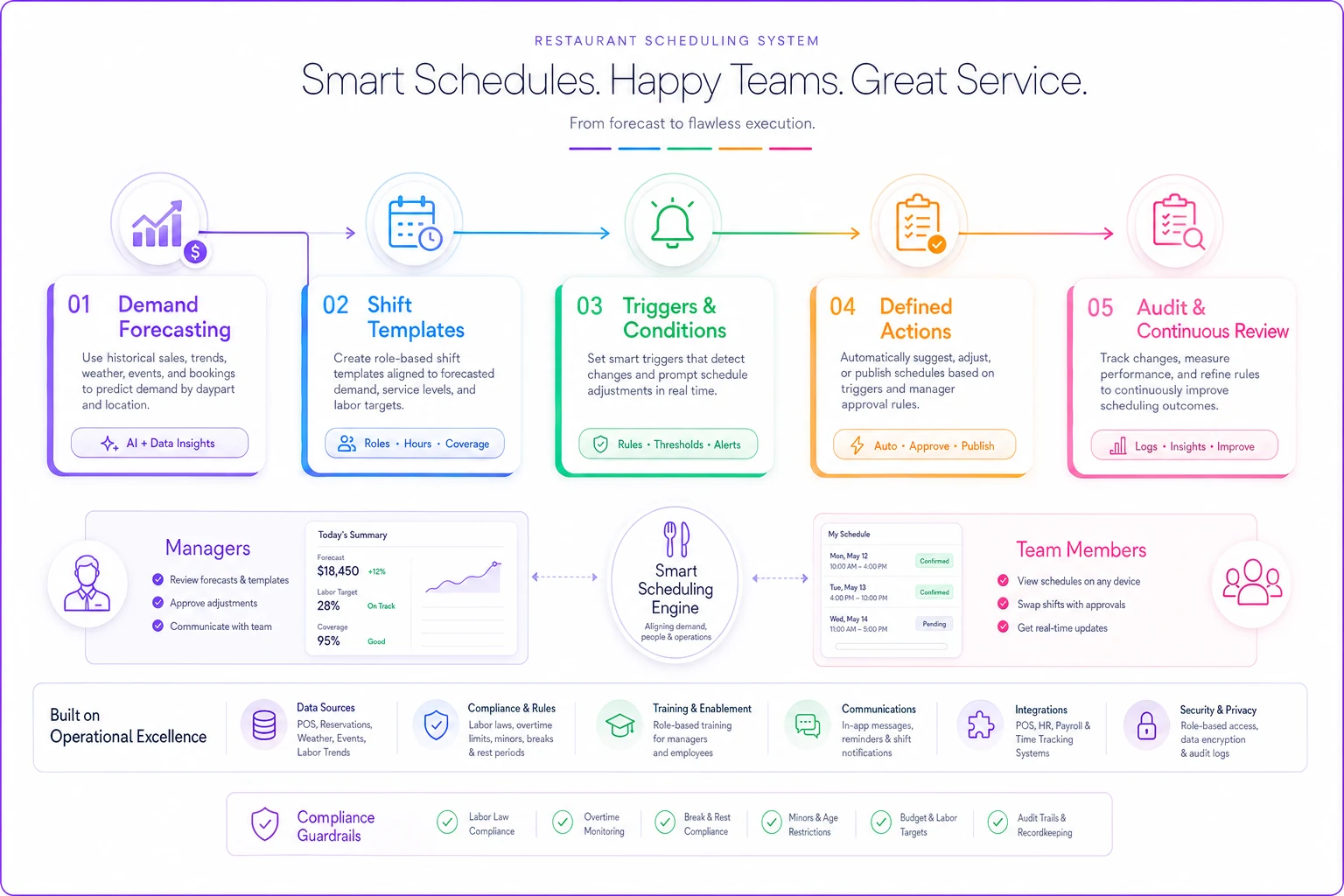
The enforcement comes from making policies systematic rather than situational. When your scheduling software automatically flags overtime risks, managers can't claim ignorance. When shift templates are system-enforced, nobody can freelance their own approach.
Profit Controls Beyond Labor Percentage
Most restaurants obsess over labor as a percentage of sales, but that metric hides critical details. You can hit your labor percentage while still destroying profitability through wrong mix, bad deployment, or hidden costs.
Track labor productivity, not just cost. Revenue per labor hour tells you if your team is actually producing. A server generating $200 per hour in sales is worth premium wages. One generating $75 per hour might need different deployment or additional training.
Monitor skill-adjusted coverage. Having four servers doesn't help if none can handle wine service and tonight's bookings are full of anniversary dinners. Your labor might look "right" on paper while being completely wrong for actual demand.
Consider total employment cost, not just wages. That $18/hour server actually costs closer to $23 with taxes, insurance, and benefits. The $15/hour host is really about $19. Build real costs into your models or your margins will always surprise you.
When This System Makes Sense (And When It Doesn't)
This kind of systematic labor strategy makes sense when:
-
You're running multiple locations or high volume
-
Your labor costs exceed $50K monthly
-
You're facing compliance scrutiny
-
Turnover is killing your training budget
-
Manager decisions are inconsistent across shifts
It's overkill if you're running a small owner-operated place where you personally know every employee's capabilities and constraints. The overhead of building templates and matrices won't pay off with eight total employees.
The sweet spot is restaurants doing $2-5M annually with 20-50 employees. That's enough complexity that systematic approaches pay dividends but not so large that you need enterprise software. At this scale, good labor strategy can swing your bottom line by 3-5 percentage points.
Technology That Connects The Pieces
The challenge with restaurant labor strategy is connecting all the pieces—demand forecasts need to flow into shift templates, which need to respect overtime guardrails while advancing cross-training goals and maintaining compliance. That's multiple systems that need to talk to each other, and most restaurants are managing that with a mix of spreadsheets and memory.
Modern operational platforms can help orchestrate these connections. AI-powered scheduling can automatically generate schedules from templates while monitoring compliance. Automated alerts flag overtime risks before they happen. Cross-training tracking feeds into capability matching. The system becomes self-reinforcing rather than constantly fighting itself.
The restaurants seeing the best results connect their labor platform to their broader operational backbone. When reservation patterns automatically trigger staffing adjustments, when sales data feeds back into forecast refinement, when employee performance connects to training priorities—that's when labor strategy becomes genuinely strategic rather than just better-organized guesswork.
Technology is just the enabler, though. The real work is defining the policies, building the templates, and creating the cross-training culture. Software can enforce your policies, but you have to create them first.
Building Your Implementation Roadmap
Don't try to revolutionize everything at once. Start with demand-based templates for your busiest shifts. Get those dialed in before touching anything else. Once managers trust the templates, add overtime guardrails. When those are working, layer in cross-training tracking.
The typical progression looks something like:
-
Map demand patterns for two weeks
-
Build templates for top 3 service periods
-
Run parallel (old and new system) for one week
-
Add overtime alerts and caps
-
Build basic cross-training matrix
-
Add compliance checkpoints
-
Expand templates to all shifts
-
Integrate with forecasting systems
Most restaurants can get through this in about 10-12 weeks if they stay focused. The ones that fail try to do everything simultaneously or get distracted by edge cases before nailing the basics.
Start with your busiest shift to show quick wins and build manager buy-in.
The biggest implementation risk is manager resistance. They've been scheduling their way for years—why change? You need to show wins fast. When that first Friday night runs smoothly with the new template, when overtime drops in month one, when a cross-trained host successfully covers a server shift—those wins build momentum.
You're not just implementing software or policies. You're changing how your entire organization thinks about labor. That takes time, patience, and reinforcement. But when it clicks, when your team starts thinking in terms of capabilities and templates rather than just bodies and shifts, that's when you'll see the real impact on your bottom line.
The restaurants thriving despite minimum wage increases, labor shortages, and compliance complexity aren't working harder. They're working systematically, and that's a gap you can close.
Ready to elevate your restaurant operations?
Join 2,000+ restaurants using Dineoly to enhance efficiency, increase table turnover, and delight diners.