


Most multi-site restaurant groups don't have a staffing problem. They have a staffing math problem. They treat every open shift as a hiring event, every turnover as a cost of doing business, and every promotion as something that happens when someone sticks around long enough. None of that connects to the P&L in any meaningful way, so nobody can answer a basic question: is it cheaper to train the line cook you already have, or to keep hiring the one you keep losing?
That question compounds fast as you add locations. A single-site owner can feel their way through it. By the time you're running four or six units, the gut-feel approach quietly bleeds money across every store, and you can't see where it's going. This is fundamentally a systems article — about how career ladders, retention metrics, and training-vs-hiring economics are supposed to feed each other, and what breaks when they don't.
Why staffing decisions default to the most expensive option
There's a pattern that shows up constantly. A location loses a decent server. The GM is slammed, so the easiest move is to post the job, interview whoever applies, and get a warm body on the floor by Friday. Nobody calculates the cost of that decision because it doesn't feel like a decision — it feels like plugging a hole.
-
Manager and trainer hours spent recruiting and onboarding
-
Reduced output while the new person ramps (usually 3–6 weeks to full productivity)
-
More comps, voids, and mistakes during the learning curve
-
The overtime other staff absorb to cover the gap
-
The small but real hit to guest experience that doesn't show up on any line item
For a salaried kitchen lead or assistant manager, that number climbs toward $8,000–$15,000 when you factor in the longer ramp time and the institutional knowledge that walks out the door with them.
The reason this stays invisible is that turnover cost is distributed. A little extra overtime here, a slightly worse ticket time there, an extra comp on a Saturday night. No single number ever gets big enough to trigger a real conversation. Meanwhile the alternative — investing in the people you already have so they don't leave — shows up as a clean, visible line item (training hours, wage bumps) that's easy to cut when margins tighten.
So the default decision is almost always the more expensive one, because the expensive option is the one you can't see.
What breaks when you scale this across locations
Turnover becomes uneven in ways you can't diagnose. Store 2 loses people every four months. Store 5 holds staff for two years. Without a shared way to measure retention, you'll assume Store 2 just has a "bad labor market" when the real issue is a GM who never promotes anyone and a schedule that punishes your best people. Without normalized metrics, you're guessing.
Eliminate operational bottlenecks effortlessly.
Dineoly helps you manage every reservation, order, and staff shift seamlessly.
- Unified reservation and order management
- Real-time staff scheduling
- Inventory and sales tracking
No credit card required
There's no path for your best people, so they leave to find one. When a strong server at a single location wants to grow, the owner notices and creates something. Across six locations, that same ambitious server is invisible to anyone above their GM. They hit a ceiling, see no ladder, and take an assistant manager role at the competitor down the street. You trained them; your competitor promoted them.
Inconsistency compounds. Every GM trains their own way, defines "ready for promotion" their own way, and sets their own bar for what a shift lead should know. A line cook who's "fully trained" at Store 1 would be considered half-trained at Store 4. That inconsistency makes it nearly impossible to move people between locations, which is exactly the flexibility you need at scale.
All three failures come from the same root: there's no system connecting the ladder (where people can go), the metrics (whether they're staying), and the economics (whether you should train or hire). Each location reinvents the wheel, badly, every time.
The investment model: treat staffing like capital allocation
The reframe that actually works is to stop thinking about labor as a monthly expense and start thinking about your workforce as a portfolio. Every person is either appreciating — gaining skills, taking on more, becoming more valuable — or depreciating, stagnating, disengaging, getting closer to leaving. Your job is to allocate training dollars toward the appreciating assets and build a structure that keeps them appreciating.
That requires three connected pieces:
-
Career ladders that define where someone can go and what "the next rung" actually requires.
-
Retention KPIs that tell you, by location and by role, whether people are climbing or leaving.
-
Training-vs-hiring ROI math that makes the build-or-buy decision explicit instead of accidental.
The value is in how they lock together.
Building career ladders that aren't just job titles
A real career ladder isn't "Server → Shift Lead → Assistant Manager." That's an org chart. A ladder spells out the competencies, timeline, and pay movement for each step, so both the employee and every GM across every location are working from the same definition.
Here's a sample front-of-house map for a mid-size group:
| Rung | Core competencies to advance | Typical time in role | Pay movement | Who signs off |
|---|---|---|---|---|
| Server (Level 1) | POS fluency, menu + allergen knowledge, basic upsell | 0–6 months | Base | GM |
| Server (Level 2) | Wine/cocktail knowledge, section of 5+ tables, trains new hires | 6–14 months | +$1.50–$2.00/hr | GM |
| Shift Lead | Opens/closes, handles guest recovery, basic scheduling input | 12–24 months | +$2.50–$3.50/hr | GM + Area Mgr |
| Assistant Manager | Labor cost control, inventory, hiring participation | 24+ months | Salary band | Area Mgr |
Use the same competency checklist across sites so promotion decisions are objective and portable.
The specific numbers matter less than the fact that they're written down and identical across sites. When the competencies are explicit, promotion stops being political and starts being earned. An ambitious Level 1 server can see exactly what Level 2 requires and start working toward it — and that visibility alone is one of the strongest retention levers you have.
The mistake most groups make is building the ladder and never tying it to actual competency tracking. A ladder only works if you can answer "who's ready for the next rung right now?" at any moment. Your cross-training infrastructure does double duty here — the same competency data that lets you build flexible peak staffing through cross-training matrices and two-week sprints is exactly what tells you who's ready to climb.
Retention KPIs that actually drive decisions
Most restaurants track turnover as a single annual percentage, which is close to useless. It's a rear-view number that doesn't tell you where to act. The metrics that matter are the ones that let you intervene before someone quits.
-
90-day retention rate — what share of new hires make it past three months. This is your best read on whether onboarding and the early experience actually work. A location sitting below 60% has a training problem, not a hiring problem.
-
Time-to-promotion — average months from hire to first rung up. When this stretches past the ladder's target by 50%+, your best people start leaving.
-
Regrettable turnover rate — separate the people you wanted to keep from the ones you didn't. Losing weak performers isn't a crisis. Losing your Level 2 servers is.
-
Internal fill rate — what percentage of shift lead and manager openings you fill from within. If this number is sitting under roughly 40%, your ladder is decorative.
-
Tenure distribution by location — not just average tenure, but the shape. Two stores can have the same average while one is all veterans and the other is a revolving door propped up by a couple of lifers.
A retention dashboard built around these turns a vague "we have turnover issues" into "Store 2's 90-day retention dropped to 48% last quarter and its internal fill rate is zero — that GM isn't developing anyone." Now you have something specific to act on.
One thing worth noting: the locations with the worst retention almost never have the worst pay. They have the worst path. People rarely quit purely over money; they quit because they can't see where they're going and nobody seems to notice their work.
The training-vs-hiring ROI calculation
This is the piece that makes the whole model financial instead of philosophical. For any role, you're comparing the fully-loaded cost of developing an internal person against the fully-loaded cost of hiring externally.
A simplified framework for a shift lead opening:
Option A — Promote and train internally
-
Training time + materials
~$1,200
-
Temporary productivity dip while they learn the role
~$800
-
Wage increase (annualized)
~$5,500
First-year cost: roughly $7,500
Option B — Hire externally
-
Recruiting + onboarding cost
~$3,500
-
Ramp-up period (lower output, more errors)
~$2,000
-
Market-rate salary for an experienced lead (often higher than your internal promotion): ~$7,000 premium over an internal bump
First-year cost: roughly $12,500
Risk: high — somewhere around 30–40% of external management hires don't make it past the first year, meaning you may end up paying the replacement cost all over again
Even with conservative numbers, internal development usually wins on a first-year basis, and the gap widens in years two and three because the retention and institutional-knowledge benefits keep compounding. External hiring genuinely makes sense when you're opening a new unit faster than your internal bench can fill, or when you need a specific skill nobody internal has. Those are real cases — but they should be decisions, not defaults.
Run this math and a lot of groups realize they've been quietly choosing the $12,500 option over the $7,500 option, dozens of times a year, without ever looking at the numbers.
Cross-site staffing: the model that only works at scale
This is where multi-site stops being a burden and becomes an actual advantage — if your ladder and competencies are standardized across locations. When every store grades skills the same way, you can model staffing across the whole group instead of store by store.
A worked example. A six-unit group is opening Unit 7. The old way: hire a full management team externally at market rates, roughly $45k–$60k in combined recruiting, onboarding, and ramp costs, with high first-year attrition risk.
The portfolio way: pull a proven assistant manager from your strongest existing store to run Unit 7, backfill their role with an internal shift lead who was already next on the ladder, and backfill that with a Level 2 server ready to step up. You hire externally only at the bottom rung, where hiring is cheapest and risk is lowest. Same new store staffed, but now with people who already know your systems — and the total cost lands closer to $20k–$28k with dramatically lower failure risk.
That cascade is only possible if you've been tracking who's ready across all locations. Without a shared competency and retention view, you can't see that Store 3 has two promotion-ready leads sitting idle while Store 5 is desperate for one. This cross-site visibility is the natural extension of tying your whole labor plan together — the same thinking behind a restaurant labor strategy that links forecasts to profitability and cross-training applies directly to development, not just scheduling.
A real scenario
A four-location casual-dining group was running annual turnover around 95% and filling nearly every management opening with outside hires. They weren't tracking anything beyond a single turnover percentage per store.
They started simple: one standardized FOH and BOH ladder across all four units, a monthly retention review built on 90-day retention and internal fill rate, and the training-vs-hiring calculation run on every management opening before posting it externally.
The first thing they found was that Store 3 — assumed to be their "bad labor market" location — actually had three promotion-ready people who'd been passed over for two years because that GM never developed from within. Two of them had one foot out the door. Both got promoted within the quarter and stayed.
Over the next year, internal fill rate for management roles went from near zero to just over half. Annual turnover dropped into the 60s, and recruiting spend fell by a meaningful chunk — roughly $30k–$40k across the group — mostly from no longer cycling through external managers who didn't stick. Nothing dramatic happened in any single month. It was the distributed cost finally flowing the other direction.
Where the systems have to connect
The three pieces reinforce each other. The ladder gives people a reason to stay. Staying improves your retention KPIs. Better retention builds the internal bench that makes the training-vs-hiring math favor development. And favoring development funds more people climbing the ladder. It's a loop, and once it's turning, each piece makes the next one cheaper.
> Retention loop: > Career ladder defined → employees have a visible path → 90-day and long-term retention improves → internal bench grows → training-vs-hiring math favors promotion → more internal promotions reinforce the ladder
It fails in most groups because these pieces live in separate heads and separate spreadsheets — the ladder buried in an HR doc nobody reads, retention as a number mentioned once a year, and the build-vs-buy decision made in a panic on a Thursday afternoon. Pulling competency data, retention metrics, and staffing records into one place is what turns three disconnected ideas into an actual investment model. That's less about any particular tool and more about refusing to let these decisions keep happening in the dark, one invisible $3,000 hole at a time.
Here's a simple workflow showing how those pieces should connect across locations.
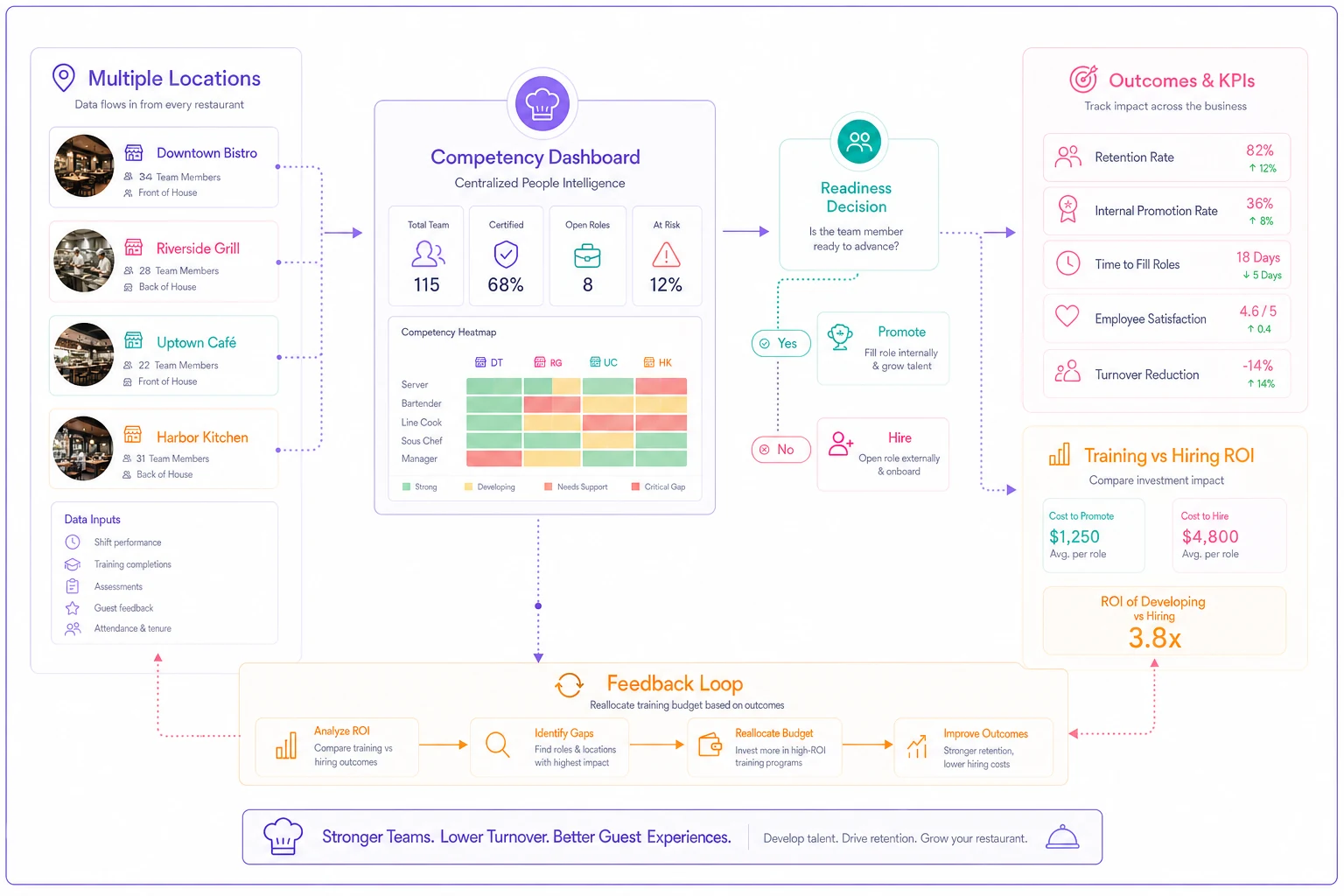
Pulling these data flows together doesn't require a specific vendor — it's about discipline: a shared competency taxonomy, a retention dashboard broken out by location and role, and a trigger to run the training-vs-hiring calculation before external recruiting.
Where to start
You don't need to build all of this at once. The sequence that works:
-
Write one standardized ladder per role family, with real competencies and pay bands, and roll it out to every GM.
-
Start tracking 90-day retention and internal fill rate by location — even in a spreadsheet — so you can see which stores develop people and which don't.
-
Run the training-vs-hiring calculation on your next three management openings before you post a single external job.
-
Once you trust the data, start modeling promotions across locations instead of within them.
The groups that get this right stop treating people as interchangeable shift-fillers and start treating their workforce the way they'd treat any other asset they've put money into — something to develop, measure, and allocate deliberately. That shift, more than any single pay raise or hiring push, is what finally makes staffing predictable at scale.
The groups that get this right stop treating people as interchangeable shift-fillers and start treating their workforce the way they'd treat any other asset they've put money into — something to develop, measure, and allocate deliberately. That shift, more than any single pay raise or hiring push, is what finally makes staffing predictable at scale.
Ready to elevate your restaurant operations?
Join 2,000+ restaurants using Dineoly to enhance efficiency, increase table turnover, and delight diners.