

Most restaurants treat marketing and operations like two separate departments that occasionally wave at each other. The marketing side runs a monthly email blast and boosts a few posts. The operations side runs service, tracks covers, and handles the day-to-day. Nobody owns the seam where those two worlds meet — which is exactly where the money leaks out.
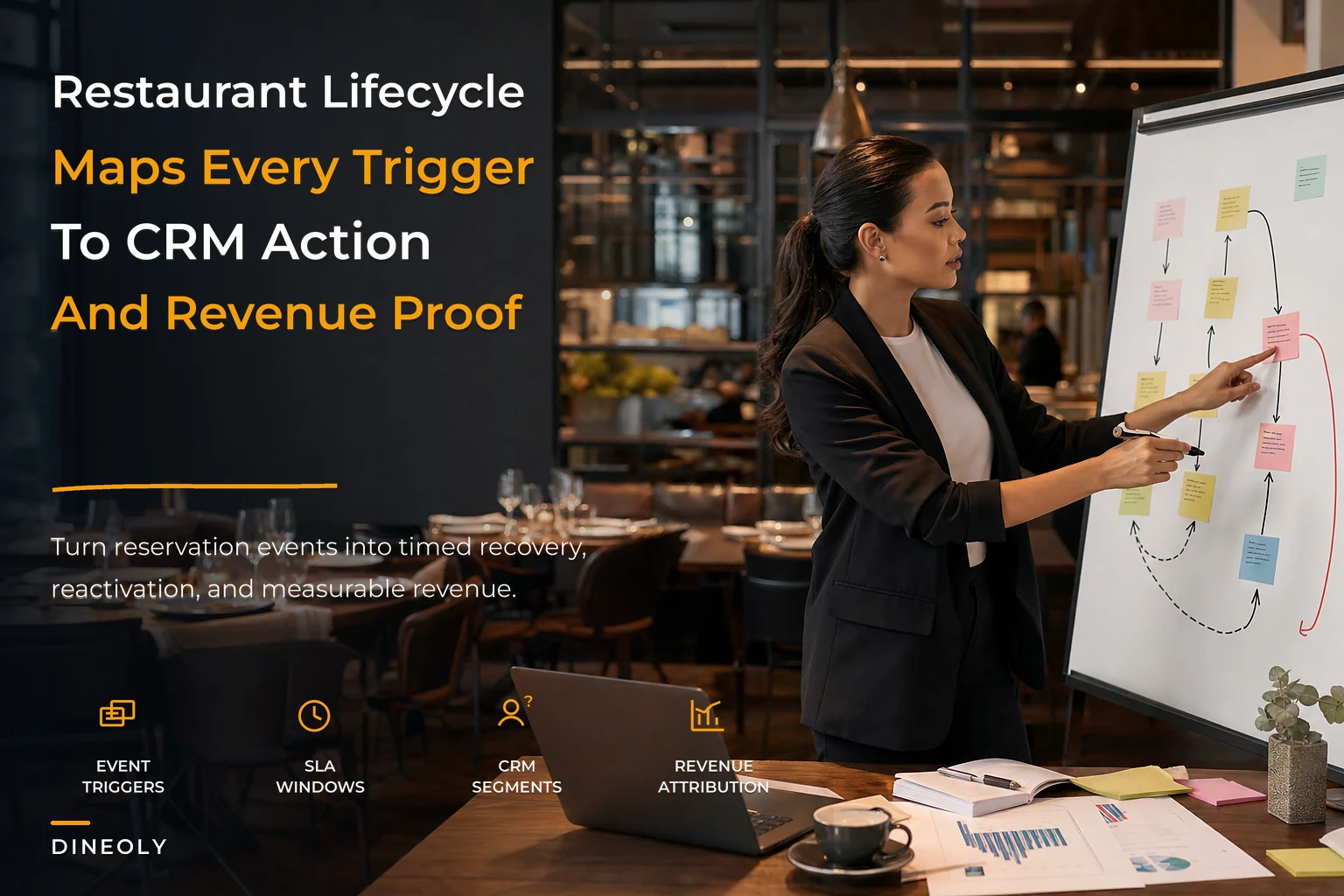
That seam is your restaurant customer lifecycle marketing architecture. It's the wiring that takes a real operational event — a reservation booked, a table seated, a no-show, a complaint, a big-spend anniversary — and turns it into the right message at the right time to the right segment. When it's built well, it mostly runs on its own. When it's not built at all, which is far more common than people admit, you're leaving repeat visits on the table and paying to re-acquire guests you already had.
This is a systems article, not a tips list. I want to walk through how the whole thing hangs together: which events matter, how they map to CRM segments, how confirmation flows into recovery flows into reactivation, and how a manager can actually measure whether any of it worked without hiring an agency or drowning in vendor dashboards.
The core problem: your best signals never leave the operations stack
The pattern that shows up over and over: a restaurant has a POS full of transaction history, a reservation platform full of booking behavior, and a review inbox full of sentiment. All three systems know things about the guest. None of them talk to each other, and the marketing tool — usually a standalone email platform — knows almost nothing.
So the marketing calendar gets built around the restaurant's schedule instead of the guest's lifecycle. Valentine's is coming, send a Valentine's email. Slow Tuesday, send a discount. It's calendar-driven, not behavior-driven.
The problem with calendar-driven marketing is that it treats a first-time guest, a regular who comes every other week, and someone who hasn't been in since spring as the exact same person. They get the same email at the same time. And because the message can't reference anything real — their last visit, what they ordered, the fact that they had a rough experience last month — it lands as noise.
The three-phase spine: confirmation → recovery → reactivation
Almost every lifecycle message a restaurant sends falls into one of three jobs. Get these three right and you've covered the majority of the revenue that lifecycle marketing can actually move.
Eliminate operational bottlenecks effortlessly.
Dineoly helps you manage every reservation, order, and staff shift seamlessly.
- Unified reservation and order management
- Real-time staff scheduling
- Inventory and sales tracking
No credit card required
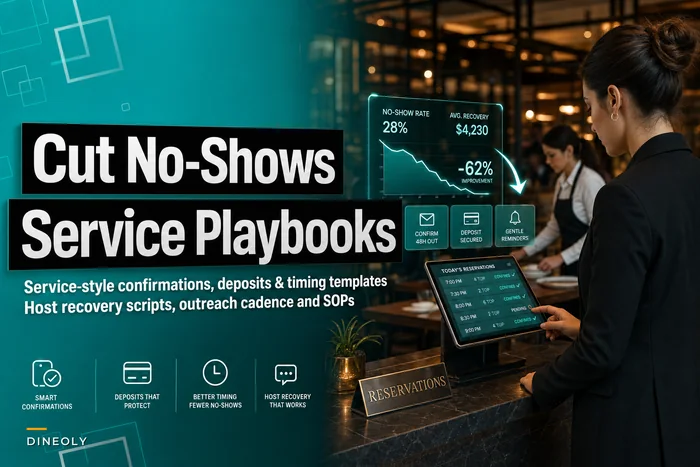
Confirmation is everything around a live, upcoming, or just-completed visit. Booking confirmations, reminders, pre-arrival prep ("we've got your window table, allergy noted"), and the immediate post-visit thank-you or feedback request. This phase is where trust and no-show reduction live. Getting the confirmation cadence right ties directly into the work covered in reducing no-shows with service-style confirmation and host recovery playbooks — the marketing layer and the operational confirmation layer are the same messages doing double duty.
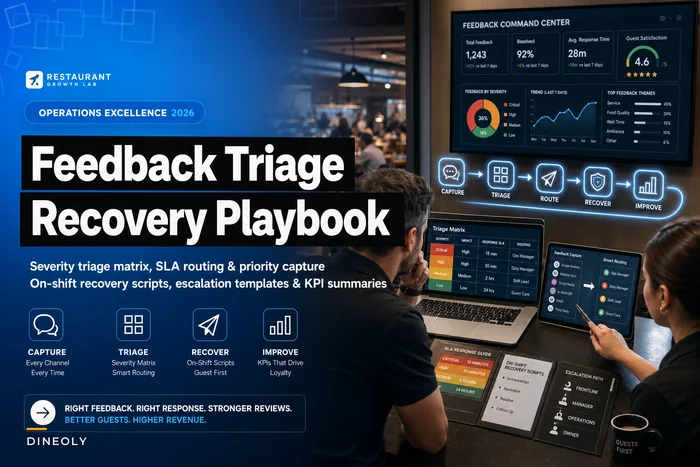
Recovery is what happens when something went sideways. A no-show. A low review score. A complaint at the table. A guest who booked, got seated, and clearly had a rough night. Recovery is the highest-leverage phase because a well-handled problem can produce more loyalty than a smooth visit that never had a problem at all. This is where your guest-feedback triage playbook becomes a marketing input — the same triage that routes a complaint to a manager should also trigger the recovery cadence automatically.
Reactivation is the long game: guests who've gone quiet. The distinction that matters here — and that most restaurants miss — is that "lapsed" means different things for different segments. A guest whose normal rhythm is once a month is lapsed at 8 weeks. A special-occasion guest who only comes for anniversaries isn't lapsed at 8 weeks; they're on schedule. Sending the same "we miss you" to both is how you annoy loyal occasional guests into unsubscribing.
The three phases aren't separate campaigns. They're a pipeline. A guest moves confirmation → (maybe recovery) → back to healthy → eventually reactivation → back to confirmation. The architecture's job is to keep everyone flowing to the right stage based on what they actually do.
Here's a simple diagram showing the workflow from confirmation through recovery to reactivation and back into confirmation.
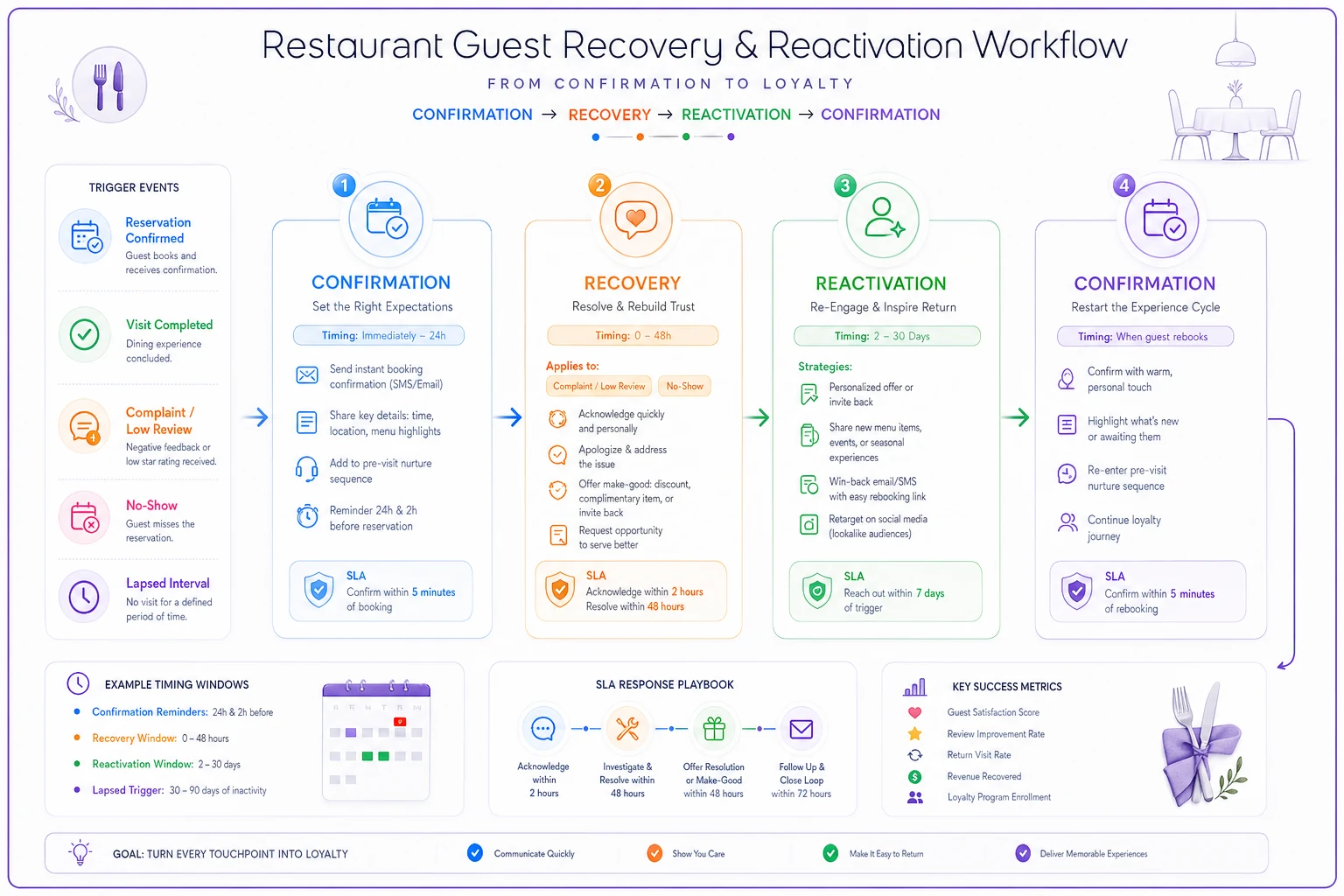
This visualization highlights how operational events push guests between phases and where timing and SLAs matter for each transition.
Mapping operational events to CRM segments
The segments only work if they're built from real events, not guesses. Below is a practical mapping of operational triggers to the segment they should push a guest into, and what the system should do next.
Below is a practical mapping of operational triggers to the segment they should push a guest into, and what the system should do next.
| Operational event | Segment it feeds | Primary phase | What fires |
|---|---|---|---|
| First completed reservation | New guest (0 prior visits) | Confirmation | Post-visit thank-you + soft second-visit nudge within 5–7 days |
| 2–3 visits in ~60 days | Emerging regular | Confirmation | Recognition message, no discount |
| No-show or same-day cancel | At-risk / recovery | Recovery | Short, non-punitive re-book offer; flag account |
| Review ≤ 3 stars or table complaint | Service recovery | Recovery | Manager-touch message, then win-back within 10 days |
| High check average (top ~15%) | VIP / high-value | Confirmation + reactivation | Priority booking perks, longer patience before "lapsed" |
| Occasion booking (anniversary, birthday) | Occasion guest | Reactivation | Annual pre-occasion reminder ~3 weeks out |
| No visit past 1.5× normal interval | Lapsing | Reactivation | Tiered win-back sequence |
The single biggest mistake is building segments off demographics — age, zip code — instead of behavior like visit rhythm, spend, and sentiment. Demographics don't predict anything about when someone will come back. A guest's own visit interval is the most useful number you have, and almost nobody uses it.
This event-to-segment wiring is the natural extension of a solid guest experience architecture that turns reservations into recovery and loyalty workflows. The experience architecture defines what you capture at each touchpoint; the lifecycle architecture defines what you do with it afterward.
-
Reservation confirmed → Guest enters the Confirmation phase; booking reminder and pre-arrival message fire on schedule
-
Visit completed without issue → Post-visit thank-you fires within 5–7 days; guest stays in Confirmation phase
-
Visit completed with complaint or low review → Guest is routed into the Recovery phase; triage fires within 24 hours
-
Recovery contact sent → If guest returns within the measurement window, they re-enter Confirmation; if not, they age toward Reactivation
-
No visit past 1.5× their normal interval → Guest moves into Reactivation; tiered win-back sequence begins
-
Guest returns → They cycle back into the Confirmation phase and the pipeline resets
This flow is the backbone. Everything else — cadences, SLAs, experiments — plugs into it.
Tying SLAs to the marketing, not just the kitchen
Operational SLAs usually live in the kitchen and on the floor — ticket times, table turns, greet-within-90-seconds. But the recovery phase depends on marketing-side SLAs that most teams never bother to define.
-
Negative-sentiment recovery contact
within 24 hours
-
No-show re-book offer
within 48 hours
-
First-visit thank-you
within 5–7 days (long enough to feel intentional, short enough to still be remembered)
-
VIP anniversary reminder
21 days before the date
Writing these down as SLAs matters because of accountability. When "someone should follow up with unhappy guests" is a vague good intention, it happens maybe a third of the time — usually only for the loudest complaints. When it's a defined window with an owner, it becomes a process you can actually audit.
Campaign cadences that don't burn the list
Cadence is where good intentions turn into unsubscribes. The instinct, once you have segments and triggers wired up, is to message more. Resist it. The healthiest lifecycle programs tend to be quieter than the calendar-blast programs they replaced, because every message is earned by an event.
-
Day 0 (lapse trigger fires) A light, no-offer "here's what's new on the menu" note. Test whether presence alone brings them back before spending margin on a discount.
-
Day 14 (if no return) A specific, low-friction incentive — a free appetizer or dessert with a booking, not a percentage off. Free-item offers tend to convert better and protect check average.
-
Day 35 (if still no return) The strongest offer you're willing to make, framed with a soft deadline.
-
Day 60 Move them to a low-frequency "dormant" list. Stop the drumbeat. Continuing to hit a non-responder just trains your domain reputation toward the spam folder.
Start with the no-offer touch to see who returns before spending margin on discounts.
The step most people skip is Step 1 — the no-offer touch. They jump straight to a discount, which trains the whole list to wait for one. If a guest will come back for a friendly nudge, never pay them to do it.
The experiment matrix: how to actually know what works
This is the part that separates a lifecycle system from a pile of automated emails. Without experiments, you can't tell whether your recovery flow is recovering anyone or whether those guests would have come back anyway.
You don't need a data scientist. You need a holdout group and patience. For any triggered flow, hold back a random 10–15% of the eligible segment and send them nothing (or your old baseline). Then compare return rates and revenue between the treated group and the holdout over a fixed window.
| Test | Variable | Control | Treatment | Primary metric |
|---|---|---|---|---|
| First-visit nudge | Timing | No message | Nudge at day 6 | 2nd visit within 30 days |
| Recovery offer type | Incentive | % discount | Free-item | Return within 21 days + check avg |
| Reactivation Step 1 | Offer vs. no-offer | Discount at day 0 | Menu note at day 0 | Return rate + margin per return |
| VIP reminder timing | Lead time | 7 days out | 21 days out | Booking rate on occasion |
Run one variable at a time. The moment you change the timing and the offer and the subject line together, you've learned nothing except that "something" moved. That's the most common experiment mistake — bundling changes and then guessing which one mattered.
Measurement windows and revenue attribution managers can actually run
Attribution in restaurants gets overcomplicated fast. You don't need multi-touch modeling. You need a defensible, consistent rule that you apply the same way every time.
Set fixed measurement windows per phase. A confirmation-phase message gets a short window — a guest either books the reminded reservation or doesn't. A recovery message gets a 21-day window. A reactivation message gets 30–45 days, because lapsed guests move slower.
Use a last-triggered attribution rule. If a guest received a triggered message and visited within its window, credit that message. It's not perfect, but it's consistent, and consistency is what lets you compare month over month. The holdout group is what keeps you honest about how much of that return was actually incremental.
-
Segment (e.g., lapsing casual regular)
-
Flow (e.g., reactivation Step 2)
-
Sent count and holdout count
-
Returns in treated group / returns in holdout
-
Incremental returns = treated return rate − holdout return rate, applied to sent count
-
Avg check for that segment
-
Incremental revenue = incremental returns × avg check
-
Offer cost (comped items × food cost, not menu price)
-
Net contribution
That last line — net contribution — is the only number that matters when you're deciding whether to keep a flow. A reactivation campaign that "brought back 40 guests" but did it entirely with 30%-off offers to people who would've returned anyway can easily be negative on net contribution once you subtract the margin you gave away.
A real scenario
A mid-size neighborhood Italian spot, roughly 120 seats, was running one monthly newsletter and nothing else. Their reservation platform and POS both had guest history, but neither connected to the email tool. No-shows sat around 12–14% on weekend prime times, and they had no idea how many first-timers ever came back.
They built the three-phase spine over about six weeks. Nothing fancy — a post-visit thank-you for first-timers, a recovery flow tied to no-shows and low reviews, and a lapse-triggered reactivation sequence based on each guest's own visit interval. They ran a 12% holdout on the reactivation flow so they could measure incrementality.
Over the following quarter, the second-visit rate for first-timers moved from somewhere around 22% to the low 30s. The recovery flow re-booked a meaningful chunk of no-shows they'd previously written off entirely. The reactivation holdout comparison showed the free-item offer produced roughly a 6–8 point lift in return rate over doing nothing — real, but smaller than the owner expected. That was itself useful information, because it stopped them from over-discounting. Net contribution across the flows landed in the low-single-digit-thousands per month. Not a transformation. A reliable, compounding gain that didn't exist before, running mostly on its own.
Where the tooling actually helps
The reason most restaurants never build this isn't that they don't understand the value. It's that manually stitching reservation events to POS spend to review sentiment to segmented messaging is genuinely tedious, and it breaks the moment a manager gets slammed.
This is the honest case for AI-assisted operational software: the boring, error-prone middle — watching for the trigger event, checking the segment, respecting the SLA window, suppressing the wrong messages, logging what got sent for attribution — is exactly the kind of coordination work that shouldn't depend on someone remembering to do it. A platform that centralizes reservation, POS, and feedback data lets events flow into segments automatically and lets you run holdouts and attribution without exporting five spreadsheets.
AI automation is useful for the pattern-matching pieces — flagging a guest as lapsing based on their own rhythm rather than a fixed 60-day rule, or routing negative sentiment to the recovery flow the same day. But the value is the system, not the software. If you can run the matrix above by hand and stay consistent, do that first. The tooling just removes the manual friction so the architecture keeps running when you're busy.
When this makes sense — and when it doesn't
Build the full architecture when: you have consistent reservation and POS data, enough guest volume for holdout groups to be meaningful (roughly a few hundred bookings a month or more), and someone who will own the measurement. Below that volume, your experiments won't reach significance and you'll be reading noise.
Start smaller when: you're low-volume or single-location with clean data but a thin team. Run just the confirmation and recovery phases first. Those two produce the most value per unit of effort, and reactivation can wait until the base is wired.
Skip the fancy version entirely when: your data is a mess. If your POS guest records are half-empty and your reservation notes are inconsistent, no lifecycle architecture will save you — you'll be automating garbage. Fix the data capture first, then build on top of it.
Restaurant customer lifecycle marketing isn't a content problem or a creativity problem. It's an integration problem. The signals you need are already sitting in your operational systems — reservations, spend, sentiment, visit rhythm. The whole architecture exists to move those signals into segments, respect the SLA windows on recovery, run confirmation → recovery → reactivation as one connected pipeline, and prove with holdouts and fixed measurement windows whether any of it actually moved revenue.
Build the plumbing once, measure it honestly, and it compounds quietly in the background while you run service. That's the difference between marketing that interrupts your guests and marketing that reaches them right when they were ready to come back anyway.
Ready to elevate your restaurant operations?
Join 2,000+ restaurants using Dineoly to enhance efficiency, increase table turnover, and delight diners.